Terence Tao continuing history’s cleverest cosmological measurements
Based on 3Blue1Brown's video on YouTube. If you like this content, support the original creators by watching, liking and subscribing to their content.
Parallax measures distance by comparing how an object’s apparent position shifts when observed from widely separated viewpoints.
Briefing
Distance in astronomy isn’t measured directly so much as assembled—step by step—into a “cosmic distance ladder.” The central insight is that once one key distance scale is nailed down, it unlocks the rest: the distance to the Sun (the astronomical unit) anchors measurements of planets, then light-speed timing, then nearby stars, then galaxies, and ultimately large-scale maps of the universe.
The ladder’s early rung begins with parallax, the same geometry behind binocular depth perception. By observing a planet from two far-apart locations on Earth at the same time, astronomers can measure how its apparent position shifts against the background stars. The method requires extreme angular precision because even the closest planets are far enough away that the lines of sight from opposite sides of Earth are nearly parallel. For Venus at its closest, the angular difference between observations is only about 1 arcminute (1/60 of a degree), so timing and observational discipline become as important as math.
That precision challenge drove the ingenuity behind the transit of Venus. When Venus crosses the Sun’s disk, observers in the Northern and Southern hemispheres see it trace slightly different paths due to parallax. Without photography, they couldn’t simply compare images; instead, they timed the transit—measuring how long Venus took to move across the Sun’s face. Because the orbital motion of Venus and the Sun was already understood from Kepler’s laws, the transit duration could be translated into the tiny angular offset between observers. From that offset, triangulation yields Venus’s distance, and with it the astronomical unit—the crucial rung needed to scale the entire solar system.
The story also includes the human cost of such campaigns. Edmund Halley proposed the transit method, but didn’t live to see it succeed. Guillaume Le Gentil attempted the 1761 transit, but war delayed him; he tried again for 1769, only to be thwarted by clouds. When he finally returned to France, he found himself declared dead and his estate plundered—an illustration of how much depended on rare celestial events.
Once the astronomical unit is known, another clever deduction follows: measuring the speed of light using Jupiter’s moon Io. Io’s eclipses behind Jupiter’s shadow occur at regular intervals, but their timing shifts over the year because Earth’s position changes the light-travel distance. Observers like Ole Rømer and later Christiaan Huygens used these timing differences—about 20 minutes for a change of roughly two astronomical units—to infer that light is not instantaneous, laying groundwork for later, more precise experiments.
With light-speed and distance scales in place, parallax expands outward to nearby stars using Earth’s orbit as the baseline. For the nearest star, Proxima Centauri, the parallax shift is only about 1.5 arcseconds—tiny enough to require careful 19th-century measurement. Beyond that limited reach, astronomers switch to indirect methods. They use the Hertzsprung–Russell diagram, built from stellar colors and brightness calibrated by parallax, to infer absolute luminosities for farther stars. Variable Cepheids provide another standard candle via the period–luminosity relation discovered by Henrietta Swan Leavitt. Then Edwin Hubble’s redshift–distance relation extends the ladder to galaxies, with modern interpretation tied to cosmic expansion.
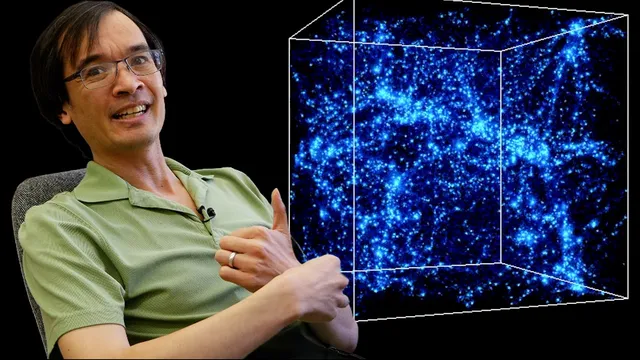
The result is a modern 3D picture of the universe—such as Sloan Digital Sky Survey maps—where galaxies cluster into filaments rather than random scatter. Yet even at the largest scales, the ladder isn’t perfectly settled: a recurring ~10% anomaly in large-scale Hubble-law behavior remains an open puzzle, raising questions about calibration, assumptions, or even deeper physics.
Cornell Notes
The cosmic distance ladder turns one hard measurement into a chain of increasingly far-reaching estimates. Parallax—measuring tiny apparent shifts from different viewpoints—works well for nearby objects, but becomes too subtle for most of the galaxy. The transit of Venus overcame that precision barrier by timing Venus’s path across the Sun from widely separated locations, converting duration differences into angular offsets and then into the astronomical unit. With that scale set, astronomers used Jupiter’s moon Io to infer the speed of light from eclipse timing shifts, and later used parallax, stellar classification (Hertzsprung–Russell), Cepheid variables (Leavitt’s law), and finally galaxy redshift (Hubble’s law) to map the universe. The ladder enables large-scale 3D surveys, even as a persistent ~10% anomaly at the largest scales keeps the story unfinished.
Why does parallax become impractical for planets like Venus, even from opposite sides of Earth?
How did the transit of Venus convert tiny parallax shifts into a distance measurement without photography?
What was the astronomical unit’s role in the distance ladder?
How did Io’s eclipses help measure the speed of light?
Why can’t parallax alone map the Milky Way, and what replaces it?
How do Cepheids and redshift extend the ladder beyond the Milky Way?
Review Questions
- What precision bottleneck makes direct parallax measurements of Venus difficult, and how does the transit of Venus sidestep it?
- Trace the chain of dependencies from the astronomical unit to measuring nearby stars and then to galaxies.
- What observational signatures—parallax shift, stellar color, Cepheid period, and redshift—serve as the key “inputs” at different rungs of the distance ladder?
Key Points
- 1
Parallax measures distance by comparing how an object’s apparent position shifts when observed from widely separated viewpoints.
- 2
The transit of Venus turns tiny parallax differences into measurable timing differences by timing how long Venus takes to cross the Sun’s disk.
- 3
Knowing the astronomical unit is the critical scaling step that locks in the physical size of the solar system and supports later distance methods.
- 4
Timing shifts in Jupiter’s moon Io eclipses provide an astronomical way to estimate the speed of light from Earth–Jupiter baseline changes.
- 5
Beyond the parallax limit, the Hertzsprung–Russell diagram links stellar spectra/color to absolute brightness, enabling distance estimates for farther stars.
- 6
Cepheids act as standard candles through the period–luminosity relation, and Hubble’s redshift–distance relation extends distance measurement to galaxies.
- 7
Large-scale distance estimates generally work, but a persistent ~10% anomaly in Hubble-law behavior at very large scales remains unresolved.