Terence Tao on the cosmic distance ladder
Based on 3Blue1Brown's video on YouTube. If you like this content, support the original creators by watching, liking and subscribing to their content.
Cosmic distances were inferred by converting observable angles and timings into ratios anchored to a reference object at a different location (often the Moon or Earth’s shadow).
Briefing
Humanity’s first “cosmic distance ladder” wasn’t built with rockets or lasers—it was built with geometry, shadows, and timing. The central achievement is a repeating strategy: to measure the size or distance of an object you can’t directly step away from, you anchor it to a reference object at a different location, then use how one affects what you can observe. Each rung—Earth, Moon, Sun, planets—turns a hard-to-measure distance into a solvable ratio problem.
The ladder starts with Earth’s radius, but even asking that question assumes Earth is roughly spherical. Ancient thinkers used the Moon as a natural reference. During lunar eclipses, Earth casts a shadow whose edge is visibly circular, implying Earth’s shape is spherical rather than a flat disk. From there comes Eratosthenes’ method for Earth’s size: on the summer solstice, a town in Syene sees the Sun directly overhead at noon, while Alexandria—on the same Earth but a different latitude—measures the Sun’s angle using a gnomon. That measured offset of about 7 degrees becomes an arc-length fraction of the full 360-degree circle. With an estimate of the distance between the two towns (expressed in stadia), Eratosthenes converts the angular difference into Earth’s circumference, achieving an accuracy on the order of ~10% despite uncertain unit conversions.
Once Earth’s size is in hand, lunar eclipses provide the next rung. The duration of a lunar eclipse, compared to the length of the Moon’s orbital month, yields how many Earth radii away the Moon must be. Aristarchus used this approach to estimate the Moon’s distance at roughly 60 Earth radii (with the Moon’s orbit varying between about 58 and 62). The same eclipse observations also reveal relative sizes: the Moon’s diameter is about a quarter of Earth’s. To refine the Moon’s radius, the Greeks used a different timing trick—how long a full Moon takes to rise—interpreting it as Earth’s rotation scanning the Moon across the horizon, letting them relate angular motion to the Moon’s distance.
The Sun is harder because it’s vastly farther away, but the Greeks exploited a geometric coincidence: during solar eclipses, the Sun and Moon appear almost the same size. That forces the ratio of Moon radius to Moon distance (which they already had) to match the ratio of Sun radius to Sun distance. To get the Sun’s distance itself, they turned to lunar phases. Half Moons occur when the geometry makes a right angle at the Moon, and the exact timing of when that “half” happens depends on the Sun’s distance. Aristarchus’ measurements were technologically limited—off by large factors in both distance and size—but the qualitative conclusion landed: the Sun is far larger than Earth, and the Sun should not orbit Earth. That reasoning fed into heliocentrism.
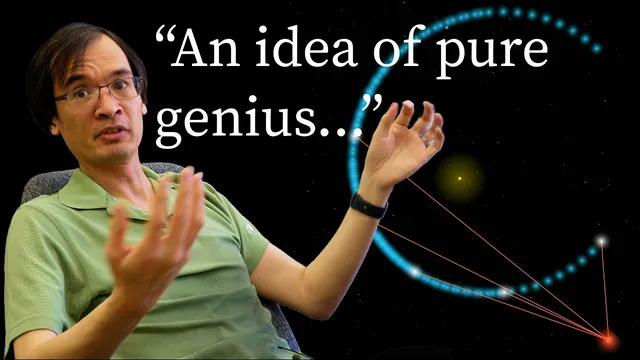
The most “genius” step comes with Kepler. Copernicus provided the periods of planetary orbits (Earth: one year; Mars: 687 days), but circular-orbit models kept failing. Using Tycho Brahe’s decades of precise sky positions, Kepler deduced that the planets’ apparent directions over time contain enough information to reconstruct orbital shapes even without knowing distances. His key move was to treat Mars as a moving reference clock: by sampling observations at intervals when Mars returns to the same apparent position (about every 729 days in the narrative), Kepler effectively triangulated Earth’s changing location relative to a consistent Mars frame. The result was the discovery that Earth’s orbit is an ellipse, with the additional law that the area swept out by the Earth is constant over equal time intervals—an insight that then made it possible to infer other planets’ orbital shapes.
Across the ladder, the pattern is consistent: clever geometry turns observable angles and timings into distances and sizes, and the biggest breakthroughs often come from finding the right reference object and the right ratio, not from having better instruments.
Cornell Notes
The cosmic distance ladder grew rung by rung using a consistent method: measure what you can (angles, shadows, timing) and convert it into ratios anchored to a reference object. Eratosthenes estimated Earth’s circumference by comparing the Sun’s angle at noon on the summer solstice between Syene (Sun overhead) and Alexandria (about a 7° offset), then scaling that arc fraction to 360°. Lunar eclipses then linked the Moon’s distance to Earth’s size by comparing eclipse duration to the Moon’s orbital month; Aristarchus got a Moon distance around 60 Earth radii. For the Sun, Greeks used solar-eclipse size coincidence and lunar phases, leading Aristarchus toward heliocentrism despite large numerical errors. Kepler’s breakthrough used Tycho Brahe’s long-term sky data plus planetary periods to reconstruct orbital shapes, showing Earth’s orbit is an ellipse and enabling further planetary inference.
Why does a lunar eclipse help prove Earth is spherical rather than flat?
How did Eratosthenes turn a 7° measurement into Earth’s circumference?
What does the timing of a lunar eclipse reveal about the Moon’s distance?
How did the Greeks estimate the Moon’s radius using full Moon rising time?
What was Kepler’s key method for deducing elliptical orbits from sky directions alone?
Review Questions
- Which observable quantities (angles, shadow shapes, durations, or timing of phases) were used at each rung of the ladder, and what ratio did they produce?
- Why does knowing only directions to planets (not distances) still allow orbital shapes to be inferred in Kepler’s approach?
- How do lunar phases encode information about the Sun’s distance, and what geometric condition defines the half-Moon moment?
Key Points
- 1
Cosmic distances were inferred by converting observable angles and timings into ratios anchored to a reference object at a different location (often the Moon or Earth’s shadow).
- 2
Earth’s spherical shape was supported by the circular boundary of Earth’s shadow during lunar eclipses, providing a geometric argument beyond single-angle appearances.
- 3
Eratosthenes estimated Earth’s circumference by measuring the Sun’s angular offset (~7°) between Syene and Alexandria at the summer solstice and scaling that arc fraction to 360°, using an estimated town-to-town distance in stadia.
- 4
Lunar eclipse duration, compared to the Moon’s ~28-day orbital month, yields the Moon’s distance in Earth radii; Aristarchus’ estimate lands near ~60 Earth radii.
- 5
The Greeks used solar-eclipse size coincidence (Sun and Moon nearly the same apparent diameter) to relate the Sun’s radius and distance to the already-known Moon radius and distance ratios.
- 6
Aristarchus’ lunar-phase method for the Sun’s distance was numerically limited by observational technology, but it still supported the qualitative shift toward heliocentrism.
- 7
Kepler’s breakthrough relied on long-term sky-position data plus planetary periods to reconstruct orbital shapes without direct distance measurements, revealing elliptical orbits and the constant-area law.