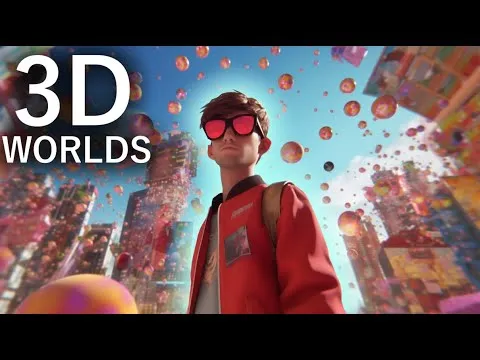
Text to 360° Worlds Using AI!
Based on MattVidPro's video on YouTube. If you like this content, support the original creators by watching, liking and subscribing to their content.
Blockade Labs’ World Builder generates 360° skyboxes using both text prompts and optional line drawings that act as layout guides.
Briefing
A free AI “world builder” called Blockade Labs lets users generate interactive 360° environments from simple text prompts and—crucially—from line drawings using brush tools. The core payoff is real-time controllability: prompts set the overall theme, while painted shapes guide how the resulting skybox is structured, producing coherent scenes like candy planets, cyberpunk cities, and even interior “POV” spaces.
The workflow starts with a blank 3D sphere “sandbox,” then moves to a Skybox generator where every new skybox is brand new. Users type a prompt describing the scene, then optionally paint guides and shapes that the system follows when constructing the environment. The creator demonstrates this with a candy-themed prompt (“Candy Land Trees Animals nature…”) in a “digital painting” style. After a long generation wait, the output lands surprisingly close to the prompt: a 360° candy world with shiny, coherent pathways and an overall consistent lighting setup (notably, a single sun rather than duplicated suns).
Next comes a more demanding test: a crude cyberpunk sketch overlaid with a short prompt (“cyberpunk City Neon Lights futuristic text robotics future city”). The AI doesn’t perfectly reproduce the drawn doorway, but it still produces a detailed cyberpunk cityscape that respects many of the user’s outlines—buildings, railings, and the general layout—while adding its own interpretation where the drawing is ambiguous. Switching styles to “cyberpunk” further changes the look while maintaining alignment with the painted guidance. A “remix” mode then re-envisions an existing world by combining the original structure with a new prompt; a cyberpunk scene remixed into “kitten Land World of cats” becomes pink and playful, showing how strongly the system can preserve underlying composition even when the prompt shifts dramatically.
The tests push into more extreme prompts, including “horrifying cat faces everywhere,” which yields a creepy but coherent 360° environment where the system interprets line guidance in unexpected ways—turning drawn elements into multiple cat heads and creating a “surrounded by cats” effect. A more technical challenge follows: drawing a car interior and prompting “POV interior of a vehicle… steering wheel… controls on the highway.” The result isn’t perfect—there are two steering wheels and some seat/structure issues—but it remains coherent enough to feel like a highway interior viewpoint. Filling in large areas of the drawing still produces a usable outcome, suggesting the system can handle more than thin line art.
Other prompts generate stadium-stage imagery from minimal stage lines (“POV singing on stage at a concert… GoPro footage”), plus whimsical “YouTube land” and “lemon land” fantasy worlds. These examples highlight a consistent limitation: heavy lifting happens inside the image generation model, so prompt adherence can be loose, especially for specific themes like “lemon.” Still, the overall impression is that Blockade Labs offers a fast, free way to prototype 360° skyboxes that can be downloaded (as high-resolution JPEGs) and potentially used in VR or other immersive setups—turning rough sketches and short descriptions into navigable worlds.
Cornell Notes
Blockade Labs provides a free AI “World Builder” that generates 360° skyboxes from two inputs: a text prompt and optional line drawings. Painted brush guides influence the layout, while the prompt steers the theme and style (e.g., digital painting, cyberpunk, realistic). Demonstrations show strong coherence—single-sun lighting, consistent pathways, and recognizable structure—especially when prompts and sketches align. Remix mode can transform an existing world into a new theme while retaining much of the original composition. Even when outputs miss exact details (like a drawn doorway), the results often remain usable and visually compelling, including POV-style interiors like a vehicle cabin.
How does Blockade Labs combine text prompts with user drawings to control a 360° world?
What does the demo suggest about how closely the AI follows prompts versus sketches?
What evidence is there that the system maintains visual coherence in 360° outputs?
How does remix mode behave when the new prompt conflicts with the original theme?
What happens when users draw complex objects or fill large areas instead of only lines?
What limitations appear in theme-specific prompts like “lemon land” or “YouTube land”?
Review Questions
- When creating a new Skybox, what two inputs can guide the final 360° environment, and how do they differ in influence?
- Give one example where the AI missed a specific drawn detail but still produced a coherent scene. What was the mismatch?
- How does remix mode change the relationship between the original world and the new prompt?
Key Points
- 1
Blockade Labs’ World Builder generates 360° skyboxes using both text prompts and optional line drawings that act as layout guides.
- 2
Each generated Skybox is brand new, starting from a blank 3D sphere “sandbox” and then producing a downloadable high-resolution JPEG.
- 3
Broad prompts (like candy-themed worlds) can yield surprisingly close thematic matches with coherent 360° lighting and scene logic.
- 4
Painted outlines can steer structure even when the AI doesn’t reproduce exact objects (e.g., a drawn doorway may be ignored while railings and city layout still align).
- 5
Style selection (digital painting vs cyberpunk vs realistic) can materially change the look while preserving much of the user’s intended composition.
- 6
Remix mode transforms an existing world into a new theme while retaining significant parts of the original composition, even when the new prompt conflicts with the old theme.
- 7
Complex POV scenes (like a vehicle interior) can work, but expect artifacts such as duplicated elements (e.g., two steering wheels) when the drawing is ambiguous or highly specific.