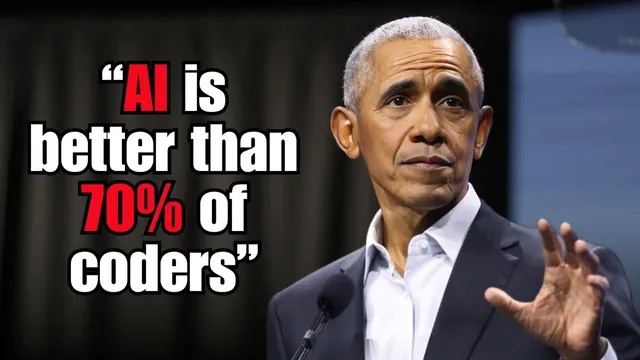
Thanks Obama, Al Codes Better Than Most Developers
Based on The PrimeTime's video on YouTube. If you like this content, support the original creators by watching, liking and subscribing to their content.
AI is portrayed as already strong enough to handle a large share of basic coding tasks, reducing the need for manual coding on routine work.
Briefing
The central claim is that AI will accelerate automation and reshape software work fast—but the biggest practical impact won’t be “fewer programmers,” it will be fewer people needing to write code for routine tasks, alongside a surge in how many people can build software at all. The transcript treats current AI coding ability as already strong enough to outperform a large share of human coders on basic work, then argues that the remaining gap will be handled through augmentation: top developers will use AI tools to move faster, while many others will enter programming through easier, more interactive workflows.
A key tension runs through the discussion: optimism about AI’s reach versus skepticism about overconfident claims. The transcript mocks exaggerated statistics and “AI will replace everyone” predictions, then lays out a spectrum of attitudes—AI enthusiasts who expect near-total solutions, casual users who enjoy it without grand promises, and opponents who refuse to use it. That framing is used to criticize confident judgments about fields people don’t actually practice, including law and medicine, even while acknowledging that AI could plausibly improve performance in narrow, data-heavy tasks.
On the labor side, the transcript predicts a shift rather than a simple collapse. Routine work will increasingly be handled by machines, and software will become more accessible than ever, creating a “gateway drug” into programming. The argument is that people will see results immediately—code changes, outputs appear, and iteration happens on-screen—so the initial barrier to entry becomes less discouraging. Even when the process turns into a loop of prompting, errors, and follow-up learning, the transcript suggests that the visible progress and interactivity will keep more people engaged rather than driving them away.
Still, the future is portrayed as messy. As automation spreads across professions, society will face hard questions about distribution, fairness, and how people find purpose when fewer tasks require human labor. The transcript leans into a dystopian-comic view of everyday life: even in a world of autonomous vehicles and instant services, bureaucracy (DMV lines) would likely persist. It also challenges “Star Trek” fantasies by insisting that most people won’t be captains exploring the final frontier; they’ll be stuck with the unglamorous parts of the system.
The closing notes land on a mix of resignation and irony: the “magical future” will probably arrive slowly and imperfectly, with a long expectation-versus-reality gap. Meaning and satisfaction—especially the satisfaction of building things—may become harder to secure as automation advances. The transcript ends with a final jab at political promises and a tongue-in-cheek reassurance that institutions and companies will keep the AI ecosystem “open,” even as the real social tradeoffs remain unresolved.
Cornell Notes
AI is expected to accelerate automation and change software work quickly, but the likely outcome is not just job loss for coders. Routine tasks will be handled by AI, while software becomes easier to access—pulling more people into programming through fast feedback and interactive iteration. The transcript also stresses a spectrum of public attitudes toward AI, warning against confident claims in domains people don’t practice. Even with technological progress, the future is framed as bureaucratic and uneven, with distribution and fairness questions—and the search for purpose—becoming harder. Overall, the shift is portrayed as disruptive but also as an entry point for broader participation in building software.
Why does the transcript claim AI will reduce the need for human coding in some areas?
What’s the “augmentation” model for software jobs, and who benefits most?
How does the transcript handle skepticism about AI hype and statistics?
Why does the transcript think more people will start programming rather than give up?
What social problems does the transcript say automation will intensify?
How does the transcript critique “Star Trek”-style futures?
Review Questions
- What does the transcript predict will happen to routine coding tasks as AI improves, and why?
- How does the transcript reconcile AI-driven automation with the idea that more people will still engage in programming?
- Which two “hard questions” does the transcript say society will face as automation spreads, and how does it connect them to purpose and fairness?
Key Points
- 1
AI is portrayed as already strong enough to handle a large share of basic coding tasks, reducing the need for manual coding on routine work.
- 2
The most likely labor-market shift is toward augmentation: top developers use AI to move faster while some work gets automated away.
- 3
Public attitudes toward AI are framed as a spectrum—enthusiasts, casual users, and opponents—highlighting how confidence can outpace real-world expertise.
- 4
Software accessibility is expected to increase dramatically, acting like a “gateway” that brings more people into programming through fast feedback.
- 5
The transcript argues that visible iteration and immediate results will keep more beginners engaged, even when learning is still required.
- 6
Automation raises distribution and fairness questions, and it may make purpose and meaning harder to sustain.
- 7
The future is depicted as bureaucratic and imperfect, with an expectation-versus-reality gap lasting for years.