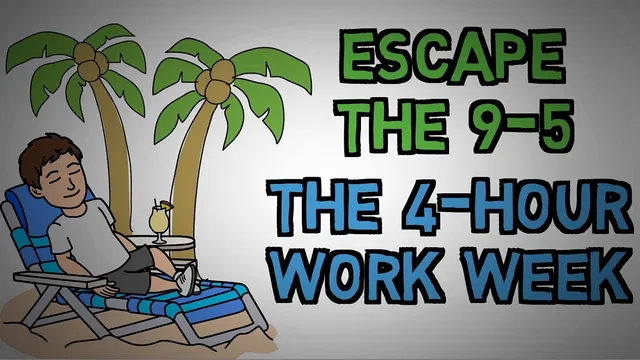
The 4 Hour Work Week by Tim Ferriss (animated book summary) - Escape The 9-5
Based on Better Than Yesterday's video on YouTube. If you like this content, support the original creators by watching, liking and subscribing to their content.
Retirement is treated as an unreliable endpoint; health risks and boredom can make later-life “freedom” less secure than expected.
Briefing
The core message behind “The 4-Hour Workweek” is that the standard 9-to-5 retirement script isn’t the best route to a good life: freedom comes from redesigning work and time, not from waiting decades to enjoy yourself. The transcript pushes back on the idea that the goal is to endure “soul-crushing” work for forty years and then hope retirement delivers happiness. It argues retirement is a weak plan because many people face health and disability risks in later life, and because boredom can set in quickly once the structure of work disappears. The practical takeaway is to ask a sharper question now—what would be worth doing if retirement weren’t an option?—so priorities shift toward building a life that doesn’t depend on an uncertain end date.
From there, the transcript reframes money as more than a yearly number. It uses a comparison between Jane, who earns $100,000 but works long hours in a high-cost city, and Mike, who earns $50,000 while working fewer hours and living somewhere cheaper. The point isn’t that absolute income doesn’t matter; it’s that “relative income” can flip the ranking when you factor in hourly earnings, cost of living, and—most importantly—freedom. Freedom is defined as control over what you do, when you do it, where you do it, and with whom you do it. Under that lens, a lower salary can be “worth more” if it buys time, flexibility, and location independence.
The transcript then targets a cultural trap: mistaking busyness for productivity. It criticizes people who feel proud of long hours spent shuffling tasks or checking email, even when the work produces little meaningful output. It also notes that employers often reward visible time rather than results, encouraging self-deception for the sake of job security. The remedy is to distinguish efficiency from effectiveness. Efficiency is doing a task well; effectiveness is doing the right tasks that move toward goals. A door-to-door salesman can be highly efficient yet ineffective if the channel is wrong—switching to email or other methods could produce far better results.
To decide what the “right tasks” are, the transcript leans on Pareto’s Law: roughly 80% of outcomes come from 20% of causes. The strategy is to identify the small set of activities that generate most results, become highly competent at them, and cut the rest. That time can be reclaimed through outsourcing—paying others to handle lower-value chores so personal time can be spent on higher-value work. The transcript illustrates this with a lawn-mowing example: if one hour of personal work is worth $50 and hiring someone costs $20, outsourcing buys back time for more important priorities.
Finally, the transcript argues that removing work doesn’t automatically create fulfillment. Too much idle time—whether for retirees or ultra-rich—can lead to depression and neurotic dissatisfaction. The goal isn’t doing nothing; it’s filling freed time with activities that excite and challenge, such as sports, learning languages or instruments, reading, improving relationships, volunteering, donating, or building projects that create impact. In short: freedom requires intentional design—of work, of money, and of what replaces the hours once reserved for employment.
Cornell Notes
The transcript presents “The 4-Hour Workweek” as a blueprint for escaping the default life plan: endure decades of 9-to-5 work, then hope retirement delivers freedom. It argues retirement is a poor end goal because health risks and boredom can undermine the “light at the end of the tunnel.” Money should be judged as “relative income,” factoring in hourly earnings, cost of living, and especially freedom—control over what, when, where, and with whom someone works. Productivity should be measured by effectiveness, not efficiency or visible busyness, using Pareto’s Law to focus on the 20% of causes that drive 80% of results. Freed time must be actively filled with challenging, joyful pursuits or community impact to avoid emptiness and depression.
Why does the transcript treat retirement as a “worst case scenario” rather than a life goal?
How does the transcript define “relative income,” and what does it conclude about higher salaries?
What’s the difference between efficiency and effectiveness, and why does it matter?
How does Pareto’s Law guide time management in the transcript?
When does outsourcing become a smart trade-off, and when should it be avoided?
Why does the transcript warn that freed time can still lead to depression?
Review Questions
- What specific factors make “relative income” different from simply comparing annual salaries?
- How do efficiency and effectiveness differ, and how could a person be efficient yet still fail to make progress?
- Using Pareto’s Law, what steps would you take to identify the 20% of activities that drive most of your results?
Key Points
- 1
Retirement is treated as an unreliable endpoint; health risks and boredom can make later-life “freedom” less secure than expected.
- 2
Money should be evaluated through relative income—hourly earnings, cost of living, and the freedom to control work conditions—not just annual pay.
- 3
Avoid confusing busyness with productivity; visible effort can replace meaningful results when employers reward time over outcomes.
- 4
Prioritize effectiveness (doing the right things) before efficiency (doing tasks well), since the wrong channel or activity can waste effort.
- 5
Use Pareto’s Law to find the small set of actions that generate most results, then cut or reduce the rest.
- 6
Outsource low-value tasks to buy back time, but don’t outsource work that can be eliminated and don’t outsource away the highest-impact priorities.
- 7
Freed time must be intentionally filled with challenging, joyful, or community-oriented activities to prevent emptiness and depression.