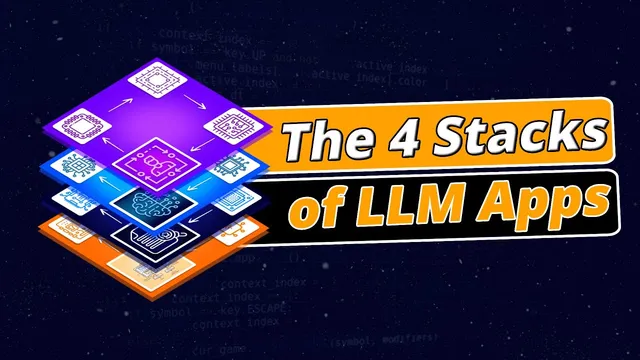
The 4 Stacks of LLM Apps & Agents
Based on Sam Witteveen's video on YouTube. If you like this content, support the original creators by watching, liking and subscribing to their content.
Organize LLM apps into four stacks: LLM, search/memory/data, reasoning-and-action, and personalization to make architecture decisions concrete.
Briefing
Building useful LLM apps and agents comes down to assembling four distinct “stacks” in the right places: the model itself, the data/search/memory layer, the reasoning-and-action layer, and the personalization layer. The practical value of this framework is that it turns vague “LLM app” ideas into an architecture you can plan—what needs to be trained or served, what information must be retrieved and injected, how decisions and tool use should work, and how the system should speak and behave.
At the foundation sits the LLM stack: everything tied to the language model’s capabilities and deployment. That includes how the model was created—pre-training, fine-tuning, and whether RLHF was used—and whether additional fine-tuning is worth doing for a specific domain, use case, or writing style. Deployment choices matter too. For open-source models, teams must decide between cloud serving (paying per token or compute) and local hosting, potentially using quantized “4-bit” style models. The tradeoff is not just cost; quantization can reduce performance on tasks beyond simple chat, especially where logic or mathematics is involved.
Above that is the search, memory, and data stack, which focuses on getting the right information into prompts. This layer typically uses semantic search and vector stores, with decisions such as whether to use Faiss or hosted options like ChromaDB or Pinecone. It also covers how data is sourced—whether from conventional databases, knowledge graphs, or the live web via tools like Google or Duck Duck Go—and how it’s extracted and injected into the model. Context window size changes what’s feasible: a 16K context window allows more retrieved content to be included. For agents, persistent memory is crucial: saving and retrieving information for in-context learning so the system can condition responses on prior facts.
The third layer—reasoning and actions—handles decision-making and tool use. Instead of leaving every choice to the language model alone, this stack often incorporates structured approaches like ReAct-style tool calling and external solvers. Mathematical or logic solvers can run heuristics over inputs and return answers that the LLM then uses to take the next step. This layer is also where API calls and “go fetch information” behaviors belong. The expectation is that this stack will grow quickly as systems adopt reasoning methods beyond pure text generation.
At the top is the personalization stack, which shapes how the system sounds and relates to users. It includes prompt engineering for personality and brand, plus customization of output style and conversational behavior. Sometimes it involves tracking user-specific details; often it’s about controlling tone, format, and interaction patterns through prompts and related manipulations. The framework helps teams allocate effort: role-playing and stylistic fidelity demand more personalization work, while knowledge-heavy applications demand more investment in the data/search/memory layer.
Finally, architecture choices determine where each stack lives. Mobile apps may push much of the heavy lifting to the cloud while keeping some personalization on-device. Agent design requires deciding which tools the agent can use, what reasoning mechanisms it relies on, and whether heuristic systems should assist. Tools like LLaMA index are positioned as strong interfaces for moving data from databases and vector stores into prompt-ready formats for in-context learning. The overall message: treat LLM apps as systems of components, not monolithic prompts, and build each stack deliberately.
Cornell Notes
Useful LLM apps and agents can be organized into four stacks: (1) the LLM stack (model training, fine-tuning, and serving choices), (2) the search/memory/data stack (retrieval, vector stores, web search, and persistent memory for in-context learning), (3) the reasoning-and-action stack (decision-making, tool use, and external solvers such as ReAct-style flows), and (4) the personalization stack (prompt engineering for tone, personality, and user-specific interaction). The key is matching each product goal to the right stack so engineering effort lands where it matters. This approach also clarifies deployment tradeoffs, like cloud vs local hosting and how quantization can affect logic-heavy tasks.
What belongs in the LLM stack, and why do deployment choices matter as much as model quality?
How does the search, memory, and data stack turn external information into prompt context?
What distinguishes the reasoning and action stack from “just prompting” an LLM?
What is the personalization stack responsible for, and what kinds of work does it demand?
How should teams decide where to invest across stacks when designing an app or agent?
Where does LLaMA index fit in this architecture?
Review Questions
- If an agent must perform reliable math or logic, which stack should carry more responsibility: personalization, data retrieval, or reasoning-and-action—and what mechanism would support that?
- How would a 16K context window change the design choices in the search/memory/data stack compared with a much smaller context window?
- What are the main tradeoffs between cloud serving and local hosting (including quantized models) in the LLM stack for logic-heavy applications?
Key Points
- 1
Organize LLM apps into four stacks: LLM, search/memory/data, reasoning-and-action, and personalization to make architecture decisions concrete.
- 2
Model quality isn’t enough; serving strategy (cloud vs local, token/compute pricing vs quantized hosting) can determine whether logic-heavy tasks perform well.
- 3
Use the search/memory/data stack to retrieve and inject grounded information via semantic search, vector stores (e.g., Faiss, ChromaDB, Pinecone), and web search (e.g., Google, Duck Duck Go).
- 4
Persistent memory for agents—saving and retrieving facts for in-context learning—is a core requirement, not an optional add-on.
- 5
Move decision-making and tool execution into the reasoning-and-action stack using patterns like ReAct and external solvers for stability.
- 6
Allocate engineering effort based on product goals: persona and style belong in personalization; grounding and retrieval belong in data; reliability in decisions belongs in reasoning-and-action.
- 7
Choose where each stack runs (cloud vs device) based on app type, latency needs, and what must remain personalized on-device.