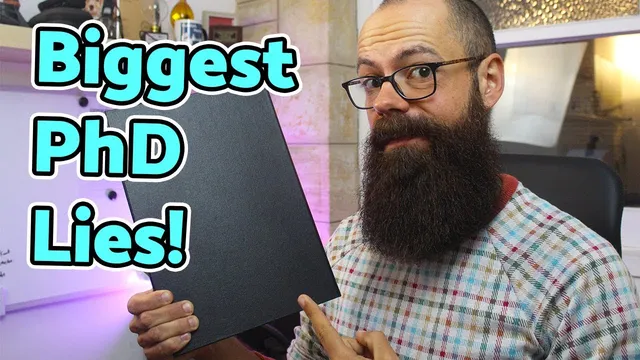
The 5 BIGGEST lies about doing a PhD
Based on Andy Stapleton's video on YouTube. If you like this content, support the original creators by watching, liking and subscribing to their content.
PhD topics are constrained by supervisor fit and funding approval, so “research whatever you want” only works within a gray zone.
Briefing
The biggest misconception about doing a PhD is that candidates can pursue “whatever they want” as long as they’re passionate. Topic choice is constrained by funding and institutional approval: a PhD typically has to fit a supervisor’s research program closely enough to secure buy-in for resources, even if the candidate’s personal interests overlap only partially. Because universities—and sometimes industry partners—are the ones paying, candidates are expected to deliver value: a credible outcome, real-world relevance, and a research direction that benefits the people funding the work. The result is a practical negotiation rather than a blank-slate creative project. Even “hot” research areas cycle in and out of fashion, so aligning with a supervisor who can champion the work matters as much as the idea itself. That alignment also affects the supervisor’s incentives—research that doesn’t match their profile can limit their ability to advance their own career, which in turn affects the candidate’s prospects.
A second major myth treats academia as the default destination and everything else as a fallback. Finishing a PhD outside a university role is often framed as failure, but the pipeline logic doesn’t support that narrative: supervisors produce large numbers of PhD graduates, and there simply isn’t room for all of them inside universities. The “alternative” career is often still an academic one—industry, law, and other sectors are common outcomes rather than exceptions. The transcript pushes back on survivorship bias: success stories in academia can hide the role of luck, timing, and privilege, even when researchers work hard. That framing can create guilt and a sense of betrayal for leaving, but the argument is that a PhD is a transferable credential for roles beyond “ivory towers.” The practical advice is to plan early—have a Plan B (and C) from the start—so the end of the PhD doesn’t feel like an identity crisis.
The third lie is the idea that a PhD is always superior to a master’s. A master’s can function as a career-building step with less uncertainty and stress, while a PhD is portrayed as a much larger commitment—more like building a whole new house than adding a single room. The transcript claims the earnings advantage of a PhD over a master’s is small (about a 3% increase), while the downsides are substantial: longer timelines, open-ended research, and higher risk of things going wrong. It also argues that the “student” label can quietly erode confidence and prestige, despite the years of effort required to reach doctoral level.
Finally, the transcript challenges the belief that PhDs are mainly for the exceptionally clever. Intelligence helps, but completion depends more on focus, persistence, and consistency—showing up daily to push through uncertainty. Once candidates reach the start of a PhD, the game becomes managing long-term ambiguity, handling data and research politics, and staying adaptable through reflection and iteration. In that view, cleverness is a minor factor; persistence and luck play a larger role.
Cornell Notes
The transcript argues that a PhD is not a free-form pursuit of any topic. Funding and supervision shape what’s feasible, and candidates must show value to the people paying—often universities or industry partners. It also rejects the idea that leaving academia means failure, emphasizing that most PhD graduates cannot all fit into academic roles and that industry and other careers are normal outcomes. The discussion further claims a master’s can be a better fit than a PhD for many professionals because the earnings gap is small while the PhD’s uncertainty and stress are much higher. Finally, it argues that PhDs rely more on persistence, focus, and adaptability than on raw cleverness.
Why can’t a PhD candidate simply research “whatever they want”?
What does the transcript say about careers outside academia after a PhD?
When might a master’s be a better choice than a PhD?
How does the transcript critique the term “PhD student”?
What skills matter most for completing a PhD, according to the transcript?
Review Questions
- What constraints—funding, supervision, and research trends—shape a PhD topic more than personal interest?
- How does the transcript use the idea of survivorship bias to challenge the “academia or failure” mindset?
- Which factors does the transcript claim matter most for PhD completion, and why does it argue cleverness is not the deciding variable?
Key Points
- 1
PhD topics are constrained by supervisor fit and funding approval, so “research whatever you want” only works within a gray zone.
- 2
Candidates are expected to deliver outcomes that benefit the people funding the work, including universities and industry partners.
- 3
Research areas rise and fall in popularity, so aligning with a supervisor’s current research profile can be as important as the idea itself.
- 4
Leaving academia after a PhD is not inherently failure; academic roles are limited, and many graduates go to industry and other sectors.
- 5
Having a Plan B (and Plan C) from the start reduces end-of-PhD guilt and uncertainty about career direction.
- 6
A master’s can outperform a PhD for many goals because the earnings gap is claimed to be small while the PhD’s stress and uncertainty are much higher.
- 7
Completing a PhD depends more on persistence, focus, and adaptability than on being exceptionally clever.