The 7 Levels of Productivity (Which One Are You?)
Based on Ali Alqaraghuli, PhD's video on YouTube. If you like this content, support the original creators by watching, liking and subscribing to their content.
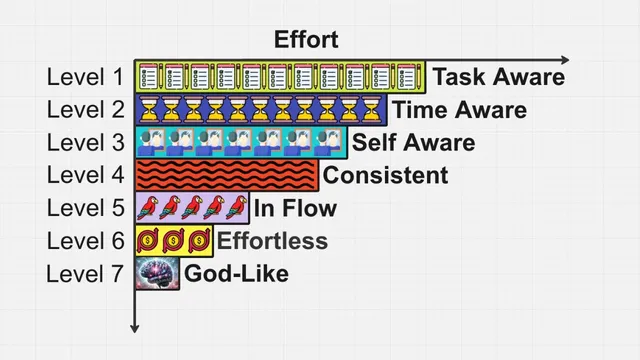
Productivity is framed as a seven-step progression from awareness to effortless execution, with each level enabling the next.
Briefing
Productivity, in this framework, is less about squeezing more hours out of the day and more about moving through seven “levels” of capability—until work starts to feel automatic. The central claim is that once someone identifies which level they’re stuck at and builds the next one, results compound faster, because action reliably produces outcomes in a physics-like world: the right action, done consistently, creates the desired reaction (business results, career progress, and personal fulfillment). The creator positions themself at “level six,” describing a shift from struggling with ADHD-related procrastination to running two businesses, working at NASA/JPL as a post-doctoral fellow, and maintaining time for family and soccer—while still feeling that getting important work done is largely effortless.
The seven levels begin with “task awareness.” At level one, people simply keep a to-do list or write down what they need to do. The downside is that awareness doesn’t guarantee execution, and even completed tasks may not be the right priorities. Level two is “time awareness,” where the key question becomes not only what to do, but when to do it. The transcript emphasizes that people with ADHD often struggle with “time blindness,” so they need external time cues—calendars, clocks, reminders—kept constantly visible. The advice is to use a calendar as a forcing function that turns vague intentions into bounded commitments.
Level three, “self-awareness,” shifts the focus from scheduling tasks to identifying what someone truly wants. Without that deeper alignment, people can sabotage themselves—pursuing logical goals while an unrecognized emotional goal pulls them off course. Once someone knows what they want, the next step is “consistency” (level four): doing the right actions regularly rather than sporadically. The transcript argues that consistency is built through routines and structure, not willpower, and warns that perfectionism undermines repetition.
To make routines stick, the creator shares a personal morning and evening protocol built around enjoyment: iced coffee with heavy cream, a hot shower followed by a cold finish, uninterrupted work time, and nightly planning using a calendar (with occasional human deviations). Level five is “inflow,” described as frequent deep focus or hyperfocus—achieved when difficulty matches skill and the work is genuinely enjoyable. Practically, that often means outsourcing tasks that don’t fit one’s strengths while learning to tolerate critical but unpleasant work until it becomes more engaging.
Level six is “effortless execution.” Here, the transcript claims decision-making and execution are so well trained that the person no longer debates whether to act; important tasks get done because the system and teams make it happen. The remaining constraint becomes time and patience—goals still take months, but the bottleneck is no longer “how to start” or “what to do.” Level seven is framed as an even higher gear: compressing multi-year goals into days. The creator says they haven’t reached that yet, but believes they’ve accelerated typical timelines from months to weeks.
Overall, the framework offers a ladder: start with writing tasks down, then schedule them, then align them with what you want, then build routines for consistency, then engineer flow, and finally create a life where execution feels natural—while still protecting time for rest and relationships to avoid burnout.
Cornell Notes
The seven-level productivity model reframes productivity as a progression from awareness to automatic execution. Level one is task awareness (having a to-do list), but that alone doesn’t ensure results. Level two adds time awareness by forcing “when” decisions through calendars and visible time cues—especially important for people with ADHD-related time blindness. Level three is self-awareness (knowing what you truly want), and level four is consistency built through routines and structure. Level five is inflow, where work becomes enjoyable and deep focus is easier; level six is effortless execution, where the right work gets done with minimal internal debate. The model matters because it turns productivity into a system you can diagnose and upgrade, not a vague push for more effort.
What distinguishes level one from level two in this productivity ladder?
Why does the transcript emphasize calendars so strongly for ADHD?
How does self-awareness (level three) connect to goal-setting and self-sabotage?
What makes consistency (level four) more than motivation?
What conditions are needed for inflow (level five)?
What does level six change about how work feels?
Review Questions
- Which specific question does the model say you must start asking at level two, and what tool is used to make it unavoidable?
- How does the transcript connect self-awareness to self-sabotage, and what kind of “goal mismatch” does it warn about?
- What practical strategies are recommended to move from consistency (level four) to inflow (level five)?
Key Points
- 1
Productivity is framed as a seven-step progression from awareness to effortless execution, with each level enabling the next.
- 2
Task awareness (level one) means writing tasks down, but results require moving beyond lists into scheduled action.
- 3
Time awareness (level two) depends on calendars and visible time cues, especially for people dealing with ADHD-related time blindness.
- 4
Self-awareness (level three) is treated as a prerequisite for meaningful goals; emotional desires can override logical plans.
- 5
Consistency (level four) is built through routines and structure, not willpower, and perfectionism is portrayed as a consistency killer.
- 6
Inflow (level five) is achieved when difficulty matches skill and work feels enjoyable; outsourcing non-strength tasks helps.
- 7
Level six is characterized by minimal internal debate and near-effortless execution, with time and patience—not decision-making—becoming the bottleneck.