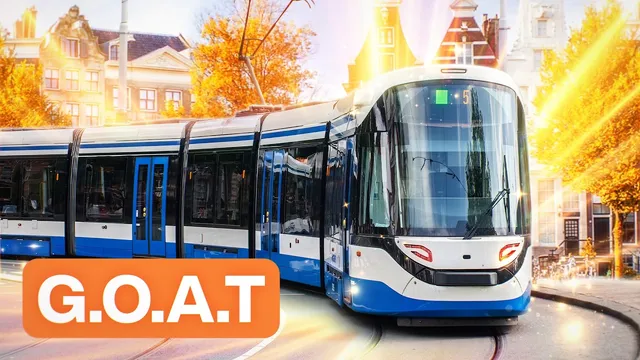
The Absolute Best Transportation for Cities (trams)
Based on Not Just Bikes's video on YouTube. If you like this content, support the original creators by watching, liking and subscribing to their content.
Trams can outperform cars in dense areas when transit signal priority and dedicated lanes prevent red-light and traffic delays.
Briefing
Trams are presented as the most effective way to connect walkable neighborhoods without breaking the street-level experience—especially when they run on dedicated lanes with level boarding and transit signal priority. In Amsterdam, the system’s practical details—nearby stops, low-floor cars for quick access, real-time LCD displays, smooth electric rides, and frequent service—add up to a transit mode that often beats driving during rush hour. The biggest operational advantage comes at intersections: transit signal priority keeps trams moving, and dedicated lanes let them glide past car traffic instead of getting trapped in it.
Beyond speed, trams are framed as an urban design tool that makes cities better to live in. Because tram tracks can be set into grass, streets can look more attractive than asphalt-heavy corridors while also absorbing some sound. Electric propulsion reduces local air pollution, and the Amsterdam network’s use of renewable energy is described as important both for climate goals and for reducing reliance on imported fossil fuels. Modern tram engineering is also credited with quieter operation and fewer ride-quality problems common in older systems, such as wheel slip.
The argument then broadens from transportation performance to city-shaping power. Trams are described as a “walking accelerator”: they operate at ground level, with stops close to destinations, so riders can move between mixed-use, human-scale areas faster than walking while still feeling like they’re part of the street life. That accessibility—easy boarding for strollers, luggage, and wheelchairs—is treated as a defining feature of truly inclusive transit.
Tram infrastructure is also portrayed as a catalyst for development. Because tram lines are seen as more permanent than bus routes, they tend to increase land values and encourage construction along the corridor. Historical examples include North American “streetcar suburbs,” where developers extended lines to new edge-of-city land to make it more valuable. Contemporary cases like Amsterdam’s IJburg and Norway’s Bergen are used to illustrate how building rail first can help new neighborhoods start with high-quality transit rather than forcing residents to drive and then trying to retrofit transit later.
The transcript contrasts trams with other modes. Metros are not treated as replacements but as complements: they’re expensive, serve longer-distance travel with fewer stops, and can leave riders disconnected from street life during underground segments. Trams, by contrast, can fill the gaps between metro stations and keep urbanism strong along the entire corridor. Buses are acknowledged as useful for low-volume feeder routes, but the discussion is sharply critical of replacing trams with buses in dense urban areas—citing comfort, safety, and the risk of “BRT creep,” where bus-rapid-transit plans get watered down into “just a bus.”
Finally, the transcript warns that tram benefits depend on funding and staffing. Amsterdam’s service is described as facing driver shortages and budget pressure, with potential line reductions that could create a vicious cycle of worse service, higher fares, and declining ridership. The takeaway is that cities that invest in trams—particularly those with grassy tracks and street-level integration—gain a transit system that supports walkability, improves streetscapes, and strengthens long-term urban development.
Cornell Notes
Trams are argued to be the best urban transit option because they connect walkable neighborhoods quickly while preserving street-level quality. Amsterdam is used as the benchmark: low-floor, level boarding, frequent service, real-time stop information, smooth electric rides, dedicated lanes, and transit signal priority that keeps trams from being delayed by red lights. The transcript frames trams as a “walking accelerator” since stops can be close to many destinations and boarding is accessible for strollers, luggage, and wheelchairs. Trams also shape cities by encouraging development along the line, and they complement metros by covering short-distance trips and filling gaps between widely spaced metro stations. Buses may work as feeders, but replacing trams with buses is criticized as inferior for capacity, comfort, and long-term planning (including “BRT creep”).
Why does the transcript treat trams as “walking accelerators” rather than just a faster bus?
What specific features in Amsterdam are credited with making tram travel faster and more reliable than cars?
How do trams influence urban development differently from buses, according to the transcript?
Why does the transcript say trams and metros should coexist instead of replacing each other?
What is “BRT creep,” and why is it used to critique bus-rapid-transit as a substitute for trams?
How does the transcript connect tram design to accessibility and safety for non-drivers?
Review Questions
- What operational and design elements make trams more competitive with cars at intersections and during rush hour?
- How does the transcript justify trams as complementary to metros rather than a cheaper substitute?
- What conditions does the transcript say would make BRT a reasonable choice, and why does it argue those cases are rare in developed countries?
Key Points
- 1
Trams can outperform cars in dense areas when transit signal priority and dedicated lanes prevent red-light and traffic delays.
- 2
Low-floor, level boarding and real-time stop information improve speed of access and reduce rider uncertainty.
- 3
Trams are framed as a “walking accelerator” because close stop spacing and street-level boarding preserve walkability between mixed-use neighborhoods.
- 4
Tram corridors can increase land values and encourage development along the line because tram service is perceived as more permanent than bus routes.
- 5
Metros and trams serve different trip lengths: metros handle longer-distance travel with fewer, expensive stations, while trams provide local connectivity along the entire corridor.
- 6
Replacing trams with buses is criticized as often inferior for capacity, comfort, and long-term planning—especially when BRT plans degrade through “BRT creep.”
- 7
Tram benefits depend on sustained funding and staffing; driver shortages and budget cuts can reduce frequency and trigger a cycle of declining ridership.