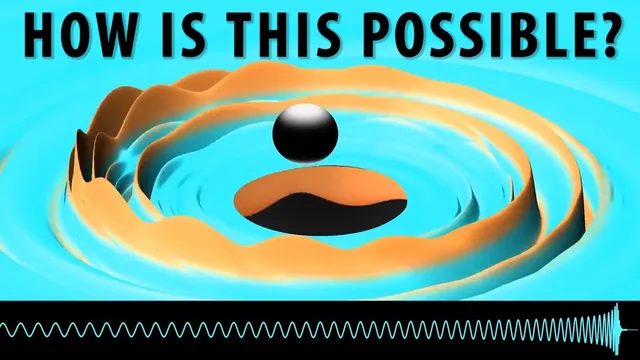
The Absurdity of Detecting Gravitational Waves
Based on Veritasium's video on YouTube. If you like this content, support the original creators by watching, liking and subscribing to their content.
Gravitational waves produce arm-length changes on the order of 10^-18 meters, requiring measurements at about 1/10000 the width of a proton.
Briefing
Gravitational waves are so faint that detecting them required building instruments capable of measuring space itself with precision far beyond everyday intuition: LIGO’s arms change length by no more than about 10^-18 meters—roughly a thousandth of the width of a proton—while the universe’s other disturbances are constantly trying to drown out that signal. The core challenge is that a passing gravitational wave stretches and squeezes space by only one part in 10^21, so the experiment must distinguish an almost vanishing “wiggle” from earthquakes, traffic, and electrical storms.
That level of sensitivity forced a chain of extreme engineering choices. The interferometer arms are four kilometers long to maximize the effect of a tiny distortion. The mirrors—40 kilograms each—are suspended on silica threads about twice the thickness of a hair to isolate them from vibration. Even then, local noise can mimic false signals, so the strategy relies on two detectors separated by large distances: a real gravitational wave should affect both sites nearly simultaneously, while local disturbances show up on only one side.
Laser stability is another make-or-break requirement. The measurement depends on interference of light, which only works if the laser wavelength stays fixed to about one part in 10^20. The best lasers used operate at 1064 nanometers (infrared), yet the arm-length changes are only about a trillionth of a wavelength—so the experiment must detect extremely small phase shifts, not obvious bright/dark swings. Quantum effects set a hard floor: because light comes in discrete photons, fluctuations in photon number (“shot noise”) scale like the square root of the photon count. That drives the need for enormous laser power—about one megawatt circulating in the arms—to reduce uncertainty.
The environment had to be controlled to an almost absurd degree. Even air would interfere with the laser, so the beam tubes were evacuated to about a trillionth of atmospheric pressure, taking 40 days to pump down. The result is described as the second-largest vacuum chamber in the world after the Large Hadron Collider, with enough air removed to fill about 2.5 million footballs.
A final conceptual hurdle is that gravitational waves stretch space-time, which also stretches the light traveling through it. If both the distance and the light’s wavelength stretch together, the effect can look like “nothing happened.” The workaround is timing: gravitational waves change slowly (about a hundred times per second), while the interferometer continuously injects fresh laser light. By tracking how interference evolves over time—while holding the laser wavelength fixed—the detector extracts the differential effect of the wave on the light’s phase.
Overall, the detection is portrayed as a triumph of engineering at the quantum limit: sensitivity is ultimately limited by quantum mechanics, akin to a Heisenberg-style uncertainty tradeoff. The design goal is to measure only one relevant quantity—how much one arm’s length differs from the other—while steering quantum uncertainty into degrees of freedom that don’t spoil the measurement. The next step, according to this framing, is scaling from two-site confirmation toward broader, more continuous observations of black holes across the universe.
Cornell Notes
Gravitational waves stretch space-time by only one part in 10^21, producing arm-length changes of about 10^-18 meters in LIGO—so tiny that distinguishing them from vibration and electromagnetic noise requires extreme isolation and redundancy. The detectors use four-kilometer arms, 40-kilogram mirrors suspended on thin silica threads, and two widely separated sites so local disturbances can’t masquerade as a real wave. Laser light must remain stable to about one part in 10^20, and quantum “shot noise” forces the use of roughly one megawatt of circulating laser power. The beam tubes are evacuated to about a trillionth of atmospheric pressure, and the experiment relies on continuous injection of fresh light to extract the wave’s time-dependent phase effect despite the fact that light itself is stretched by the same space-time distortion.
Why does LIGO need such long arms and such extreme measurement precision?
How do two detectors help prevent false detections from environmental noise?
Why is laser wavelength stability so critical for interferometry?
How does quantum uncertainty set a limit, and why does it imply megawatt laser power?
Why does the experiment require an extreme vacuum, and how was it achieved?
How can the detector measure a gravitational-wave effect if both space and the light get stretched?
Review Questions
- What specific design choices address the three major noise sources mentioned: environmental vibration, laser instability, and quantum shot noise?
- Explain the “it looks the same if everything stretches” conundrum and how continuous injection of light resolves it.
- Why does measuring only one quantity (arm-length difference) matter for how quantum uncertainty is handled in these detectors?
Key Points
- 1
Gravitational waves produce arm-length changes on the order of 10^-18 meters, requiring measurements at about 1/10000 the width of a proton.
- 2
Four-kilometer interferometer arms increase the accumulated phase shift from an effect that is only 1 part in 10^21.
- 3
Two widely separated detectors are used so local disturbances appear on one side, while real gravitational waves appear on both nearly simultaneously.
- 4
Laser wavelength stability must reach about one part in 10^20; drifting wavelength would ruin the phase-based distance measurement.
- 5
Quantum shot noise from photon discreteness sets a sensitivity floor, and reducing it requires about one megawatt of circulating laser power.
- 6
The beam tubes must be evacuated to about a trillionth of atmospheric pressure to prevent air from adding phase noise.
- 7
Because space-time stretching also stretches light, the experiment relies on the wave’s slow time variation and continuous replacement of light to recover the phase effect over time.