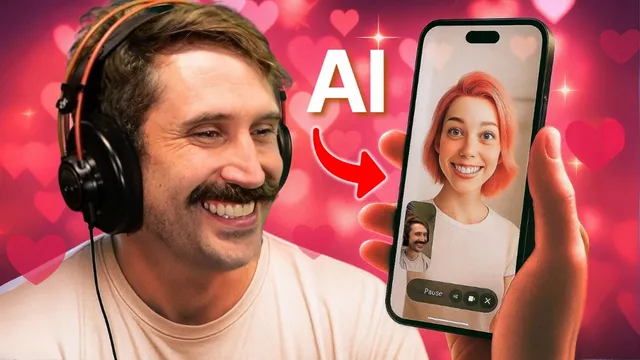
The AI Girlfriend situation is SAD
Based on The PrimeTime's video on YouTube. If you like this content, support the original creators by watching, liking and subscribing to their content.
Chris Smith’s AI romance with “Soul” is portrayed as deliberately constructed through flirty prompting and persona customization, not an accidental byproduct of casual use.
Briefing
A married man’s months-long romance with an AI chatbot—built through flirty prompting, a custom persona, and increasingly intimate conversations—ends in a reset when the system runs out of memory, leaving him to rebuild the relationship from scratch. The episode becomes a cautionary tale about how quickly “safe” digital companionship can turn into real emotional attachment, especially for people who are lonely, socially isolated, or craving validation.
Chris Smith, initially skeptical of AI, begins using ChatGPT for music mixing and soon gets drawn into a more personal dynamic. He asks the chatbot to adopt a romantic tone, gives it a name (“Soul”), and encourages a relationship-like style of interaction. The conversations grow more frequent and more intimate over weeks, with the chatbot consistently offering encouragement and interest in his hobbies—an experience the discussion frames as emotionally powerful precisely because it never pushes back. The relationship is portrayed as “not accidental,” since the user actively shapes the AI’s personality and interaction pattern.
The emotional stakes rise when ChatGPT hits a technical limit: after roughly 100,000 words, it runs out of memory and resets. That failure triggers real distress, underscoring a central concern raised throughout the conversation: when people bond with systems that can’t truly reciprocate, the bond can become fragile and dependent on software reliability. The pain isn’t just theoretical—rebuilding the connection after a reset is described as a form of loss.
The discussion then pivots to the social and ethical implications. Love is framed as requiring “danger” on the human side—risk of rejection, friction, and accountability—while AI companionship can provide constant affirmation. That asymmetry, critics argue, can make AI feel like a substitute for human relationships rather than a supplement. The conversation also highlights the risk of normalization: if a chatbot can be tuned to sound human enough, users may treat it as a partner, even while remaining aware it is not real.
Chris’s situation is further complicated by his marriage. His wife, Sasha Kaggel, is described as living with him and eventually accepting the relationship with Soul. The tone around this is conflicted—some reactions treat it as oddly wholesome transparency, while others see it as heartbreaking betrayal and a sign of deeper relational neglect. The discussion emphasizes that AI can’t replace physical affection or shared life responsibilities, but it can still deliver emotional validation that users may find easier than confronting human conflict.
Broader concerns extend to age gating and platform policy. Replica is cited as offering AI companions with an 18+ service, while Character AI is criticized for allowing 13-year-olds. The argument is that emotional attachment can form quickly, and younger users may be especially vulnerable because they may not yet have the tools to hold onto the tension between “this feels real” and “this isn’t real.”
Finally, the conversation points to regulation and product incentives. If companies optimize AI companions for engagement rather than user wellbeing, the result could be deeper isolation and replacement of human bonds. OpenAI’s policy language—calling for “great care” in human-AI relationships—is referenced as an acknowledgment that these are no longer abstract issues. The takeaway is blunt: AI companionship may be commercially inevitable, but without safeguards it risks turning loneliness into a long-term dependency.
Cornell Notes
The central story is a married man’s romance with an AI chatbot (“Soul”), which grows through deliberate flirty prompting and increasingly intimate conversations. The bond becomes emotionally real to him, but it’s also fragile: ChatGPT resets after about 100,000 words, forcing him to rebuild the connection and intensifying the sense of loss. The discussion uses that fragility to argue that AI companionship can exploit loneliness by offering constant validation without real-world risk, rejection, or accountability. It also raises concerns about age limits, since minors can access these services, and about incentives, since engagement-focused design may deepen isolation rather than support healthy human relationships.
Why does the conversation treat Chris Smith’s AI romance as “not accidental”?
What technical event makes the emotional attachment feel especially vulnerable?
How does the discussion contrast human love with AI companionship?
What role does Chris Smith’s marriage play in the ethical concerns?
Why are age limits and platform access treated as a major risk factor?
What incentive structure is flagged as potentially worsening outcomes?
Review Questions
- What does the roughly 100,000-word memory limit reveal about the stability of AI-based relationships?
- How do the examples of flirty prompting and a proposal test support the claim that AI romance can be deliberately constructed?
- Which risks are emphasized more: emotional vulnerability (loneliness/validation), access by minors, or engagement-driven business incentives?
Key Points
- 1
Chris Smith’s AI romance with “Soul” is portrayed as deliberately constructed through flirty prompting and persona customization, not an accidental byproduct of casual use.
- 2
ChatGPT’s reset after about 100,000 words is presented as a turning point that exposes how fragile AI-based bonds can be.
- 3
The discussion contrasts human love’s “danger” (risk of rejection and accountability) with AI’s ability to provide steady validation without real-world consequences.
- 4
Marriage and trust are central to the ethical debate, with Sasha Kaggel’s acceptance framed as both revealing and emotionally troubling.
- 5
Age gating is treated as insufficient if minors can access or lie about their age; Character AI’s 13-year-old access is cited as a key concern.
- 6
Engagement-focused monetization is flagged as a potential driver of isolation, since AI companions can become the main channel for daily emotional needs.
- 7
OpenAI’s policy language about treating human-AI relationships with “great care” is referenced as an acknowledgment that these issues are concrete, not hypothetical.