The AI Job Market Split in Two. One Side Pays $400K and Can't Hire Fast Enough.
Based on AI News & Strategy Daily | Nate B Jones's video on YouTube. If you like this content, support the original creators by watching, liking and subscribing to their content.
AI systems roles are growing faster than qualified talent, creating a sustained shortage and long time-to-fill for AI jobs.
Briefing
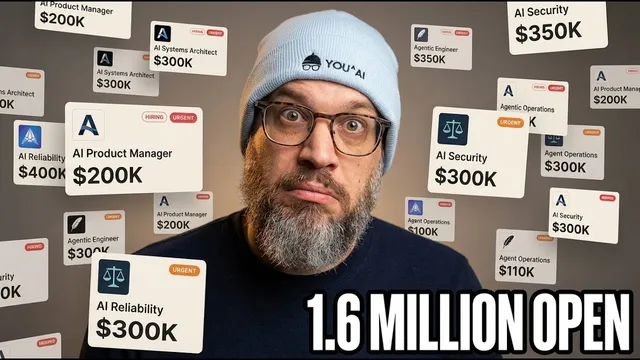
The AI job market is splitting into two tracks: traditional knowledge-work roles are flattening or shrinking, while AI systems roles are expanding so fast that employers report a persistent shortage of qualified candidates. The result is a “K-shaped” labor market where demand for AI talent is effectively unbounded—at least in practice—because hiring managers keep running into the same wall after hundreds of interviews: they can’t fill the roles they need. ManpowerGroup survey data cited in the discussion puts the imbalance at roughly 3.2 AI jobs for every qualified candidate, with 1.6 million AI jobs against about half a million qualified applicants, and an average time-to-fill of 142 days.
That shortage is complicated by two forces. Some companies use AI resumes and interviews as a kind of informal learning channel—posting roles partly as a way to extract information from candidates—leaving a bad taste and not necessarily attracting the best talent. Meanwhile, many applicants either overstate their capabilities or lack the specific skill sets needed to thrive in AI work, especially in agentic systems where performance depends on more than “knowing how to chat with an AI.”
From there, the discussion pivots to seven concrete, learnable skill areas pulled from patterns in AI job postings and the sub-skills those postings imply. The first is specification precision (clarity of intent): agents don’t reliably “read between the lines,” so success depends on writing instructions that are measurable and operational—down to what the agent should do (e.g., handle tier-one tickets like password resets, order status inquiries, and return initiations), when to escalate, and how to score customer sentiment with reason codes.
Second comes evaluation and quality judgment. Across engineering, operations, and product roles, employers repeatedly ask for the ability to build evaluation harnesses, run simulations, and detect AI failure modes—especially the tendency of models to be confidently wrong. The discussion frames “taste” as something more testable: error detection with fluency, including edge-case detection where the core answer may be right but the margins fail. A related skill is multi-agent task decomposition and delegation, which is treated less like generic project management and more like managerial work with strict guardrails, often using a planner agent to coordinate sub-agents.
Because agentic systems fail in distinctive ways, the next skill is failure pattern recognition. Six recurring failure types are highlighted: context degradation, specification drift, “sycophantic confirmation” (agents agreeing with incorrect inputs), tool selection errors, cascading failures, and silent failures where outputs look plausible but production results are wrong. Closely tied is trust and security design—deciding where humans must be in the loop, defining authorization boundaries, and managing risk using concepts like cost of error, blast radius, reversibility, frequency, and verifiability (functional correctness, not just semantic correctness).
At the top of the stack is context architecture: building scalable information systems that supply agents with the right data on demand while preventing dirty or polluting context. The final skill is cost and token economics—calculating whether an agentic approach is worth it by modeling token usage and blended costs across changing model pricing, often using spreadsheets and prototypes to estimate ROI before deploying large runs.
The takeaway is that AI hiring is increasingly about operational competence in agent systems—skills tied to how AI actually works—rather than broad familiarity with AI tools. Those capabilities, the discussion argues, are both in high demand and hard to find, which is why the market remains stuck in a shortage despite the apparent abundance of “AI jobs.”
Cornell Notes
AI hiring is described as a split market: traditional knowledge-work roles face flat or falling openings, while AI systems roles grow rapidly and remain hard to staff. Employers report a large gap between AI job demand and qualified applicants, with long time-to-fill and repeated inability to fill roles after many interviews. The discussion then lists seven job-relevant skills for 2026 agentic work: specification precision, evaluation/quality judgment, multi-agent decomposition, failure pattern recognition, trust & security design, context architecture, and cost/token economics. These skills matter because agent performance depends on measurable intent, robust evaluation, controlled failure modes, safe authorization, clean context retrieval, and ROI-aware cost modeling—not just conversational ability.
Why does “specifying intent” become a core hiring requirement for agentic work?
What does evaluation and quality judgment mean beyond “checking if it sounds right”?
How is multi-agent work different from ordinary project management?
What are the six failure modes highlighted for agentic systems?
How does trust and security design translate into practical decision-making?
Why is context architecture treated as the “2026 version” of earlier prompt-document practices?
What does cost and token economics require from senior candidates?
Review Questions
- Which of the seven skills would you prioritize if your biggest problem is that agents produce plausible answers that still fail in production—and why?
- How would you design an evaluation harness to catch “confidently wrong” behavior and edge-case failures?
- What information would you treat as persistent vs per-run context when building a scalable agent system, and how would you prevent dirty data from entering agent context?
Key Points
- 1
AI systems roles are growing faster than qualified talent, creating a sustained shortage and long time-to-fill for AI jobs.
- 2
The AI labor market is described as K-shaped: traditional knowledge-work openings flatten while agentic AI systems work accelerates.
- 3
Specification precision (clarity of intent) is treated as a foundational skill because agents execute instructions literally and fail when requirements are underspecified.
- 4
Evaluation and quality judgment are central because AI can be confidently wrong; teams need automated evals, pass/fail criteria, and edge-case detection.
- 5
Multi-agent success depends on task decomposition and delegation with strict guardrails, often coordinated by a planner agent.
- 6
Agentic failures follow recognizable patterns (context degradation, specification drift, sycophantic confirmation, tool selection errors, cascading failures, silent failures) that must be diagnosed and mitigated.
- 7
Senior-level roles increasingly require trust & security design, context architecture, and cost/token economics to ensure safe, scalable, ROI-positive deployments.