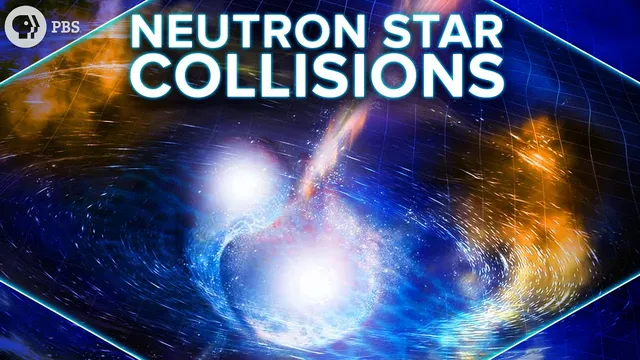
The Alchemy of Neutron Star Collisions
Based on PBS Space Time's video on YouTube. If you like this content, support the original creators by watching, liking and subscribing to their content.
Supernovae can produce some r-process material, but multiple inconsistencies—Galactic abundance expectations, explosion model difficulties, and the lack of r-process enrichment in supernova 1987A—make them unlikely as the dominant source.
Briefing
Neutron-star collisions are emerging as the dominant cosmic engine behind many of Earth’s heaviest elements—especially the neutron-rich isotopes that the classic “rapid neutron capture” (r-process) requires. For years, supernovae were the default explanation for r-process material, but multiple lines of evidence didn’t quite fit: r-process yields should be neutron-rich, yet the Milky Way doesn’t show the expected buildup; supernova models struggle to eject enough of the right material; and the nearby supernova 1987A showed no clear r-process enrichment. That mismatch has shifted attention to neutron-star mergers, which now have both observational support and a plausible physical pathway for manufacturing heavy nuclei.
The merger scenario starts with two neutron stars spiraling together as gravitational waves drain their orbital energy. In the final moments, the collision triggers a rapid transformation: the combined object collapses into a black hole within milliseconds, while surrounding matter is thrown into a turbulent, neutron-rich environment. As the debris expands, neutrons undergo beta decay—turning into protons while emitting electrons and neutrinos. That decay both reshapes the nuclear composition and helps drive material outward. Meanwhile, the still-neutron-rich region enables the r-process: newly formed nuclei and existing iron seeds capture neutrons faster than they can decay, building heavier and heavier elements until the unstable isotopes decay into more stable forms.
A key detail is the role of neutrinos. Although neutrinos are often described as nearly non-interacting, the densities in the merger environment are high enough that neutrinos and matter effectively couple, producing a neutrino-driven outflow. Calculations suggest neutron-star mergers can outperform supernovae at producing heavy elements and delivering them into space, where they can seed future star systems.
Observations have strengthened the case. After gravitational-wave detections of neutron-star mergers by LIGO and Virgo, telescopes recorded electromagnetic counterparts and spectral signatures consistent with r-process elements in abundance. With those fingerprints in hand, neutron-star mergers have become the leading candidate for producing much of the heavy-element inventory found on Earth.
The story then turns from “where elements come from” to “when they arrived.” A Nature study by Marko and Bartos used radioactive chronometers embedded in early solar-system material. Certain r-process isotopes have half-lives short enough that they would have decayed long before Earth formed, but their decay products can remain locked inside ancient minerals. By comparing the relative abundances of curium-247 (half-life 15.6 million years) and plutonium-244 (half-life 80.8 million years) through their daughter products in meteorites, researchers inferred the timing and distance of the responsible merger. Their simulations point to a single nearby event occurring roughly 40–120 million years before the solar system formed, at a distance of about 650–1,300 light-years. More stable heavy elements likely accumulated through multiple mergers over time.
Taken together, the evidence reframes heavy-element origins: neutron-star mergers likely dominate the production of elements with atomic masses 44 and up, including lead, silver, gold, rare earth elements, and radioactive species such as uranium and plutonium. Even biologically relevant heavy elements like molybdenum and iodine may owe a significant fraction of their presence to these ancient stellar collisions—atoms forged near a black hole, then traveling through cosmic time until they became part of living matter that can measure their origin.
Cornell Notes
Neutron-star mergers are now the leading source of many heavy elements on Earth, especially the neutron-rich isotopes associated with the r-process. Supernovae were once the default explanation, but their predicted r-process yields and ejecta conditions don’t match observed Galactic abundances, and the nearby supernova 1987A showed no clear r-process enrichment. In a merger, neutron-rich debris undergoes rapid neutron capture while beta decay (with electrons and neutrinos) both reshapes nuclei and helps drive material outward. A Nature study used radioactive “clocks” preserved in ancient meteorites—comparing curium-247 and plutonium-244 via their decay products—to infer that one major neutron-star collision likely occurred 40–120 million years before the solar system formed, 650–1,300 light-years away. This supports a picture where rare, high-yield mergers seed short-lived r-process isotopes, while additional events build up longer-lived heavy elements over time.
Why did supernovae stop looking like the full answer for r-process elements?
What physical steps in a neutron-star merger enable the r-process?
How do neutrinos help eject r-process material from the merger?
What observational evidence links neutron-star mergers to r-process elements?
How can scientists date a neutron-star merger billions of years after it happened?
What did the meteorite-based study conclude about the timing and distance of the key merger?
Review Questions
- What specific observational or modeling problems undermine the idea that supernovae are the dominant r-process source?
- Describe the sequence of nuclear processes in a neutron-star merger that leads to heavy-element buildup and eventual stabilization.
- How do half-life differences and meteorite mineral formation enable reconstruction of a merger’s time and distance?
Key Points
- 1
Supernovae can produce some r-process material, but multiple inconsistencies—Galactic abundance expectations, explosion model difficulties, and the lack of r-process enrichment in supernova 1987A—make them unlikely as the dominant source.
- 2
Neutron-star mergers provide a natural r-process environment: neutron-rich ejecta enables rapid neutron capture before nuclei decay.
- 3
Beta decay in merger debris both transforms the nuclear composition and supplies electrons and neutrinos that help drive an outflow.
- 4
Neutrino-driven winds can help heavy nuclei escape the merger’s strong gravity instead of being swallowed by the forming black hole.
- 5
Gravitational-wave detections combined with electromagnetic spectroscopy have linked neutron-star mergers to observed r-process element signatures.
- 6
Radioactive chronometers preserved in early solar-system meteorites allow dating of a merger by comparing daughter-product abundances tied to parent isotope half-lives.
- 7
A key inferred event likely occurred 40–120 million years before solar system formation, 650–1,300 light-years away, with additional mergers contributing to longer-lived heavy elements.