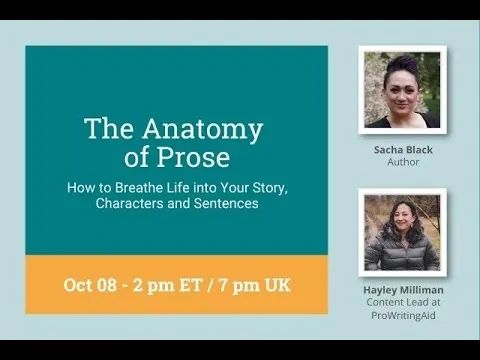
The Anatomy of Prose: How to Breathe Life into Your Story, Characters and Sentences with Sacha Black
Based on ProWritingAid's video on YouTube. If you like this content, support the original creators by watching, liking and subscribing to their content.
Use juxtapositions at both the story level and the sentence level to create sharp conflict-and-imagery through contrast.
Briefing
Prose comes alive when writers treat description, characterization, and dialogue as tools for contrast—turning abstract emotion into concrete images, tightening word choice, and making every character’s “voice” stay distinct. The session’s central throughline is that strong writing isn’t just prettier language; it’s controlled specificity that creates conflict, immediacy, and reader immersion.
A major focus is on juxtapositions: placing two things side by side—often opposites—to spark sharp imagery and deeper meaning. At the “macro” level, story itself behaves like a juxtaposition: a flawed protagonist in a normal world is set against the arc that heals or transforms them by the end. At the “micro” level, juxtapositions can happen inside sentences and descriptions, where contrasting descriptors force the reader to visualize something stark and memorable. The examples drawn from V. E. Schwab’s Addie LaRue highlight how pairing smooth/rough or delicate/large can create a vivid mental picture while also enriching the emotional texture of a scene.
To make intangible ideas feel real, the session pushes writers to convert the ungraspable into the tangible—especially in description. Time, love, hope, loss, and other internal states can be made relatable through comparisons that readers already understand physically. Schwab’s lines about a “moment” like a brief yawn, or trying to “hold time like a breath in her chest,” demonstrate how borrowing bodily sensations and familiar actions can translate complex emotion into something the reader can almost feel.
Tightening prose is handled through practical revision tactics. Overused adverbs often “tell” rather than “show,” so replacing them with stronger verbs can sharpen impact. Another common drag on immediacy is filtering—phrases like “I heard,” “she saw,” or “he thought”—which adds an extra step between the reader and the character’s experience. Removing filter words makes action land more directly on the page, increasing urgency and reducing word count.
Repetition gets treated as a craft problem rather than a stylistic quirk. Repeating the same information in multiple sentences, reusing similar phrasing, or cycling through the same descriptive beats across scenes wastes space and dulls effect. Even “near-repetition” matters: repeated word families (humming/hummed), repeated scene openings or closings, and multiple characters with similar names can all blur clarity.
Character differentiation is anchored in the idea that character voice is personality—shaped by actions, thoughts, dialogue, and feelings—while author voice can shift across genres. Two characters witnessing the same parade should sound different because their word choice, sentence rhythm, and imagery reflect their emotional stance. Theme also becomes a differentiator: the hero embodies the theme, the villain embodies the anti-theme, and side characters each represent different angles of the same thematic question. Consistency matters, but it must be shown in varied ways so bravery, for example, can appear through different behaviors, word choices, and reactions.
Dialogue differentiation closes the loop. Dialogue should communicate character-to-character, not writer-to-reader, and writers should build a “word bag” of what each character is comfortable saying. Profession, history, social setting, flaws, and emotional state all influence diction, sentence length, and even how accents are handled. Under pressure, characters don’t all shout or freeze the same way—so emotional triggers become another lever for distinct prose.
By the end, the guidance converges on a single standard: prose should be clean, specific, and efficient enough that every sentence advances characterization, theme, and immediacy—without wasting words on distance, sameness, or generic narration.
Cornell Notes
The session argues that vivid prose comes from deliberate contrast and immediacy: use juxtapositions to create sharp imagery, translate intangible emotions into tangible comparisons, and tighten sentences by removing adverbs and filtering. Character voice should stay consistent with personality, so actions, thoughts, dialogue, and feelings must shape word choice and sentence rhythm. Theme should cascade through the cast: heroes embody the theme, villains embody the anti-theme, and side characters each test a different version of the thematic question. Dialogue differentiation relies on each character’s “word bag,” shaped by profession, history, social setting, and emotional reactions—especially under stress.
How do juxtapositions create both imagery and story meaning?
What does “intangible to tangible” mean in practice for description?
Why are adverbs and filtering words considered common prose problems?
How can writers keep characters consistent without repeating the same behavior?
What makes character voice different from author voice?
How should dialogue be differentiated so characters don’t sound interchangeable?
Review Questions
- Where would you remove filtering words in a sample paragraph to make the scene feel more immediate?
- Pick one character trait (e.g., bravery). List three different ways that trait could appear across scenes without repeating the same action.
- How would you build a “word bag” for two characters with different backgrounds so their dialogue stays distinct even in a tense conversation?
Key Points
- 1
Use juxtapositions at both the story level and the sentence level to create sharp conflict-and-imagery through contrast.
- 2
Translate intangible emotions and concepts into tangible comparisons (time as a yawn; time as a breath) to make internal states feel physical.
- 3
Tighten prose by replacing weak adverbs with stronger verbs and by removing filtering words like “I heard” or “she saw.”
- 4
Treat repetition as a revision target: cut repeated information, repeated phrasing, repeated scene openings/closings, and near-repetitions like word-family echoes.
- 5
Differentiate characters by keeping character voice consistent with personality while letting author voice vary by genre or tone.
- 6
Make theme do work across the cast: hero embodies the theme, villain embodies the anti-theme, and side characters represent different angles of the same thematic question.
- 7
Differentiate dialogue using each character’s word bag, shaped by profession, history, social setting, and emotional reactions—especially under pressure.