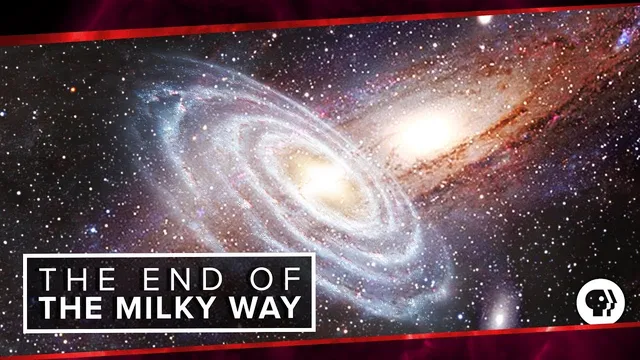
The Andromeda-Milky Way Collision
Based on PBS Space Time's video on YouTube. If you like this content, support the original creators by watching, liking and subscribing to their content.
Andromeda (M31) is expected to collide with the Milky Way in roughly four billion years, disrupting both spiral galaxies and ending in a merged elliptical galaxy.
Briefing
In about four billion years, the Andromeda Galaxy will collide with the Milky Way, tearing both spiral galaxies apart and reshaping the night sky for any future observers. Andromeda—known as M31—sits roughly 2.5 million light-years away and is already moving toward the Milky Way at about 110 kilometers per second. Over the next two billion years it will swell in apparent size, with the growth accelerating as the galaxies close the gap. By roughly four billion years from now, Andromeda’s disk will crash through the Milky Way, producing a dramatic disruption marked by long tidal tails and a final merger into a single, football-shaped elliptical galaxy.
The collision’s inevitability hinges on more than Andromeda’s “toward us” speed. Doppler measurements reveal only the line-of-sight component of motion, leaving open the possibility that Andromeda could miss if it had enough sideways velocity. That uncertainty has been narrowed by precise proper-motion work using the Hubble Space Telescope. Researchers led by Roeland van der Marel mapped thousands of stars in Andromeda between 2002 and 2010, compared their motions against background galaxies, and corrected for Andromeda’s rotation and the Sun’s own movement. The resulting transverse velocity is about 17 kilometers per second—small enough that, even accounting for uncertainties, a head-on collision is effectively unavoidable.
Once the galaxies begin to interact, simulations suggest a sequence of events. The first major impact, around four billion years out, should completely disrupt both spiral structures, generating tidal tails similar to those seen in currently colliding systems such as the Antennae. After Andromeda’s core plunges through, it will continue for a time before falling back. Over the following couple of billion years, the two galaxies merge into a larger elliptical system, with both galaxies’ supermassive black holes sinking toward the center through dynamical friction—gravitational interactions that scatter stars into wider orbits while the black holes lose angular momentum.
When the black holes get within about a light-year of each other, gravitational waves take over, driving the final inspiral and merger. The merged black hole could briefly power a new quasar if gas funnels into the core, and shocks across remaining gas may trigger additional star formation—though the exact outcome is uncertain because both galaxies will have used much of their gas by then.
For the solar system, the odds favor survival. Direct star-to-star collisions are not expected because typical stellar spacing is about 100 billion times the diameter of a star, so stars should pass each other without impact. The main risk comes from rare close encounters that could perturb a planet’s orbit—estimated at roughly one in 10 million for a star passing inside Neptune’s orbit. The bigger unknown is where the Sun ends up after the merger. In the simulations, many Sun-like trajectories end up in the outer regions of the new galaxy, while some plunge through the center periodically or even dash through the Triangulum Galaxy before it is absorbed. A small chance remains that the Sun could be slingshotted by a supermassive black hole during its descent.
From Earth’s perspective, the sky would look like a long-lived “train wreck” for about two billion years after the first impact, eventually dominated by a large, featureless elliptical glow. But by then, Earth will already be uninhabitable due to the Sun’s evolution into a red giant and earlier brightening—so future observers would likely need to watch from elsewhere, such as the outer ocean worlds of Enceladus or Europa.
Cornell Notes
Andromeda (M31) is closing on the Milky Way and is expected to collide in about four billion years, disrupting both spiral galaxies and ultimately merging into a single elliptical galaxy. The collision is considered inevitable because Andromeda’s measured transverse velocity (~17 km/s) is far smaller than its line-of-sight approach speed (~110 km/s), leaving little room for a miss. Simulations predict a first major disruption around four billion years, followed by a merger into a football-shaped elliptical galaxy around six billion years, with both galaxies’ supermassive black holes sinking to the center and merging later via gravitational waves. The solar system is unlikely to experience direct star collisions, though rare close stellar flybys could perturb planetary orbits. The biggest uncertainty is the Sun’s final orbit after the merger and whether it ever gets strongly scattered by a central black hole.
Why does measuring only Doppler shift not settle whether Andromeda will actually hit the Milky Way?
How did astronomers estimate Andromeda’s transverse velocity despite its extreme distance?
What sequence of structural changes do simulations predict for the Milky Way–Andromeda merger?
What happens to the supermassive black holes during the merger?
How likely is it that the solar system gets physically struck by another star?
Where might the Sun end up after the merger, and what are the main uncertainties?
Review Questions
- What observational strategy allows transverse velocity to be measured for a galaxy as distant as Andromeda?
- How do dynamical friction and gravitational waves differ in driving the final black hole merger?
- Why are direct star collisions during a galaxy merger considered unlikely, even though the galaxies themselves collide violently?
Key Points
- 1
Andromeda (M31) is expected to collide with the Milky Way in roughly four billion years, disrupting both spiral galaxies and ending in a merged elliptical galaxy.
- 2
Andromeda’s approach speed is about 110 km/s, and its measured transverse velocity is about 17 km/s, making a head-on collision effectively unavoidable.
- 3
The first major disruption should occur around four billion years, with tidal tails forming as both disks are torn apart.
- 4
The merger should complete into a football-shaped elliptical galaxy around six billion years, after which both central supermassive black holes sink to the center and eventually merge.
- 5
Direct star-to-star collisions are unlikely for the solar system because stellar separations are vastly larger than stellar sizes.
- 6
The solar system’s survival is more threatened by rare close stellar flybys (e.g., inside Neptune’s orbit) and by uncertainty in the Sun’s final orbit after the merger.