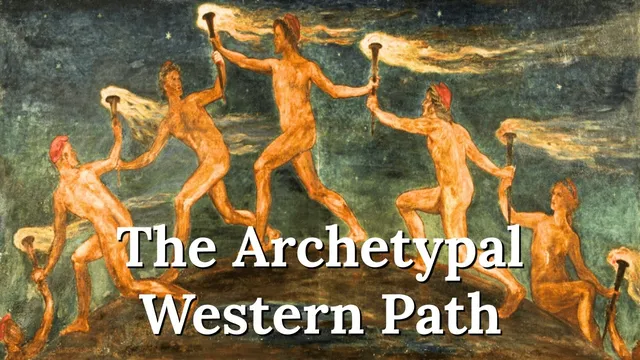
The Archetypal Western Path, the Last Man, and the Daimon
Based on Academy of Ideas's video on YouTube. If you like this content, support the original creators by watching, liking and subscribing to their content.
The transcript defines westernness as an inherited psychological mindset, not a matter of where someone lives or what ethnicity they are.
Briefing
Western identity is framed as a set of deep psychological values—especially a drive to engage the material world, pursue purpose, and express individual freedom—and the “last man” represents what happens when those archetypal forces go missing. Friedrich Nietzsche’s late-19th-century diagnosis of decline is invoked to describe a civilization losing creative vitality and producing people who chase shallow pleasures and material goods. The result is not just cultural fatigue but moral and spiritual collapse, leaving widespread disorientation.
The core claim is that “westernness” can’t be reduced to geography or ethnicity. With globalization and mass migration, physical location no longer reliably signals a shared mindset. Instead, westernness is described as an innate inclination toward a particular way of being—an internal template of thinking, feeling, wanting, and behaving. That matters because identity rooted in one’s inherited psychological soil is portrayed as necessary for full human flourishing. Carl Jung is used to argue that transplanting a life path into foreign cultural practices—such as adopting yoga as a Western substitute—fails to align with Western dispositions and can block genuine development. History, Jung warns, is “written in the blood,” meaning people carry their cultural inheritance in their psychology.
Bernardo Castro’s “diamond” framework supplies the video’s practical answer to the “meaning crisis.” Several archetypal traits define the Western path. First is a distinctive relationship to matter: Westerners are portrayed as naturally drawn to concreteness, building, sculpting, and using technology. Even Christianity is cited—particularly Catholic and Orthodox traditions—as a religion that uses beautiful forms of matter to inspire awe rather than retreat from the physical world. Second is a purpose-oriented, almost theological drive: Westerners feel a perennial lack at the core of being, which is often misattributed to external circumstances. That lack fuels action—what’s likened to a Promethean impulse.
Prometheus becomes the symbol of Western creative energy: the drive to create and discover, sometimes with little regard for consequences. The same force that built technological and cultural achievements is also linked to moral catastrophe, from crusades and colonialism to world wars and the nuclear bomb. The argument is not that the impulse should be eliminated, but that moral discernment is required to channel it.
Individualism is treated as the next pillar. Western societies historically enabled people to unfold idiosyncratic selves through freedoms of speech, association, and property. Increasing authoritarian intrusion is described as a direct threat to individuation, contributing to anxiety, depression, and neurosis.
The “last man” is then contrasted with those who follow the diamond. The diamond is described as an impersonal force within—akin to vocation, fate, or calling—that compels a person toward their archetypal identity. Following it is said to saturate life with meaning and reduce nihilism and ennui. Practical signs include reduced need for social validation, alignment with one’s talents, and emotionally charged guidance—especially suffering, which is framed as a steering mechanism when someone strays off course. A Western revival, the video concludes, doesn’t require everyone to change; a minority who embody the force of nature can still make a historical mark, while last men remain weak and powerless.
Cornell Notes
The Western “last man” is portrayed as the outcome of losing archetypal identity: a drift toward shallow pleasure, material chasing, and spiritual/moral disorientation. Westernness is defined not by geography but by an inherited psychological mindset—especially engagement with matter, a purpose-driven drive fueled by a primordial lack, and a strong commitment to individual freedom. That drive can produce both greatness and evil, so moral discernment is essential. The proposed remedy is reconnecting with the “diamond,” an impersonal inner force (vocation/fate/calling) that steers people toward their natural path. When someone follows the diamond, life gains meaning and the “meaning crisis” recedes; when people live as last men, depression, ennui, and nihilism spread.
Why does the transcript treat “westernness” as psychological rather than geographic?
What does the “primordial lack” mean, and how does it connect to Western action?
How does the Promethean impulse explain both Western achievements and Western atrocities?
Why does Jung’s warning about yoga matter to the video’s identity argument?
What is the “diamond,” and how is it supposed to restore meaning?
How can someone tell whether they’re following the diamond or a self-deception?
Review Questions
- What traits define the archetypal Western path in the transcript, and which one is described as fueling action most directly?
- How does the transcript reconcile the Promethean impulse’s role in both progress and moral catastrophe?
- What practical signs are offered for detecting the “diamond,” and how do those signs differ from chasing status or external validation?
Key Points
- 1
The transcript defines westernness as an inherited psychological mindset, not a matter of where someone lives or what ethnicity they are.
- 2
Carl Jung’s “tree in foreign soil” warning is used to argue that Westerners flourish best through their own cultural spiritual and life traditions.
- 3
Western identity is characterized by engagement with matter, a purpose-driven drive, and a commitment to individual freedom.
- 4
A “primordial lack” is presented as the engine behind Western striving, often misattributed to external life circumstances.
- 5
The Promethean impulse is framed as both the source of major achievements and a driver of grave evils, requiring moral discernment rather than suppression.
- 6
The “diamond” is offered as an inner, impersonal force of vocation/fate that restores meaning when followed.
- 7
A Western revival is portrayed as possible through a minority who embody the diamond, even if most people live as “last men.”