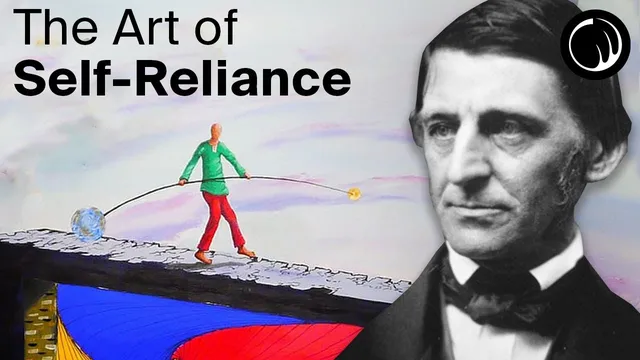
The Art of Trusting One's Self - The Philosophy of Ralph Waldo Emerson
Based on Pursuit of Wonder's video on YouTube. If you like this content, support the original creators by watching, liking and subscribing to their content.
Emerson’s self-reliance centers on present-moment experience as the source of spiritual truth, not inherited doctrine or future authority.
Briefing
Ralph Waldo Emerson’s philosophy of self-reliance argues that genuine spiritual insight doesn’t come from inherited doctrine or future authority—it arises from the individual’s direct experience in the present moment. That claim matters because it reframes “truth” as something you discover and express from within, rather than something you receive and repeat from outside systems, even when doing so conflicts with social convention.
Emerson’s ideas grow out of a larger metaphysical view: nature is unified with a single divine essence, so there is no real separation between humanity and the natural world. In his essay “Nature” (1836), he treats every distinction—trees, bugs, dirt, stars—as largely “phenomenal,” while the underlying reality is one. The spiritual experience, then, is not a distant reward but an immediate perception: in a famous passage, he describes becoming a “transparent eyeball,” where universal currents seem to circulate through the self. Nature is also in constant flux, and human life should move in coordination with that change. The practical implication is radical—people should trust their own intuition and live “on the bare ground,” letting the present illuminate what matters rather than forcing life into fixed beliefs from the past.
That emphasis on immediacy becomes Emerson’s most popular concept in “Self-Reliance” (1841). Emerson argues that people often fail to realize their own unique greatness not because it is inaccessible, but because they are pulled away by others’ expectations and by systems of convention. Great writers, thinkers, and artists aren’t great because they possess exclusive information; they stand out because they candidly express what they feel in the moment, even if it challenges norms. In this view, originality isn’t just novelty—it’s the honest articulation of experiences that many others share but haven’t dared to claim as legitimate.
Emerson also insists that self-trust doesn’t require hostility toward others or nature. Sympathy and connection remain important, but self-reliance prevents the self from being “disparaged” by external standards. The core epistemic move is simple: if anything can be known with certainty, it’s one’s own existence and experience. From there, Emerson pushes individuals to treat their perceptions as real and to express them with integrity.
The transcript acknowledges a tension: people’s circumstances differ, so self-trust and self-expression may not be equally available to everyone. It also raises a philosophical challenge—if all knowledge is experiential and the world is unified, how much “say” does a person truly have? Emerson’s answer, as presented here, is that self-reliance can still coexist with limitation as long as a person authentically stands in their own confusion and relative truth.
Finally, the discussion turns to the cost of living this way. Self-reliance is portrayed as difficult in a world that consolidates everyone into shared expectations, sometimes requiring separation from the common populace. Yet the alternative—hiding oneself out of fear of rejection—is framed as rejecting the only life one can truly live. The takeaway is an ethic: meet each moment with individuality, honesty, and authenticity, “raise the sail” of one’s own life, and keep moving forward while creating oneself anew.
Cornell Notes
Emerson’s philosophy of self-reliance holds that the most reliable spiritual insight comes from direct experience in the present, not from inherited doctrine or future authority. His metaphysics in “Nature” (1836) treats nature as a unified expression of one divine essence, dissolving the realness of rigid separations between self and world. Because nature is always changing, people should trust their intuition and flow with the moment rather than cling to fixed beliefs from the past. In “Self-Reliance” (1841), Emerson argues that individuals often suppress their unique perspective due to social convention, and that authentic expression is what makes great art and thought. The practice is demanding—sometimes socially costly—but it’s presented as the only way to live fully with integrity.
How does Emerson connect his metaphysics of nature to the ethics of self-reliance?
What does “self-reliance” mean in practice, according to the transcript?
Why does Emerson insist people should not rely on past beliefs or predictions about the future?
How does the transcript address the criticism that people have unequal resources for self-trust and self-expression?
What tension does the transcript highlight about knowledge and agency?
What does the transcript say is the cost of self-reliance, and why is it still worth it?
Review Questions
- In what ways does Emerson’s view of nature as a unified essence support the claim that spiritual insight is found within the individual?
- How does “self-reliance” differ from simply doing whatever one feels, based on the transcript’s description of authenticity and present-moment perception?
- What are the main objections raised in the transcript to Emerson’s ideal of self-trust, and how does the response attempt to reconcile them?
Key Points
- 1
Emerson’s self-reliance centers on present-moment experience as the source of spiritual truth, not inherited doctrine or future authority.
- 2
“Nature” (1836) treats nature as one unified divine essence, making rigid separations between self and world largely superficial.
- 3
Because nature is always changing, Emerson urges people to trust intuition and avoid clinging to fixed beliefs from the past.
- 4
In “Self-Reliance” (1841), originality comes from candidly expressing what one genuinely feels in the moment, not from possessing exclusive information.
- 5
Self-reliance is presented as compatible with sympathy and connection to others; it mainly guards against letting external standards undermine one’s own experience.
- 6
The transcript acknowledges unequal life circumstances and frames self-reliance as authentic alignment with one’s relative truth, even amid confusion and limitation.
- 7
Living self-reliance can carry social risk, but the alternative—hiding from fear of rejection—is framed as rejecting the only life one must live.