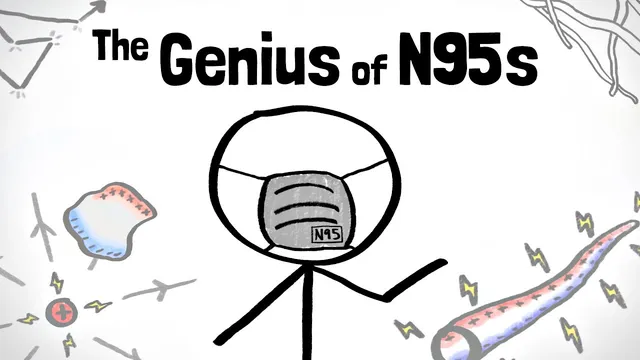
The Astounding Physics of N95 Masks
Based on minutephysics's video on YouTube. If you like this content, support the original creators by watching, liking and subscribing to their content.
N95 masks capture particles primarily by making them touch fibers and then stick, not by simply blocking particles larger than fiber gaps.
Briefing
N95 masks work less like a “fine strainer” and more like a sticky, multi-layer capture system that’s engineered to make airborne particles touch and adhere to fibers—so it can trap both very large and very small particles, with the hardest-to-catch range sitting in the middle. The key shift is that filtration doesn’t mainly depend on whether particle size is smaller than the gaps between fibers. Instead, the mask’s performance hinges on whether particles collide with fibers and then stay stuck, which is driven by molecular-scale stickiness and several physics-based mechanisms.
At the microscopic level, matter behaves “sticky” because weak attractive forces between molecules are still strong enough to hold small things in place once contact happens. That means N95 filtration is better compared to a spider web than a window screen: an insect can be caught regardless of size as long as it touches a strand. N95 masks are designed to maximize those touch events across a wide range of particle sizes.
Multiple layers of fibers increase the odds of capture. For very large particles—on the order of more than a thousandth of a millimeter—momentum carries them along in nearly straight paths, and the sheer number of layers makes it likely those paths intersect a fiber. For extremely small particles, collisions with air molecules shove them into a random zig-zag motion called Brownian motion, which again boosts the chance of bumping into fibers. The “middle-sized” particles are the tricky group: they don’t move straight due to inertia, but they also don’t bounce randomly like the tiniest particles. Instead, airflow carries them around fibers, letting some slip through even when many layers are present.
To address that gap, N95 masks add an electric-field trick. In an electric field, even neutral particles develop an internal electrical imbalance that draws them toward the field source. The mask fibers are electrets—materials that hold a long-lasting electric charge, analogous to how magnets can be permanently magnetized. This persistent electric attraction helps capture particles of many sizes, boosting performance substantially compared with ordinary fibers.
The N95 rating ties directly to how well the mask blocks the hardest-to-filter fraction: if it filters at least 95% of the relevant particles, it earns the N95 designation. But real-world effectiveness depends heavily on fit. If the mask doesn’t seal to the face, air can bypass the filter material entirely, undermining the physics inside.
Finally, practical use during healthcare shortages adds another constraint: N95 masks are intended to be disposable, yet decontamination and reuse have become necessary. Some decontamination methods—such as using alcohol or certain liquids—can damage the mask’s electrostatic properties, reducing filtration even if the mask still looks intact. Research efforts like N95decon focus on evidence-based decontamination approaches that preserve the mask’s filtering function while enabling reuse.
Cornell Notes
N95 masks filter by making airborne particles touch and stick to fibers, not by acting like a simple mesh strainer. Molecular-scale attraction keeps particles adhered once contact happens, and the mask’s layered structure increases collision chances for large particles (straight-line motion) and very small particles (Brownian motion). Middle-sized particles are harder because airflow carries them around fibers, so N95s add an electric-field mechanism using electret fibers that attract particles across sizes. The N95 rating corresponds to filtering at least 95% of the relevant particle fraction, but real protection depends on a proper face seal. Reuse during shortages requires decontamination methods that don’t destroy the mask’s electrostatic filtering properties.
Why is an N95 mask not like a “fine strainer” that only blocks particles larger than the gaps between fibers?
How do particle size and motion explain why large and tiny particles are easier to capture than middle-sized ones?
What role does an electric field play in N95 filtration?
What are electrets, and why do they matter for N95 performance?
Why does fit matter as much as filter material for N95 effectiveness?
Why can some decontamination methods reduce N95 performance even if the mask looks fine?
Review Questions
- What physical mechanisms make N95 masks effective for both very large and very small particles, and why do middle-sized particles pose the biggest challenge?
- How do electret fibers and an electric field work together to improve particle capture beyond mechanical layering?
- What kinds of problems can occur if an N95 mask is not properly sealed or if decontamination damages its electrostatic properties?
Key Points
- 1
N95 masks capture particles primarily by making them touch fibers and then stick, not by simply blocking particles larger than fiber gaps.
- 2
Layering increases capture probability by forcing more opportunities for collisions across particle sizes.
- 3
Large particles tend to follow straighter paths; very small particles undergo Brownian motion; middle-sized particles are most likely to be carried around fibers.
- 4
Electret fibers create a persistent electric field that attracts particles, including neutral ones that polarize in the field.
- 5
An N95 rating corresponds to filtering at least 95% of the relevant particle fraction, but real protection depends on a proper face seal.
- 6
Decontamination methods can reduce filtration by damaging the mask’s electrostatic properties, even if the mask still looks intact.