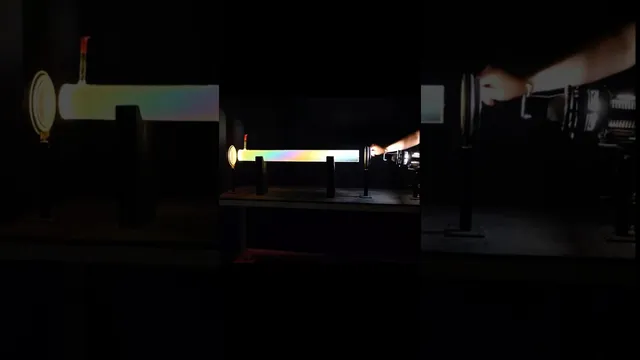
The barber pole optical mystery
Based on 3Blue1Brown's video on YouTube. If you like this content, support the original creators by watching, liking and subscribing to their content.
Polarized light entering a sugar-water tube twists its polarization direction gradually as it propagates.
Briefing
A dense sugar-water tube turns ordinary white light into a striking pattern of colored diagonal stripes when the light enters through a polarizing filter. The key mechanism is polarization twisting: as polarized light travels through the sugar solution, interactions with sugar molecules gradually rotate the direction of polarization along the tube. Crucially, the twist rate depends on light frequency—higher-frequency components (toward purple) rotate faster than lower-frequency components (toward red). By the time the light reaches the far end, each frequency has its own polarization direction, so the light’s color components become “sorted” by polarization even though the beam still looks white when viewed straight through.
The puzzle is why any color separation shows up at all when looking from the side. In the middle of the tube, the light still contains all frequencies mixed together, and there’s no second polarizing filter selecting one polarization state. The explanation hinges on how scattering works at the molecular level. When light bounces off water, air, or sugar molecules toward an observer, the scattering direction is not uniformly random; it depends on the polarization of the incoming light. In an idealized picture, scattering is strongest in directions perpendicular to the polarization direction and suppressed along the polarization direction. That means an observer’s line of sight preferentially collects certain colors at certain positions: if, at a given location, red light’s polarization happens to be oriented so that its “perpendicular” scattering points toward the viewer, red becomes more visible there, while frequencies whose polarization aligns differently scatter less toward the eye.
That still leaves another geometric question: why the stripes are diagonal rather than purely vertical. The transcript attributes the diagonal orientation to two coupled effects. First, the tube is circular, so moving the viewpoint left-to-right changes the effective scattering geometry relative to the polarization direction. Second, the light refracts as it passes from the sugar solution into the glass tube and then into air. Those bending effects vary with viewing angle, so the polarization-dependent scattering condition shifts not only across the tube’s width but also with height. The result is a pattern where color bands tilt—an optical “barber pole” outcome emerging from polarization rotation, polarization-dependent scattering, and refraction through curved interfaces.
The broader takeaway is methodological: a seemingly simple visual mystery can force a deeper understanding of foundational optics—how light’s polarization evolves in matter, how frequency-dependent effects create separation, and how microscopic scattering rules translate into macroscopic color patterns. The phenomenon becomes a gateway into core concepts like why light slows in glass or water in a color-dependent way and how those ideas connect to other optical puzzles.
Cornell Notes
A sugar-water tube rotates the polarization of incoming polarized light, and the rotation rate depends on frequency. Higher-frequency components (near purple) twist faster than lower-frequency components (near red), so different colors acquire different polarization directions along the tube. Looking straight through can still look white because all frequencies remain present, just with different polarization states. Side viewing reveals color separation because molecular scattering is polarization-dependent: light scatters more strongly in directions perpendicular to its polarization and less along it. The stripes appear diagonal because the tube’s circular geometry and refraction through the sugar solution, glass, and air change the scattering geometry with both horizontal and vertical viewing angles.
How does the sugar-water tube create color separation starting from white light?
Why can the light still look white when viewed from one end, yet show colored stripes when viewed from the side?
What role does polarization-dependent scattering play in producing the stripes?
Why are the stripes diagonal instead of vertical?
How does frequency determine where a color appears in the pattern?
Review Questions
- If red and purple twist at different rates, what observable change would you expect in the stripe pattern when the tube length is increased or decreased?
- Explain how side-viewing reveals information about polarization states that straight-through viewing might hide.
- What geometric factors (tube shape and refraction) must be present to turn vertical color bands into diagonal ones?
Key Points
- 1
Polarized light entering a sugar-water tube twists its polarization direction gradually as it propagates.
- 2
The polarization twist rate is frequency-dependent, so different colors acquire different polarization orientations along the tube.
- 3
Straight-through viewing can still look white because all frequencies remain present, just with different polarization states.
- 4
Side-view color separation arises because molecular scattering depends on polarization direction, favoring scattering perpendicular to polarization.
- 5
Diagonal stripes result from the tube’s circular geometry combined with refraction at the sugar-water, glass, and air interfaces.
- 6
The phenomenon links macroscopic stripe patterns to microscopic rules for how light interacts with molecules and interfaces.