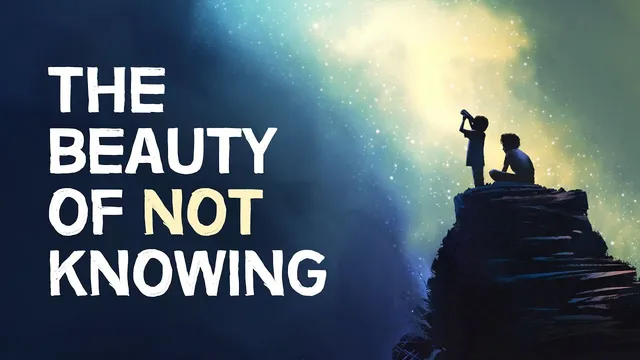
The Beauty of What We Just Don't Know (A Philosophy of Trust)
Based on Einzelgänger's video on YouTube. If you like this content, support the original creators by watching, liking and subscribing to their content.
Humans often invent explanations when faced with uncertainty, turning mystery into folklore, religion, or ideology to reduce emotional discomfort.
Briefing
Human beings can’t tolerate mystery for long: when understanding runs out, people rush to invent explanations—sometimes as folklore, sometimes as religion, sometimes as ideology. That impulse can bring comfort and meaning, but it also fuels dogma, conflict, and even “analysis paralysis” when certainty becomes the goal. The central claim is that the healthiest response to the unknown isn’t to force answers at any cost, but to learn how to live with not knowing—turning uncertainty into trust rather than fear.
The argument begins with a historical pattern. In earlier eras, the night sky and the mechanics of life were baffling, so creation stories and symbolic archetypes emerged to reduce the pain of ignorance. The same need persists today, even as science expands what humans know. Despite growing knowledge of the cosmos and terrestrial history, big questions remain unresolved: origins, purpose, the existence of God, and whether reality could be simulated. When these questions irritate people—because chaos feels intolerable—some respond by constructing simplistic or even nonsensical answers. In extreme cases, belief becomes worth dying for, turning the search for truth into a kind of crusade against the unknown.
That drive shows up in how people treat time. The past can’t be fully recovered because perception is limited to human senses, memories distort, and even shared accounts can’t recreate what truly happened. The future is even less accessible, so people cling to prognoses, projections, prophetic dreams, hunches, and destiny—often paying for supposed foresight. Yet every answer generates thousands of new questions, and the attempt to clarify everything can freeze action. Even the present—the only moment directly accessible—remains elusive because humans can’t know what others think, what lies far beyond observation, or what sustains the whole system.
The transcript then links the hunger for certainty to dogma. When explanations become sacred and unquestionable, they stop functioning as hypotheses and start functioning as power. The same dynamic appears across religion, atheism, conspiracy thinking, and even science: “truth versus truth” becomes a fight over an invisible bone. Attachment to beliefs can also become rigid, blocking new experiences; meanwhile, trying to understand everything can trap people in accumulation rather than movement.
The proposed alternative is to stop pushing the Sisyphean rock—ceasing the attempt to predict and answer everything as an intellectual safety net. Religious faith is offered as a model: faith acknowledges that reason and logic reach a boundary, and that beyond it lies genuine uncertainty. Rather than endless questioning, faith becomes a willingness to act while holding “complete trust,” stepping into the dark with the torch of confidence. The payoff is practical and emotional: fewer cycles of anxiety and a more livable relationship with mystery—an agreement with the unknown that replaces fear with trust.
Cornell Notes
The transcript argues that humans can’t comfortably sit with uncertainty, so they often invent explanations to soothe the discomfort of not knowing. That impulse can produce folklore and belief systems, but it also hardens into dogma—where certainty becomes power and conflict follows. Attempts to predict the future or reconstruct the past fully are limited by human perception, distorted memory, and the impossibility of knowing everything in the present. The alternative offered is trust: accepting that reason has boundaries and choosing action without total certainty, likened to faith. Living this way reduces rigidity and analysis paralysis and makes mystery something to navigate rather than fear.
Why does the transcript treat “not knowing” as a recurring human problem rather than a temporary gap in knowledge?
How does the transcript explain why the past and future remain fundamentally mysterious?
What is dogma in this framework, and why does it lead to conflict?
What problem does the transcript associate with both certainty-seeking and knowledge-accumulating?
How does the transcript connect faith to trust as a practical response to uncertainty?
Review Questions
- What mechanisms does the transcript use to show that neither the past nor the future can be fully known?
- How does the transcript distinguish between belief as comfort and belief as dogma?
- What does “trust” require in the transcript’s view, and how does it change how a person navigates life?
Key Points
- 1
Humans often invent explanations when faced with uncertainty, turning mystery into folklore, religion, or ideology to reduce emotional discomfort.
- 2
The past remains incomplete because perception is limited, memories distort, and even shared accounts can’t recreate what truly happened.
- 3
The future remains unknowable because predictions depend on the present, and humans can’t access everything occurring in any moment.
- 4
Dogma forms when explanations become sacred and unquestionable, creating “truth versus truth” conflicts across belief systems.
- 5
Certainty-seeking can make people rigid, while trying to understand everything can cause analysis paralysis and prevent action.
- 6
A trust-based response treats reason as bounded and chooses movement without total certainty, with faith offered as a model for that stance.