The Benefits of Ignoring People
Based on Einzelgänger's video on YouTube. If you like this content, support the original creators by watching, liking and subscribing to their content.
Ignoring people can be a legitimate form of self-care when attention is being demanded in ways that undermine autonomy or sanity.
Briefing
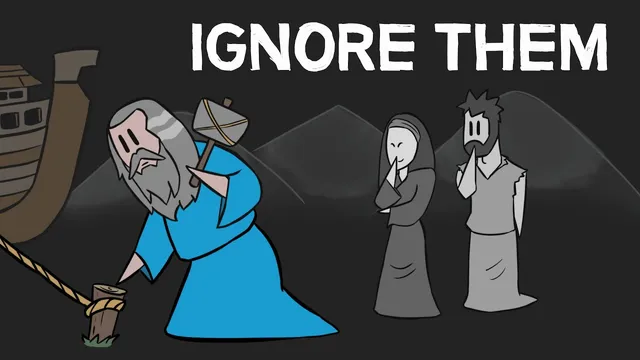
No one is entitled to your attention—and selectively ignoring people can protect mental health, preserve autonomy, and make room for work that actually matters. The core thread runs from a biblical example to modern life: Noah kept building the ark despite ridicule, and the payoff was survival. That same logic is applied to everyday communication—mockery, unsolicited advice, and endless online noise don’t deserve equal access to a person’s time and inner focus.
The argument starts by challenging a common assumption: if someone reaches out, the recipient is not automatically obligated to respond. Ignoring can be rude in some contexts, but it can also be a form of self-care and sanity maintenance in a world engineered to demand constant engagement. Online, anonymous opinions and hot takes multiply, and adopting them too readily can erode independent thinking. Ralph Waldo Emerson’s “Self-Reliance” is used to frame the stakes: fulfillment and wisdom come from trusting an inner guiding voice rather than surrendering decisions to social expectations. The guiding principle is blunt—“What I must do is all that concerns me, not what the people think”—and it’s presented as a line between “greatness” and “meanness,” even when others insist they know better.
From there, the focus shifts to technology and attention economics. Smartphones and social media deliver nonstop stimuli—notifications, messages, and a flood of information—while also intensifying competition for attention. A study cited from the U.S. National Library of Medicine links excessive social media use to anxiety and other psychological problems, including depression, insomnia, stress, decreased subjective happiness, and a “sense of mental deprivation.” The takeaway is less about moralizing and more about cognitive overload: social media is described as “human noise amplified,” a mass-produced, superficial way of relating that can damage self-esteem and inner peace.
Ignoring, in this framing, becomes a practical countermeasure. Turning off devices, muting platforms, and letting insults pass reduces the energy spent on arguments that go nowhere. The transcript also leans on resilience: people who post publicly invite trolling, so treating toxicity as part of the environment—like rude bathhouse patrons in an Epictetus analogy—helps someone keep composure instead of feeding the cycle.
Attention is portrayed as scarce and monetized. Companies, employers, and platforms all compete for it, and the cost is time and emotional bandwidth diverted from ambitions, creativity, and deep relationships. The transcript claims that sustained creative output often requires isolation from distraction and opinion; it points to personal experience building a channel in 2019 and to historical figures such as J.K. Rowling and Nikola Tesla, alongside Noah, as examples of productive seclusion.
Finally, the idea is extended to social life. Having many contacts can still mean loneliness if attention is scattered. Arthur Schopenhauer’s “hedgehogs” analogy supports keeping distance to avoid mutual harm, while the conclusion argues that meaningful bonds require selectivity. Ignoring people, then, is positioned not as cruelty but as a right to choose where attention goes—because how it’s spent shapes quality of life.
Cornell Notes
Selective ignoring is presented as a rational way to protect autonomy, mental health, and creative focus. The transcript uses Noah’s ark story to illustrate persistence despite ridicule, then argues that people are not entitled to a person’s attention or immediate replies. Emerson’s “Self-Reliance” is used to defend inner guidance over outside opinions, warning that constant adoption of others’ views reduces independence. Social media is framed as an attention trap that amplifies “human noise,” with a cited U.S. National Library of Medicine study linking heavy use to anxiety, depression, insomnia, stress, and reduced happiness. Ignoring trolls, turning off devices, and limiting shallow connections are offered as strategies to reclaim scarce attention for meaningful work and relationships.
Why does the transcript treat ignoring people as more than rudeness?
How does Emerson’s “Self-Reliance” connect to the benefits of ignoring others?
What role does social media play in the transcript’s case for ignoring?
How does the transcript suggest dealing with insults and trolling?
Why is attention described as a scarce resource worth protecting?
How does the transcript connect ignoring to building relationships?
Review Questions
- What conditions does the transcript use to justify ignoring someone—what makes it “wise” rather than harmful?
- How do Emerson’s ideas about self-reliance and the cited social media study support the transcript’s claim that attention should be protected?
- What trade-offs does the transcript suggest between many acquaintances and a few deep relationships, and how does “ignoring” resolve them?
Key Points
- 1
Ignoring people can be a legitimate form of self-care when attention is being demanded in ways that undermine autonomy or sanity.
- 2
Independent decision-making is framed as superior to adopting anonymous or socially pressured opinions, echoing Emerson’s “Self-Reliance.”
- 3
Excessive social media use is linked to mental health risks such as anxiety, depression, insomnia, and stress, making stepping back a practical intervention.
- 4
Trolling and insults are treated as predictable byproducts of public visibility; ignoring them reduces wasted energy and prevents endless conflict.
- 5
Attention is portrayed as monetized and scarce, so reclaiming it helps protect time for creative work and long-term goals.
- 6
Deep relationships require selectivity; ignoring the many is presented as a way to make room for the few meaningful bonds.