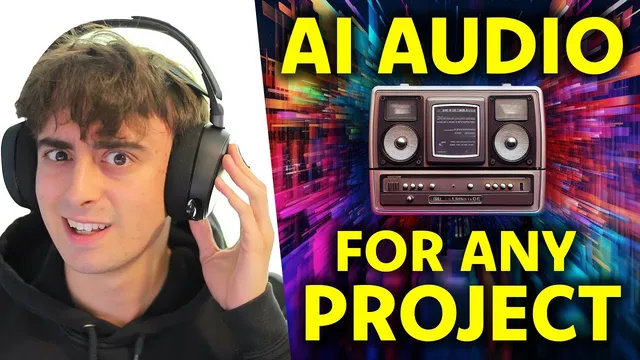
The BEST AI Music For Your Next Project! | Full Guide, Stable Audio, Suno AI, Jen-1
Based on MattVidPro's video on YouTube. If you like this content, support the original creators by watching, liking and subscribing to their content.
Stable Audio turns text prompts into downloadable music and sound effects using a web interface designed for quick, low-tuning workflows.
Briefing
Stable Audio, Stability AI’s new text-to-music and sound-effects generator, is positioned as a fast, “out-of-the-box” way to create usable tracks directly from descriptive prompts—without the prompt-tuning grind common to many AI music tools. The core pitch: type a mood, genre, and optional details like BPM and duration, then download the result. Early tests in the guide show consistent, high-quality output at 44.1 kHz, with short generations that fit common content workflows like YouTube Shorts, Instagram Reels, and ads.
The free tier is built for experimentation. It supports generating and downloading tracks up to 45 seconds (the guide notes 4 45 seconds as the free limit), and the interface stores previously created tracks in the user account. Downloads are available immediately after generation, and results can be rated so users can iterate on prompts. The guide emphasizes practical prompting: keep prompts simple, specify what you want (mood, style, BPM), and adjust by removing or swapping words rather than rewriting everything. Shorter durations generate faster, which makes it easier to produce multiple “snippet” variations for mood and style testing.
A key workflow example is using Stable Audio to prototype music for real projects. For musicians, the tool can generate small 15–20 second fragments to spark ideas and then build from those snippets in traditional music software. For YouTubers, it can generate background tracks—light-hearted, inspiring, or genre-specific—though the guide warns that overly specific pop-culture references (like “Mario Kart style”) can overshoot and feel too on-the-nose. The guide also tests sound effects, noting that while sound-effect generation works, the results may be less convincing than the music outputs.
Pricing and licensing are treated as the deciding factors for professional use. The free plan is limited to non-commercial testing, while the Pro subscription (listed as $12/month) expands track generation capacity (up to 500 track generations per month) and includes a commercial use license. A higher tier offers custom pricing and custom generation limits for organizations that need longer durations—while the guide expects future upgrades beyond the current 90-second ceiling.
The guide also places Stable Audio in a broader ecosystem of alternatives. MusicGen by Facebook (available via Hugging Face) is described as free and controllable, though generally less polished than Stable Audio. Another item—Gen 1—is framed as a near-future research release rumored to produce even higher-fidelity audio (the guide claims 48 kHz) with stereo output and potentially longer generations. Finally, Suno AI is presented as a different category: a Discord-based beta that can generate full songs with lyrics in addition to music, making it useful when the goal is complete, lyric-driven tracks rather than instrumental background music.
Overall, the guide’s takeaway is pragmatic: Stable Audio stands out for ease and quality for short-form and iterative creative workflows, while alternatives cover different tradeoffs—free access, open-source control, higher fidelity, or full-song generation with lyrics.
Cornell Notes
Stable Audio is Stability AI’s text-to-music (and sound-effects) tool that turns descriptive prompts into downloadable tracks through a simple web interface. In the guide’s tests, it produces clear, usable music at 44.1 kHz, with the free plan limited to short downloads (up to 45 seconds) and non-commercial use. Pro ($12/month) increases monthly generation capacity and adds a commercial license, making it more viable for YouTube and client work. Prompting works best when users keep requests straightforward—mood, genre, and optional BPM—then iterate by swapping or removing words. The guide also compares alternatives: Facebook’s MusicGen (free, open-source, lower polish), rumored Gen 1 (claimed higher fidelity and stereo), and Suno AI (Discord beta that generates full songs with lyrics).
What makes Stable Audio practical for day-to-day creative work, beyond just “it sounds good”?
How should prompts be handled to get more reliable results?
What are the main differences between Stable Audio and the alternatives mentioned?
How do licensing and plan limits affect who should use Stable Audio?
What did the guide suggest about using Stable Audio for sound effects versus music?
Review Questions
- What specific prompt elements (e.g., mood, BPM, duration) does the guide say help control Stable Audio outputs, and why does prompt simplicity matter?
- Compare the roles of Stable Audio, MusicGen, and Suno AI in terms of output type (instrumental vs. full songs with lyrics) and practical constraints (cost, access method, licensing).
- How do plan limits (free vs. Pro) change what kinds of projects a creator can ship commercially?
Key Points
- 1
Stable Audio turns text prompts into downloadable music and sound effects using a web interface designed for quick, low-tuning workflows.
- 2
The free plan supports short track downloads up to 45 seconds and is positioned for non-commercial testing.
- 3
Pro ($12/month) adds a commercial use license and increases monthly generation capacity to 500 track generations.
- 4
Prompt iteration works best when users keep requests straightforward (mood/genre/BPM) and adjust by removing or changing words between generations.
- 5
Stable Audio’s music output is described as consistently usable at 44.1 kHz, while sound effects may be less reliable than music.
- 6
MusicGen (Facebook) is a free, open-source alternative on Hugging Face that can produce usable tracks but generally with lower polish.
- 7
Suno AI differs by generating full songs with lyrics via a Discord beta, making it more suitable for lyric-driven compositions than background music.