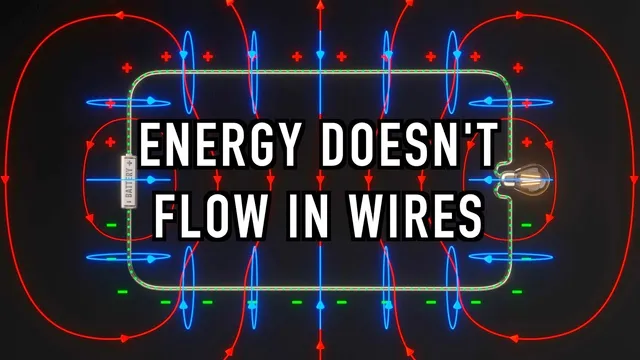
The Big Misconception About Electricity
Based on Veritasium's video on YouTube. If you like this content, support the original creators by watching, liking and subscribing to their content.
Energy in electrical circuits is carried by electromagnetic fields, not by electrons traveling from source to load.
Briefing
A common misconception about electricity says energy rides along with electrons through a continuous wire loop. The more accurate picture: electrical energy travels through the surrounding electric and magnetic fields, which propagate at nearly the speed of light—so a bulb can light up almost immediately even when the wires are “light-seconds” long.
The video starts with a thought experiment: a battery, switch, light bulb, and two extremely long wires (each about 300,000 kilometers) connect to form a circuit. After the switch closes, the question is how long until the bulb lights—half a second, one second, two seconds, 1/c seconds, or never. The intuitive answer many people reach for is “about a second,” because light would take about a second to traverse the wire length. The correct answer offered is roughly 1/c seconds, meaning the limiting factor is not the electrons crawling down the wire but the speed at which electromagnetic fields reach the bulb.
That claim is built by dismantling the usual “electron chain in flexible tubing” story used to describe AC power. In the grid, electrons mostly oscillate back and forth rather than traveling from the power plant to the home. Also, real circuits contain gaps and discontinuities—transformers, for example—so electrons cannot simply flow straight through the entire system. Even if electrons carried energy one way, the return flow would seem to imply energy should travel both directions, yet power delivery is effectively one-way.
The alternative framework comes from 19th-century physics. Maxwell’s work links light to oscillating electric and magnetic fields. Later, John Henry Poynting developed an energy-flux equation for electromagnetic fields: the Poynting vector, S, is proportional to the cross product of the electric field E and magnetic field B (S = (1/μ0) E × B). This vector points in the direction energy flows and is perpendicular to both E and B.
Using a battery-and-bulb circuit, the video explains how energy flux emerges even before electrons complete any long journey. A battery produces an electric field that extends through the circuit at light speed. When the circuit closes, charges redistribute on conductor surfaces, creating a small internal electric field that drives slow electron drift (about a tenth of a millimeter per second). Meanwhile, the moving current produces magnetic fields around the conductors. With electric and magnetic fields coexisting in space, the Poynting vector indicates energy flows outward from the battery through the surrounding region and then into the bulb from all directions around it.
For AC, the direction of current reverses every half-cycle, but the electric and magnetic fields flip together, so the Poynting vector still points from source to load at each instant. That’s why power plants can deliver energy through power lines: the electrons oscillate locally, while the electromagnetic field pattern carries energy onward.
The video reinforces the field-based view with the history of undersea telegraph cables. Early failures sparked a debate between a “signals move like water in a tube” model and a “fields carry energy and information” model. The field-based explanation ultimately prevailed, and cable design evolved to manage how electromagnetic fields propagate.
In the end, the bulb’s near-instant response comes from field propagation: electromagnetic waves around the wires reach a nearby load in nanoseconds, while the electrons themselves barely move. The practical takeaway is that everyday electricity—like flipping a light switch—works because energy rides on fields, not on a long, continuous electron trip.
Cornell Notes
Electric power delivery is often misunderstood as electrons transporting energy through wires. A field-based approach uses the Poynting vector, S = (1/μ0) E × B, to track electromagnetic energy flow. In a battery-and-bulb circuit, electrons drift slowly due to small internal electric fields, but the electric and magnetic fields around the conductors carry energy outward from the source and into the load. For AC, current reverses, yet both E and B reverse together, so the Poynting vector keeps pointing from the power source to the bulb. This explains why a bulb can light almost immediately—on the order of 1/c seconds—rather than waiting for electrons to traverse “light-second” wire lengths.
Why doesn’t the “electrons carry energy down the wire” story fully work for real circuits?
What does the Poynting vector tell you, and how is it defined?
In a simple battery-and-bulb circuit, where does energy flow according to the field picture?
How can AC deliver energy in one direction if electrons reverse direction every half-cycle?
Why did undersea telegraph cable failures matter for deciding between competing theories?
Review Questions
- In the Poynting vector formula S = (1/μ0) E × B, what determines the direction of energy flow?
- How does the field-based explanation reconcile slow electron drift with rapid power delivery to a nearby load?
- During AC operation, why does the energy flux direction remain the same even though current reverses?
Key Points
- 1
Energy in electrical circuits is carried by electromagnetic fields, not by electrons traveling from source to load.
- 2
The Poynting vector S = (1/μ0) E × B provides a direction and magnitude for electromagnetic energy flux.
- 3
Electron drift in conductors is typically very slow compared with the speed at which electric and magnetic field changes propagate.
- 4
In a closed circuit, the battery’s electric field and the current’s magnetic field coexist around the wires, enabling energy flow into the load via the fields.
- 5
For AC, simultaneous reversal of electric and magnetic fields keeps the Poynting vector pointing from source to load at each instant.
- 6
Real-world circuit elements like transformers break the idea of a single continuous electron path through the entire system.
- 7
Historical telegraph cable failures helped validate the field-propagation model over analogies that treated signals like fluid flow.