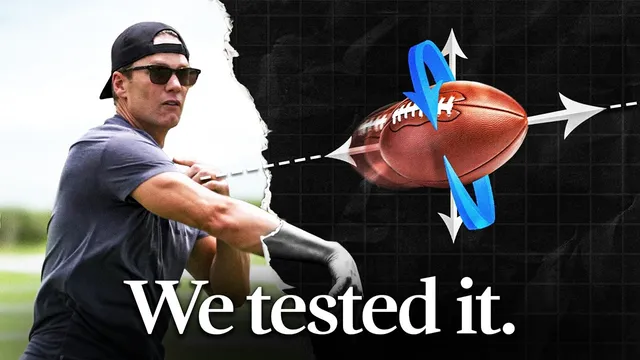
The Biggest Misconception in Football (ft. Tom Brady)
Based on Veritasium's video on YouTube. If you like this content, support the original creators by watching, liking and subscribing to their content.
Even elite spirals include measurable wobble and drift; those effects can be aerodynamic byproducts rather than errors.
Briefing
Tom Brady’s “perfect spiral” isn’t perfect—long passes show a small wobble and a consistent rightward drift—but those quirks are not flaws. They’re the aerodynamic byproduct of how a spinning football interacts with air and follows a curved (parabolic) flight path, a physics effect that helps the ball stay aligned with its direction of motion long enough to reduce drag and improve accuracy.
High-speed analysis and embedded sensors reveal that even Brady’s deep throws include a subtle wobble around the ball’s long axis and a slight lateral drift. The key point is that the wobble is tied to the physics of spinning: without spin, a football launched “cleanly” would be unstable. With no rotation, airflow over the ball is symmetric only in theory; any tiny disturbance—like a gust—creates uneven pressure, increases drag, and can push the ball into a tumble. The transcript quantifies the penalty: when the ball is pointed into the airflow, its drag coefficient is about 0.14, but when it’s on its side it rises to about 0.85, and the sideways orientation exposes roughly 70% more area to the wind. The result is drag up to ten times larger, plus unpredictable motion as the ball tumbles.
Spin fixes that by giving the ball angular momentum, which resists changes to its axis—an idea illustrated with spinning tops and historically with rifled firearms. In the mid-1800s, the Minie ball and rifling made bullets spin, improving stability and range. The same principle helps a quarterback: a tight spiral reduces the ball’s effective frontal area and drag coefficient, letting it fly farther and faster.
The “weird” part comes on long passes. If angular momentum simply locked the ball’s orientation, the nose should stay pitched up the whole way. Instead, the ball turns over during flight—shifting from a positive tilt after release to a negative tilt by the time it’s caught. That turnover is essential because it keeps the ball’s orientation closely aligned with the changing direction of motion along the arc, minimizing drag throughout the trajectory.
A 2020 theoretical model in the American Journal of Physics frames turnover as a gyroscopic procession problem combined with the fact that the ball’s flight path is a parabola. In a wind-tunnel setup, spinning the ball changes how it responds to forces: when airflow pushes on a tilted spinning ball, the gyroscopic effect causes the nose to trace a circle around the airflow direction, producing a slow wobble. As the airflow direction shifts along the parabolic path, the wobble doesn’t just persist—it gradually pitches the nose downward, creating the turnover that keeps the ball pointed into the relative wind.
That same rightward lean has a measurable side effect: right-handed throws tend to drift right, left-handed throws drift left. A drone view of Brady’s “straight” throws shows the drift at the end of the pass, attributed to lift generated by the ball’s tilt. The transcript also argues wobble happens even indoors because it’s driven by air resistance and the ball’s own motion, though outdoor wind amplifies the challenge. Completion-rate analysis from the NFL data team finds indoor domes are consistently more accurate than outdoor stadiums.
Brady’s own perspective ties the physics to practice: he describes training across varied weather and conditions for decades, treating it like tuning an F1 car—adjusting clothing, preparation, and comfort to match humidity, temperature, and wind. The takeaway is that what looks like imperfection is often the mechanism that makes the throw work: wobble is unavoidable, and when managed correctly, it’s part of how a football stays stable, turns over at the right time, and reaches the target.
Cornell Notes
Even Tom Brady’s deep passes show a small wobble and slight lateral drift, but those effects are tied to physics that improves performance. A football launched without spin is aerodynamically unstable: tiny disturbances increase drag dramatically (drag coefficient rising from ~0.14 nose-on to ~0.85 sideways) and can cause tumbling. Spin adds angular momentum, helping the ball resist axis changes and maintain a more efficient orientation through flight. The turnover on long throws comes from gyroscopic procession plus the fact that the ball follows a parabolic path, so the airflow direction keeps changing; the wobble becomes essential to keeping the nose aligned with the relative wind. The tilt also generates lift, explaining why right-handed throws drift right and left-handed throws drift left.
Why does a football without spin tend to go off course or tumble?
How does spin improve a passing throw beyond just “stability”?
What explains the “turnover” on long Hail Mary passes if angular momentum resists axis changes?
Why do right-handed throws drift right (and left-handed throws drift left)?
Does wobble only happen in outdoor wind, or does it occur indoors too?
How did the wind-tunnel and sensor work connect to Brady’s real throws?
Review Questions
- What aerodynamic instability arises when a football is launched without spin, and how do drag coefficient and exposed area change in that case?
- How do gyroscopic procession and a parabolic flight path combine to produce turnover during a long pass?
- What role does lift play in explaining lateral drift for right-handed versus left-handed throws?
Key Points
- 1
Even elite spirals include measurable wobble and drift; those effects can be aerodynamic byproducts rather than errors.
- 2
A non-spinning football is unstable: small disturbances increase drag and can trigger tumbling, with drag rising from ~0.14 nose-on to ~0.85 sideways.
- 3
Spin adds angular momentum, helping the ball resist axis changes and maintain a more efficient orientation through flight.
- 4
Turnover on long throws is explained by gyroscopic procession plus the changing airflow direction along a parabolic trajectory; wobble becomes essential to staying aligned with the relative wind.
- 5
The ball’s tilt generates lift, which helps explain why right-handed throws drift right and left-handed throws drift left.
- 6
Wobble happens indoors too, but outdoor wind significantly worsens accuracy; indoor domes show higher completion accuracy across distances.
- 7
Brady’s performance is framed as practical mastery of variable conditions through extensive, weather-specific preparation.