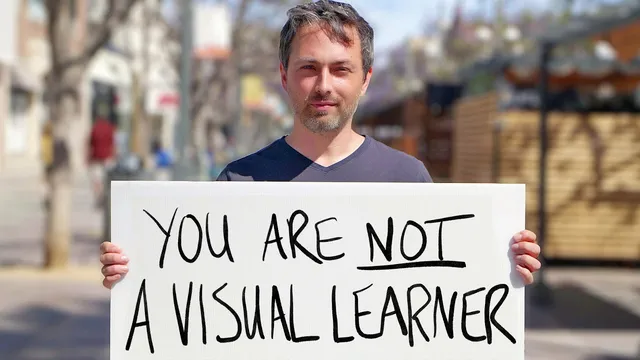
The Biggest Myth In Education
Based on Veritasium's video on YouTube. If you like this content, support the original creators by watching, liking and subscribing to their content.
Learning-styles frameworks like VARK are widely believed, but controlled experiments find no learning advantage from matching instruction to a learner’s stated preference.
Briefing
Education’s most persistent “learning styles” promise—that students learn best when instruction matches their preferred category—doesn’t hold up under controlled testing, and the mismatch is often irrelevant to performance. The widely used VARK framework (Visual, Auditory, Reading-Writing, Kinesthetic) feels intuitive because people genuinely differ in strengths: some process images quickly, others understand spoken explanations, and many learn best through hands-on practice. But the key claim—that these preferences stay stable and predict who benefits from which teaching format—fails to produce measurable learning gains.
Support for the idea is easy to find in classrooms and in surveys. A study of nearly 400 teachers across the UK and the Netherlands found that more than 90% believed students learn better when material is delivered in their preferred learning style. In practice, students often report strong self-identification: visual learners say they need to see diagrams or watch demonstrations; auditory learners say lectures work; reading-writing learners rely on textbooks; kinesthetic learners want to touch, manipulate, and “do it yourself.” Yet self-reports don’t prove that tailoring instruction by category improves outcomes.
A street-style memory exercise illustrates why the “match your style” story can be misleading. When participants were shown pictures either in a way that aligned with their stated preference or in a mismatched format, recall differences didn’t track the match. Instead, people used memory strategies—like ordering items into a list or turning objects into a story—suggesting performance depended on tactics rather than modality preference.
More rigorous evidence points in the same direction. In one computer-based study, students were classified as “visualizers” or “verbalizers” using questions about whether they preferred reading text or seeing diagrams. Researchers then randomly assigned participants to lessons delivered in either text-based or picture-based formats. Afterward, test scores showed no advantage for students whose instruction matched their preference. The result held again when the experiment was repeated with 61 non-college-educated adults.
Even when learning styles are treated as stable preferences, they don’t reliably govern study behavior. A 2018 study at a university in Indiana had over 400 students complete the VARK questionnaire early in the semester, then later report their actual study strategies. Most students used methods that were supposedly incompatible with their assigned style, and those who did match showed no significant performance difference.
The deeper problem is conceptual: learning styles theories assume that people’s preferences for sensory input should consistently predict learning across subjects. But many tasks require specific modalities—music demands hearing, geography often relies on maps—and aptitude varies by domain. Review articles have repeatedly concluded there’s no credible evidence that learning styles exist in a way that improves instruction.
What does help is evidence-based teaching that uses multiple modes together and drives active thinking. Research on the multimedia effect finds that presenting words alongside relevant visuals improves learning more than using either alone. Effective instruction also emphasizes what learners do internally—solving problems, reasoning through misconceptions, and integrating meaning—rather than optimizing for a presumed label. The practical takeaway is blunt: students aren’t locked into one learning channel. The best learning experiences blend approaches and keep learners actively engaged.
Cornell Notes
Learning styles—especially the VARK categories (Visual, Auditory, Reading-Writing, Kinesthetic)—are popular in education, but controlled studies find no performance advantage when instruction matches a learner’s stated preference. Teachers and students often find the idea intuitive, and people can report that certain formats “click” for them, yet preference-based tailoring doesn’t reliably improve test results. Experiments that randomly assign learners to matching vs. mismatching formats show equal outcomes, and studies tracking real study habits find most students use strategies outside their assigned style without worse performance. Evidence-based alternatives point toward multimodal instruction (words plus visuals) and active learning as more reliable drivers of understanding.
Why does the learning-styles idea feel convincing to many students and teachers?
What does the “matching vs. mismatching” memory exercise suggest about learning styles?
What do randomized studies find when learners are assigned to matching or mismatching instruction?
How do real study behaviors challenge the idea that learning styles govern learning?
If learning styles don’t improve learning, what instructional approach has stronger evidence?
Why might sensory preferences fail to predict learning across subjects?
Review Questions
- What evidence suggests that matching instruction to VARK preferences does not improve test performance?
- How do memory strategies in the picture recall exercise undermine the learning-styles explanation?
- What is the multimedia effect, and how does it differ from learning-styles tailoring?
Key Points
- 1
Learning-styles frameworks like VARK are widely believed, but controlled experiments find no learning advantage from matching instruction to a learner’s stated preference.
- 2
Self-identification (e.g., “I’m visual” or “I’m hands-on”) can reflect comfort or prior experience rather than a reliable predictor of learning gains.
- 3
Randomized matching vs. mismatching studies (including visualizer/verbalizer designs) show equal outcomes, weakening the core learning-styles hypothesis.
- 4
Most students do not consistently study in ways that align with their assigned VARK category, and matching those preferences doesn’t produce measurable performance benefits.
- 5
Learning styles claims struggle conceptually because some subjects inherently require particular modalities and because aptitude varies by domain.
- 6
Evidence-based instruction emphasizes multimodal teaching (words plus visuals) and active cognitive engagement, not preference-based labeling.
- 7
Treating learning styles as a fixed identity can waste time and resources that could go toward interventions with stronger support.