The Bizarre Behavior of Rotating Bodies
Based on Veritasium's video on YouTube. If you like this content, support the original creators by watching, liking and subscribing to their content.
The Dzhanibekov effect arises from unstable rotation about an asymmetric body’s intermediate principal axis, not from external torques.
Briefing
A spinning object can suddenly “flip” 180 degrees and then keep doing it back and forth—even when no external forces or torques act—because rotation about the object’s intermediate principal axis is dynamically unstable. That counterintuitive behavior, known through the Dzhanibekov effect (and also as the tennis racket theorem or intermediate axis theorem), looks like magic in microgravity but follows from how an asymmetric rigid body stores rotational energy across three different axes.
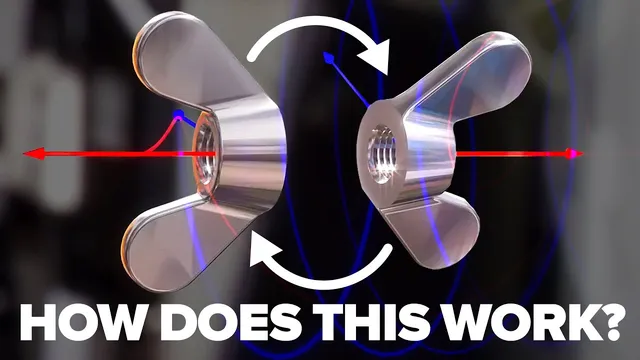
The phenomenon became famous after Soviet cosmonaut Vladimir Dzhanibekov, during a 1985 mission to rescue the disabled space station Salyut 7, observed a wing-nut that was initially spinning in a fixed orientation. As the wing-nut’s spin settled, it maintained its pointing direction briefly, then flipped 180 degrees, then flipped back a few seconds later, repeating at regular intervals. The key detail: nothing was pushing or twisting the nut during the flips. The motion came purely from the object’s own rotational dynamics.
Classical mechanics explains the effect using the idea of principal axes and moments of inertia. A tennis racket (an asymmetric top) has three principal axes with three different moments of inertia: spinning about one axis (through the handle) is easiest because it has the smallest moment of inertia, while spinning about the axis perpendicular to the racket’s face is hardest because it has the largest moment of inertia. Rotations about the smallest- and largest-inertia axes are stable. But rotation about the intermediate axis—where the moment of inertia sits between the other two—does not stay put. Instead, the body’s orientation wanders until it effectively swaps which side is “leading,” producing the characteristic half-turn.
The explanation gains intuition from a model attributed to mathematician Terry Tao: imagine a thin disc with heavy masses on opposite edges along one axis and lighter masses along a perpendicular axis. In the frame rotating with the disc, centrifugal effects appear. If the disc is perfectly aligned with the intermediate-axis rotation, the forces balance in a way that keeps the configuration steady. But a small bump breaks that alignment: the lighter masses then experience centrifugal forces that grow as they move farther from the intermediate axis. Those forces accelerate them toward one side, then later decelerate them as they approach the opposite side—setting up a repeating flip-flop cycle.
Although the behavior is rooted in old physics—its understanding traces back at least to Louis Poinsot—spaceflight makes it look more dramatic. That’s why microgravity clips spread online and why the Soviet secrecy lasted about a decade after Dzhanibekov’s observation. The transcript also connects the effect to speculation about Earth flipping, including a 2012 RusCosmos birthday note that floated the idea that Earth’s orbital motion could overturn the planet. The counterargument comes from energy dissipation: angular momentum can remain constant while rotational kinetic energy is converted into heat, pushing bodies toward the lowest-energy rotation state. Experiments on the International Space Station (including Don Pettit’s demonstrations with books and cylinders) and satellite history (Explorer 1’s antenna-driven instability) support the same principle. Earth, like many astronomical bodies, is expected to settle into rotation about the axis with the maximum moment of inertia, making a global flip extraordinarily unlikely.
Cornell Notes
The Dzhanibekov effect (tennis racket theorem) describes how an asymmetric spinning object can repeatedly flip 180 degrees with no external torque. The flips happen because rotation about the intermediate principal axis is unstable: small deviations grow, then reverse, producing a regular back-and-forth motion. An intuitive model (from Terry Tao) treats an asymmetric body as a disc with heavy and light masses; in the rotating frame, centrifugal effects on the light masses drive the system toward one side, then slow and reverse it toward the other. In space, microgravity makes the instability easier to see, but the underlying mechanism is classical rigid-body dynamics. Energy dissipation over time also helps explain why Earth is not expected to flip: bodies tend to settle into the lowest rotational kinetic energy state, which corresponds to the maximum moment of inertia axis.
Why does an object flip even when no forces or torques act on it?
What role do the three principal axes and their moments of inertia play?
How does Terry Tao’s “disc with heavy and light masses” model create the flip-flop cycle?
Why do microgravity videos look more dramatic than a tennis racket flip on Earth?
Why isn’t Earth expected to flip over like the wing-nut?
What experimental evidence supports the “maximum moment of inertia” end state?
Review Questions
- How does the stability of rotation differ among the smallest, intermediate, and largest principal moments of inertia?
- In Tao’s disc model, what changes when the disc is “bumped,” and how does that lead to a 180-degree flip?
- What physical mechanism allows a rotating body to change its rotational state over time even if angular momentum remains constant?
Key Points
- 1
The Dzhanibekov effect arises from unstable rotation about an asymmetric body’s intermediate principal axis, not from external torques.
- 2
Moments of inertia determine stability: rotations about the smallest and largest principal axes are stable, while the intermediate axis is unstable.
- 3
A small perturbation can grow because centrifugal effects in the rotating frame accelerate parts of the body away from the intermediate-axis alignment, then reverse as the body approaches the opposite side.
- 4
Microgravity makes the intermediate-axis instability easier to observe because external disturbances are reduced and the free motion persists.
- 5
Energy dissipation can convert rotational kinetic energy into heat, driving objects toward the lowest-energy rotation state for a fixed angular momentum—typically the maximum-moment-of-inertia axis.
- 6
Earth is unlikely to “flip” because it should already have relaxed into stable rotation about the maximum moment of inertia axis, given internal dissipation mechanisms.