The Bizarre Physics of Electric Guitars
Based on minutephysics's video on YouTube. If you like this content, support the original creators by watching, liking and subscribing to their content.
The magnetic pick does not make guitar strings vibrate; it induces signals by interacting with the guitar’s pickups.
Briefing
A magnetic “electric guitar pick” marketed as letting players sound notes without touching the strings turns out to work through pickup interference—not string actuation. Hands-on tests find that the pick never makes the guitar strings vibrate on its own; instead, it modulates the signal coming from the guitar’s pickups, which can create many of the same audible effects shown in promotional material.
In store trials and controlled demonstrations show the core mismatch between claim and mechanism. When the pick is held near the pickups, it can generate audible changes, but the effect is tied to the pickup’s magnetism: moving magnetic fields near the pickup’s coil induce electrical currents. That means the pick can “shape” what the pickup outputs, yet the strings remain the source of true string vibration. The clearest check comes from separating actions: one hand plays the strings while the other positions the magnetic pick near the pickup. Even when the pick is placed to look like it’s doing the work, the sound tracks the string vibrations; the pick mainly alters the pickup’s output, effectively turning the string sound quieter or otherwise changing its character rather than creating a note from a silent string.
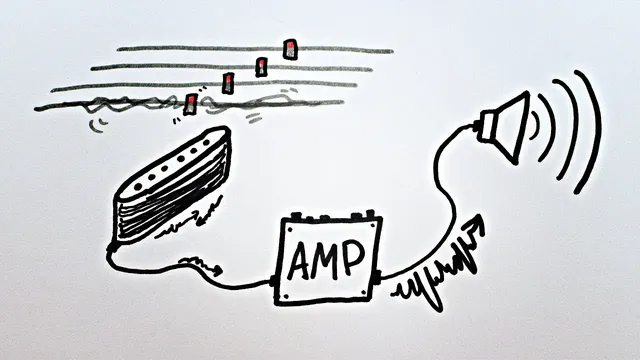
To ground the physics, the explanation of electric guitar pickups is central. Pickups contain a coil of wire and rely on electromagnetic induction: a changing magnetic field near the coil drives current. Electric guitar strings are typically made from magnetizable metals like iron or nickel, so they can be magnetized by magnets inside the pickup. As the strings vibrate, they act like moving magnets, producing the tiny currents that the amplifier boosts into audible sound. Crucially, any moving magnet near the pickup can also induce currents, which is why a “magnetic pick” can generate signals without contacting the strings.
The transcript also tests whether the pick’s effects depend on amplifiers or pedals. Recording the guitar’s raw output and then routing it through effects produces the same picking sound, indicating the pick’s influence is not some special interaction with the amp chain. Further, combining signals after the fact—using a normal pick to generate string vibration while using the magnetic pick only to create a pickup-modulated signal—still reproduces the strumming-like effects. That supports the conclusion that the magnetic pick’s role is post-processing the pickup signal, not remote strumming.
Final verdict: the pick isn’t a scam in the narrow sense that it can reproduce the sounds in the promo. But it’s badly explained. The advertised “play without touching the strings” implication fails because the strings don’t move; the pick instead creates loud low-frequency pulses and other induced signals that, through carefully crafted signal processing, yield the musical effects. The price may be defended by the integrated magnet-and-pick form factor and by the development of playing techniques and effects that make the system musically usable, even if the underlying physics is simpler than the marketing suggests. The result is a product that can expand creative options—while also being easy to misunderstand.
Cornell Notes
The magnetic guitar pick marketed for “playing without touching the strings” does not actually set the strings vibrating. Tests show it works by interacting with the guitar’s pickups: a magnet near the pickup’s coil induces electrical currents via changing magnetic fields. Those induced signals can be processed to reproduce many of the sounds shown in promotional clips, but the audible output ultimately depends on pickup modulation and post-processing rather than remote string actuation. Controlled comparisons—playing strings normally, recording raw output, and combining signals after the fact—produce the same effects, reinforcing that the pick is essentially a strong magnet used to manipulate the pickup signal. The takeaway is that the physics is straightforward, while the marketing implication and human interpretation are what create the controversy.
What physical mechanism lets a magnet-shaped pick produce sound even when it doesn’t move the strings?
How do tests distinguish between “the pick makes the strings move” and “the pick modulates the pickup signal”?
Why does the pick’s effect persist through pedals and amps, and what does the recording test show?
What does the “non-magnetic pick + magnetic pick combined after the fact” experiment demonstrate?
Why do critics call it a hoax or fraud, and why does the transcript argue it’s not a scam in a narrow sense?
What practical drawback is mentioned for using the magnetic pick on real strings?
Review Questions
- What role do the guitar strings play in generating the pickup signal, and how does that differ from the role of an external magnet near the pickup?
- Describe two experimental checks mentioned that undermine the claim that the magnetic pick moves the strings.
- How can a device that doesn’t vibrate strings still reproduce the sounds shown in promotional material?
Key Points
- 1
The magnetic pick does not make guitar strings vibrate; it induces signals by interacting with the guitar’s pickups.
- 2
Electric guitar pickups rely on electromagnetic induction: changing magnetic fields near a coil create electrical currents.
- 3
Because any magnet near the pickup can induce current, a magnet-shaped pick can modulate the pickup output without touching the strings.
- 4
Controlled demonstrations separate string vibration from pickup modulation, showing the pick mainly changes the pickup signal rather than replacing string motion.
- 5
Recording and post-processing tests indicate the effects can be recreated after the fact, not requiring special amp or pedal interactions.
- 6
The pick can reproduce promo-like sounds through induced low-frequency pulses and signal processing, but the “play without touching strings” claim is misleading.
- 7
The product’s value proposition may come from integrated design and the developed playing/post-processing techniques, even if the physics is simpler than marketed.