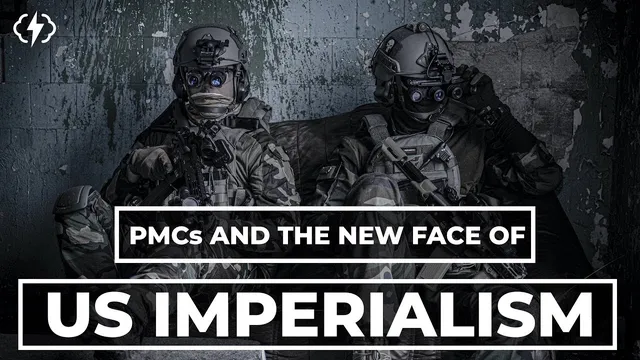
The Blackwater Pardons, PMCs, And US Imperialism
Based on Second Thought's video on YouTube. If you like this content, support the original creators by watching, liking and subscribing to their content.
Private military companies (PMCs) provide armed security or combat services for profit, often under U.S. government direction.
Briefing
The presidential pardons granted to four Blackwater contractors after the 2007 Baghdad massacre put private military companies at the center of a broader pattern: outsourcing lethal violence to armed groups that are easier to shield from accountability. The core flashpoint was the September 16, 2007 attack in Baghdad, when contractors operating under the call sign “Raven 23” opened fire in a busy traffic circle, killing 14 Iraqis—including two children aged 9 and 11—and wounding at least 20 others. Court findings and later evidence described the shooting as unprovoked, with victims and local security forces unable to respond, while the contractors continued firing even as people tried to flee.
After years of litigation, four men were prosecuted in 2014—Nick Slatten (the sniper) sentenced to life, and Dustin Hurd, Evan Liberty, and Paul Slough receiving 30-year sentences that were later reduced to roughly 12 to 15 years. On December 22, 2020, President Donald Trump issued full pardons for all four, citing “a long history of service to the nation.” Iraqi officials and many families of victims reacted with outrage, arguing the pardons ignored the dignity and rights of those killed and reopened wounds for survivors who had long viewed the incident as proof that American forces did not value Iraqi lives.
The controversy also highlighted how private military companies (PMCs) operate differently from regular armed forces—often in ways that make prosecution and oversight harder. PMCs are private firms that provide armed combat or security services for profit, with contractors hired to protect officials, secure corporate interests in hostile regions, and carry out covert missions at the direction of the U.S. government. The transcript frames this as a structural advantage for U.S. power: contractors can be deployed in war zones while maintaining “plausible deniability,” and if a group becomes legally or politically toxic, it can be shut down and reconstituted under a new name and paperwork.
Blackwater—now known as Academi—was founded in 1997 by former Navy SEAL Eric Prince. After the Iraq invasion, it became a major contractor, receiving billions in U.S. government contracts across the state department, the military, and the CIA, with work ranging from guarding dignitaries to securing oil fields. The transcript links the company’s impunity to a wider shift in warfare: as large-scale troop deployments give way to remote strikes and “hands-off” enforcement, the number of private contractors has surged. It claims the contractor-to-military ratio has flipped dramatically since the 1990s, with armed contractors now outnumbering active-duty personnel in overseas violence.
The broader argument ties the pardons to U.S. imperialism and the media ecosystem that sustains it. The transcript contends that U.S. news coverage often manufactures consent for recurring low-level wars, and that criticism of Trump’s pardons can coexist with downplaying the media’s own role in enabling the conditions under which atrocities occur. Ultimately, the pardons are presented as a signal to other PMCs that even mass violence can be absorbed by politics rather than punished by law—setting expectations for continued expansion of paramilitary activity in occupied regions.
Cornell Notes
Private military companies (PMCs) let the U.S. pursue armed objectives abroad while reducing accountability compared with regular military forces. The clearest case in the transcript is the 2007 Baghdad massacre by Blackwater contractors (later Academi), where 14 Iraqis were killed—including two children—and at least 20 were wounded after contractors opened fire in a traffic circle. After years of prosecution, four contractors were sentenced in 2014, but President Donald Trump pardoned all four in December 2020, triggering sharp condemnation from Iraqi officials and victims’ families. The transcript argues the pardons fit a larger pattern: outsourcing violence to profit-driven contractors increases plausible deniability, complicates oversight, and helps imperial goals proceed with less political cost.
What happened in the 2007 Baghdad incident involving Blackwater contractors, and what did later findings say about provocation?
How did the legal timeline unfold for the four Blackwater contractors before the pardons?
Why does the transcript argue PMCs are harder to prosecute and oversee than regular militaries?
What role does Blackwater/Academi play in the PMC ecosystem described here?
How does the transcript connect PMCs to changes in how wars are fought and to U.S. imperial strategy?
What message do the pardons send, according to the transcript’s interpretation?
Review Questions
- What factual details about the Baghdad massacre are used to support claims of unprovoked violence and civilian targeting?
- How does the transcript explain the shift from military personnel to private contractors, and why that matters for accountability?
- In what ways does rebranding or corporate restructuring function as a mechanism for avoiding legal consequences, according to the transcript?
Key Points
- 1
Private military companies (PMCs) provide armed security or combat services for profit, often under U.S. government direction.
- 2
The 2007 Baghdad massacre attributed to Blackwater contractors resulted in 14 civilian deaths (including two children) and at least 20 injuries, with later findings described as rejecting claims of provocation.
- 3
Nick Slatten received a life sentence, while Dustin Hurd, Evan Liberty, and Paul Slough received 30-year sentences later reduced to about 12–15 years, before all four were fully pardoned on December 22, 2020.
- 4
The transcript argues PMCs are structurally difficult to prosecute due to secrecy, cross-border operations, and limited oversight.
- 5
A key claim is that PMCs can be shut down and reconstituted under new names, creating plausible deniability and complicating accountability.
- 6
The pardons are portrayed as a political signal that PMCs may face impunity, encouraging further paramilitary activity in occupied regions.
- 7
The transcript links PMC impunity to a wider media-and-consent ecosystem that sustains recurring low-level wars and high military spending.