The Blender Question Everyone Gets Wrong
Based on Veritasium's video on YouTube. If you like this content, support the original creators by watching, liking and subscribing to their content.
The blender question is fundamentally a scaling problem: escape depends on how forces, motion, and constraints change when size shrinks dramatically.
Briefing
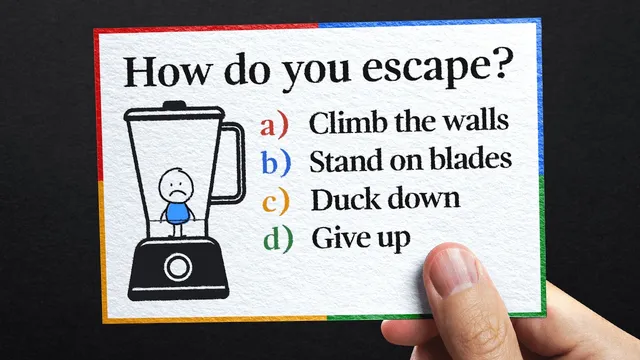
A famous Google interview brainteaser—shrunk to nickel size and trapped in a blender—has become a physics stress test for intuition. The “obvious” answer (“duck and miss the blades,” “break the bottom,” or “hide under the blades”) runs into a basic scaling problem: at that size, the blender’s wall is effectively enormous, and escape requires forces and timing that seem wildly unrealistic. That’s why the question keeps resurfacing online with competing “best” solutions.
The most popular proposed fix is to jump out. On the surface, it sounds impossible: a nickel-sized person would need to clear a wall roughly 15 times their height, like leaping over an eight-story building. But biomechanics research points to a counterintuitive scaling law in animal jumping. Smaller animals can jump relatively higher because strength doesn’t shrink as fast as weight. Muscle force depends on cross-sectional area (scaling with the square of linear size), while body weight scales with volume (scaling with the cube). As animals get smaller, strength-to-weight ratio rises, letting them achieve comparable jump heights across large size differences—an observation traced to biomechanics work by Alfonso Borrelli.
To test whether that logic survives contact with real-world constraints, a simulation scales a human down to nickel size and asks whether a jump can clear the blender. Using a model of a 2-centimeter-tall jumper who must reach about 30 centimeters to escape, the simplified physics suggests a jump height around 42 centimeters—enough to get out. But adding air resistance changes the outcome. At nickel scale, drag becomes more consequential because the jumper’s cross-sectional area is large relative to weight. With drag included, the jump height drops to roughly 39 centimeters.
The bigger problem comes from imperfect execution. If the tiny person flips onto a side mid-jump, the exposed surface area increases sharply, boosting drag and cutting the jump height dramatically—down to about 22 centimeters in the simulation. That turns “jump out” from a clean solution into a fragile one: a correct jump might work, but small mistakes could mean getting chopped. The takeaway is less “jumping is impossible” and more “the margin for error at that scale is brutal,” especially if someone tries showy maneuvers like backflips.
The debate then widens beyond mechanics into biology and physiology. Hearts, lungs, and neural control systems don’t scale freely; shrinking a human to nickel size would likely break the assumptions behind both jumping and even basic survival. Meanwhile, Google’s original purpose for brainteasers wasn’t to find the physically correct answer. Hiring leaders later argued that such puzzles are a poor predictor of job performance and mainly make interviewers feel clever. Still, the blender question persists because it forces people to reframe a familiar problem through scaling—exactly the kind of “ridiculous” thought experiment that has historically sparked real science, from Einstein’s thought experiments to graph theory and quantum mechanics illustrations.
Cornell Notes
The nickel-in-a-blender brainteaser became a scaling problem: can a shrunken human escape before the blades spin? The “jump out” idea looks impossible because the blender wall is about 15 times the person’s height, but biomechanics shows smaller animals can jump relatively higher because strength scales with muscle cross-sectional area (square) while weight scales with volume (cube). A scaled simulation suggests a nickel-sized jumper might clear the blender in ideal conditions (about 42 cm), but adding air resistance reduces the jump (around 39 cm). The escape fails under realistic mistakes—flipping onto a side increases drag and can drop the jump height to roughly 22 cm. The broader lesson is that scaling changes everything, and brainteasers often test reasoning more than correctness.
Why does “jumping out” become plausible at tiny scales even though the blender wall is much taller than the person?
What does the scaled simulation predict for a nickel-sized jump when air resistance is ignored?
How does including air resistance change the outcome?
Why does the simulation become pessimistic if the jumper flips onto a side mid-jump?
What broader critique challenges the idea that physics-only scaling settles the question?
Why did Google use brainteasers like this in the first place, and why did that practice get criticized?
Review Questions
- In the jumping argument, which scaling relationship (square vs cube) makes smaller animals relatively stronger, and how does that connect to escape height?
- What specific change in the simulation turns a successful jump into a failed one, and what does that imply about real-world execution?
- How do the critiques from physiology (heart, lungs, neurons) complicate a purely mechanical “jump out” solution?
Key Points
- 1
The blender question is fundamentally a scaling problem: escape depends on how forces, motion, and constraints change when size shrinks dramatically.
- 2
Muscle strength-to-weight improves at smaller sizes because strength scales with cross-sectional area (square) while weight scales with volume (cube).
- 3
A simplified nickel-scale jump can clear the blender in idealized conditions, but adding air resistance reduces the margin.
- 4
Realistic mistakes—especially flipping onto a side—can increase drag enough to drop jump height well below what’s needed.
- 5
The debate isn’t only physics; shrinking a human also strains biological systems like circulation, breathing, and neural control.
- 6
Google’s later hiring critique suggests brainteasers are poor predictors of job performance, even if they’re great for stimulating reasoning.
- 7
The enduring value of the question is forcing people to re-check intuition through quantitative scaling and thought experiments.