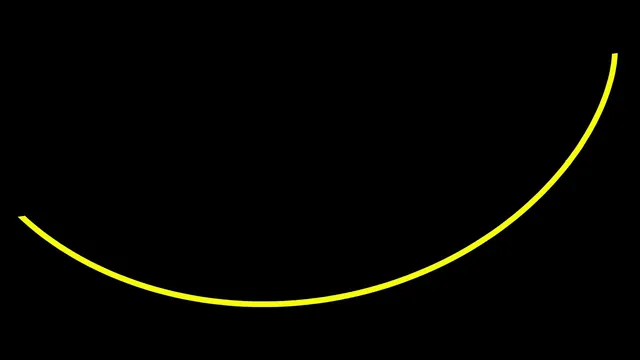
The Brachistochrone
Based on Vsauce's video on YouTube. If you like this content, support the original creators by watching, liking and subscribing to their content.
The brachistochrone curve minimizes travel time under gravity, even when it is longer than the straight-line path.
Briefing
The brachistochrone curve—often described as the “toddoc(h)rone” path—turns out to be the fastest route under gravity when the goal is to minimize travel time between two points at different heights. The key insight is that the optimal path doesn’t merely shorten distance; it balances two competing effects: gravity accelerates motion more quickly on steeper segments, but a longer route can still win if it gets up to speed early enough. In the classic setup, a straight line is shortest in distance yet loses in time because it spends too long moving slowly near the start.
The episode links that time-optimal path to a broader principle known from optics: Snell’s law. When light moves between materials with different speeds, it refracts along the route that minimizes travel time. Bernoulli’s move was to treat a falling object as an “analog” of light that continually changes speed as it accelerates. Instead of one abrupt change in speed, the falling body’s speed increases continuously, so Bernoulli’s construction uses many increasingly thin layers—each with a slightly different effective speed—so the light-like “fastest-time” rule can be applied. The resulting brachistochrone curve matches a cycloid: the path traced by a point on a circle rolling along a straight line.
That cycloid connection matters because it provides both a geometric recipe and a physical explanation for why the curve is optimal. A cycloid satisfies the same time-minimizing condition (Snell’s law) everywhere along the trajectory, meaning it achieves the right tradeoff between early acceleration and overall path length. The episode also emphasizes that the cycloid isn’t just fast for one starting point: it has a striking timing property. When released from different positions along the same cycloid arc, objects reach the bottom in the same amount of time—an effect that holds in idealized math and can be tested in the real world.
To make the math tangible, Vsauce and Adam Savage build a cycloid track and compare it against alternatives, including a straight-line track and an “extreme” curve. They cut and sand a cycloid pattern, transfer it to clear acrylic, and assemble channels and rollers so objects can roll with minimal slipping. In side-by-side trials, the cycloid consistently beats the other paths in reaching the finish line, with the straight line proving slowest despite being the shortest distance.
They then test the cycloid’s equal-time behavior by releasing objects from multiple starting points along the same curve. Despite real-world friction and minor imperfections, the releases land with near-simultaneous timing, reinforcing the central claim: the brachistochrone curve is not only the fastest path between two heights, but also a geometry-driven mechanism for equal travel times from different starting locations. The result turns a historically abstract calculus problem into something physically observable—complete with a track that behaves like a “geometry machine” for time optimization.
Cornell Notes
The brachistochrone problem asks for the quickest path between two points when motion is driven only by gravity. The fastest route is not the shortest distance (a straight line), but a cycloid: the curve traced by a point on a circle rolling along a line. Bernoulli connected the solution to Snell’s law from optics by modeling a continuously accelerating fall as light moving through many thin layers with increasing speed. A cycloid also has a remarkable property: objects released from different points along the same cycloid arc reach the bottom in the same time (in ideal conditions). The episode demonstrates this by building a cycloid track and comparing it to straight and extreme curves, with the cycloid winning in time and showing near-equal arrival timing in real trials.
Why does the straight line lose even though it’s the shortest distance?
How does Snell’s law from optics connect to falling objects?
What curve solves the brachistochrone problem, and why is it special?
What is the cycloid’s equal-time property?
How do the physical track tests validate the theory?
Review Questions
- In the brachistochrone setup, what two competing factors determine the optimal path, and how does a cycloid balance them?
- Explain the analogy between Snell’s law and Bernoulli’s solution in terms of changing speed and time minimization.
- What does the equal-time property say about release points on a cycloid, and how would friction affect real experiments?
Key Points
- 1
The brachistochrone curve minimizes travel time under gravity, even when it is longer than the straight-line path.
- 2
A straight line is shortest in distance but not optimal in time because it doesn’t maximize early acceleration.
- 3
Bernoulli’s approach uses an optics analogy: Snell’s law for light becomes a time-minimization rule for a continuously accelerating fall.
- 4
The brachistochrone solution is a cycloid, the roulette traced by a point on a circle rolling along a line.
- 5
A cycloid satisfies the time-minimizing condition along the entire path, not just at the endpoints.
- 6
Objects released from different points along the same cycloid arc reach the bottom in the same time in ideal conditions.
- 7
Real-world tests with a built cycloid track show the cycloid’s time advantage and near equal arrival timing despite friction and construction tolerances.