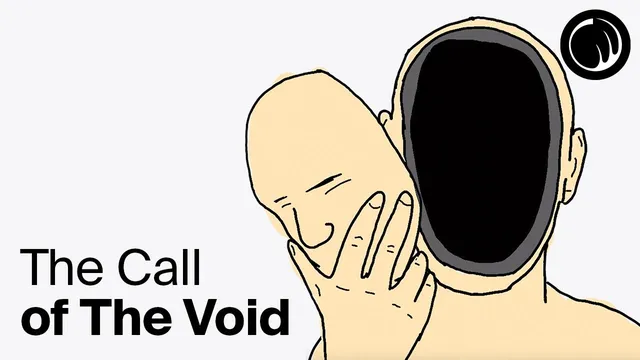
The Call of the Void - Where Do Horrible Thoughts Come From?
Based on Pursuit of Wonder's video on YouTube. If you like this content, support the original creators by watching, liking and subscribing to their content.
“Call of the Void” refers to intrusive, unwanted urges toward extreme actions in safe situations, often experienced as sudden and visceral.
Briefing
“Call of the Void” describes a common, unsettling mental experience: in safe situations—often while standing high with little or no protection—people suddenly feel an intrusive urge to do something extreme, like jumping off a ledge or driving into oncoming traffic, even while they have no desire to die or harm anyone. The core finding is that these thoughts are widespread and typically unwanted, yet they can feel vivid and bodily real, creating a brief but powerful sense that one isn’t as in control of the mind as assumed.
A particularly studied version is the “high place phenomenon.” In this scenario, a person near an edge experiences anxiety not about the physical instability of the ledge, but about the possibility that the brain might “convince” the body to jump without consent. A 2011 study at Florida State University led by psychologist Dr Jennifer L. Haymes found that about one-third of 431 participants reported having experienced it. Other research cited in the discussion suggests that more than half of people have encountered at least aspects of the phenomenon.
Explanations fall into competing camps. One view treats the experience as a misread survival response. When confronted with the danger of falling, the mind triggers protective reactions—imagining the worst case, scanning for risk, and moving away from the edge. The conscious mind then misinterprets those avoidance-related mental images and impulses as an actual desire to jump, turning a safety mechanism into a frightening “urge.”
Philosophical interpretations shift the emphasis from biology to existential meaning. Existentialists use the cliff-edge moment to illustrate “vertigo of possibility” and “anxiety is the dizziness of freedom.” In this framing, the mind recognizes that, in principle, anything is possible—and that responsibility for choosing lies with the individual. The anguish comes from realizing that life is a constant negotiation among infinite options, uncertainty, and personal accountability.
A counterpoint argues the feeling may instead reflect a realization of constraint rather than freedom: under stress, people may perceive how little they truly control. Thoughts and impulses can appear without permission, shaped by genetics, mood, environment, and unconscious processes. The unsettling part is not that one wants to jump, but that one cannot fully predict or govern what will arise in consciousness.
The discussion ends on a note of humility about what’s known. Research remains limited, and certainty about a single cause is lacking. Still, the “call” is portrayed as a rare moment of psychological clarity—an echo between what people think they control and what they actually don’t. The result is a thought that feels like it belongs to the self but doesn’t, leaving a lingering dissonance even after the danger has passed. The segment also ties the topic to broader mental-health themes, pointing to tools for understanding and interrupting unwanted thought patterns and anxiety.
Cornell Notes
“Call of the Void” refers to intrusive, unwanted urges to do extreme things—most famously, jumping from a high place—despite having no real desire to die or harm others. The high place phenomenon is a common subtype where anxiety centers on the fear that the brain might trigger the body to jump without consent. A 2011 Florida State University study led by Dr Jennifer L. Haymes reported about one-third of 431 participants experienced it, and other findings suggest most people encounter at least aspects of the experience. Explanations range from a misinterpretation of survival-based avoidance reactions to existential accounts of freedom, responsibility, and the “dizziness” of possibility. A competing view emphasizes perceived lack of control: impulses and thoughts can arise unpredictably from unconscious and situational forces.
What exactly counts as the “call of the void,” and why does it feel so disturbing even when someone doesn’t want to act on it?
How does the “high place phenomenon” narrow the concept, and what does the anxiety focus on?
What do the cited studies suggest about how common these experiences are?
How does the “misinterpretation of survival instinct” explanation work in the high place scenario?
What existentialist interpretation is offered using the cliff-edge example?
What’s the alternative view that shifts from “freedom” to “lack of control”?
Review Questions
- Which features distinguish the high place phenomenon from fear of physical danger (like wind or unstable ground)?
- How do the survival-instinct and existentialist explanations differ in what they think the cliff-edge moment reveals?
- Why might the call of the void feel like an “echo” of a voice that isn’t fully one’s own?
Key Points
- 1
“Call of the Void” refers to intrusive, unwanted urges toward extreme actions in safe situations, often experienced as sudden and visceral.
- 2
The high place phenomenon is a common subtype where anxiety centers on the fear of being compelled to jump without consent, not on the ledge being physically unsafe.
- 3
A 2011 Florida State University study led by Dr Jennifer L. Haymes found about one-third of 431 participants reported experiencing the high place phenomenon.
- 4
One explanation treats the experience as a misread survival response: avoidance-related mental imagery and impulses get interpreted as a desire to do harm.
- 5
Existentialist accounts use the cliff-edge moment to illustrate “vertigo of possibility” and “the dizziness of freedom,” tying the anxiety to responsibility amid infinite options.
- 6
An alternative explanation emphasizes perceived lack of control: thoughts and impulses can arise unpredictably from unconscious and situational causes.
- 7
Despite frequent reports, the discussion highlights that research is limited and no single explanation has full certainty.