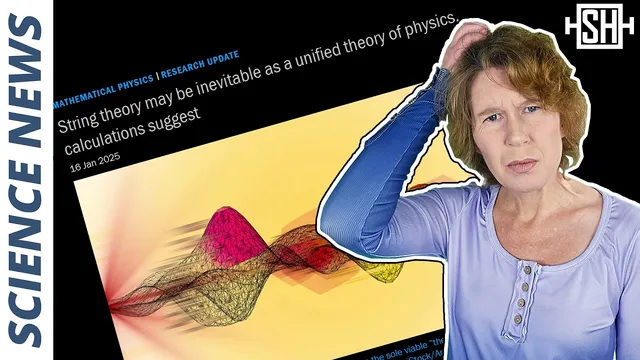
The Case for String Theory Just Got Stronger
Based on Sabine Hossenfelder's video on YouTube. If you like this content, support the original creators by watching, liking and subscribing to their content.
The new paper claims that, given certain mathematical constraints on graviton scattering amplitudes, the Veneziano amplitude is the unique consistent solution.
Briefing
A newly published paper strengthens the case for string theory by showing—under a specific set of mathematical conditions—that the graviton (the quantum of gravity) scattering amplitude must take the form associated with the Veneziano amplitude, meaning closed strings are required to avoid inconsistencies. The claim matters because it targets a long-standing gap: string theory has long been viewed as one workable route to quantum gravity, but not necessarily the only logically consistent one. The new result narrows that space by arguing that, if gravity is quantum and the resulting theory is well-behaved, the amplitude structure that string theory produces is essentially forced.
The argument builds on the historical origin of string theory. In the 1960s, Gabriela Veneziano sought an empirical description of strong-interaction scattering data from experiments that smashed electrons into protons. The resulting Veneziano amplitude turned out to describe an interaction mediated by a closed string—a loop—whose quantum excitations can be interpreted as a spin-2 particle, the graviton. That connection helped revive hopes that string theory could deliver a consistent quantum theory of gravity, avoiding the infinities that plagued earlier attempts.
The new paper’s headline—often summarized as “string theory is inevitable”—comes from a mathematical exercise: it lists assumptions that a graviton amplitude must satisfy and then proves that the Veneziano amplitude is the only solution consistent with those constraints. In other words, the derivation doesn’t merely show that string theory works; it claims that, given the stated requirements, the amplitude structure associated with strings is the unique way to make quantum-gravitational interactions behave.
Still, the strength of the conclusion depends entirely on what is assumed. The most consequential premise is that the quantum-gravity theory is complete in the sense of being UV finite, meaning it does not generate infinities at arbitrarily high energies. But UV finiteness is not guaranteed for any “next” theory; a deeper framework could exist in which today’s effective description is incomplete. Another key assumption is the existence of gravitons themselves. If gravity is not fundamentally quantum in the graviton sense—or if the relevant degrees of freedom are different—then searching for a “quantum” amplitude of the graviton may be the wrong target.
So the paper is best read as tightening the logical net around string theory rather than declaring it unavoidable in the real world. The result is a careful map of what is mathematically possible under particular conditions; it becomes a stronger physical claim only if those conditions reflect nature. In that sense, the work raises the odds that string theory is not just convenient, but deeply connected to how quantum gravity can be made consistent—while leaving room for other possibilities if the assumptions fail.
Cornell Notes
A new paper argues that, under specific mathematical constraints on graviton scattering, the only consistent form of the amplitude is the one associated with the Veneziano amplitude—implying closed strings are required. This matters because it addresses a central criticism of string theory: it has been one successful route to quantum gravity, but not obviously the unique one. The reasoning ties back to the 1960s origin of string theory, when Gabriela Veneziano’s amplitude matched strong-interaction data and later was interpreted as involving closed strings and a graviton-like spin-2 excitation. The conclusion is not absolute, though: it relies on assumptions such as UV finiteness (no high-energy infinities) and the physical existence of gravitons. If either assumption is wrong, the “inevitability” claim weakens.
What is the core technical claim behind the “inevitable” headline?
Why does the Veneziano amplitude matter historically to quantum gravity?
What assumption most directly limits how strong the inevitability conclusion can be?
How could the “graviton exists” assumption undermine the result?
What does the argument’s logical structure imply about what physics can conclude from it?
Review Questions
- What specific uniqueness result does the paper claim for graviton scattering, and what amplitude is singled out?
- Which two assumptions are highlighted as the biggest vulnerabilities of the “inevitability” interpretation?
- How does the historical development from strong-force scattering to closed strings and a graviton-like excitation connect to the new argument?
Key Points
- 1
The new paper claims that, given certain mathematical constraints on graviton scattering amplitudes, the Veneziano amplitude is the unique consistent solution.
- 2
The uniqueness result is interpreted as requiring closed strings to realize the graviton amplitude structure under those assumptions.
- 3
String theory’s earlier appeal traces to the Veneziano amplitude’s later interpretation as involving closed strings and a spin-2 graviton-like excitation.
- 4
The strongest limitation is the assumption of UV finiteness/completeness of quantum gravity, which may not hold if the theory is only an effective description.
- 5
Another vulnerability is the assumption that gravitons exist as the relevant quantum degrees of freedom; if gravity is different, the graviton-amplitude logic may not apply.
- 6
The work is best viewed as narrowing what is mathematically possible rather than proving string theory must be the physical theory of everything.