The Closest We’ve Come to a Theory of Everything
Based on Veritasium's video on YouTube. If you like this content, support the original creators by watching, liking and subscribing to their content.
The brachistochrone problem’s fastest path is a cycloid, derived by mapping mechanics to an optics-style refraction setup using Snell’s law.
Briefing
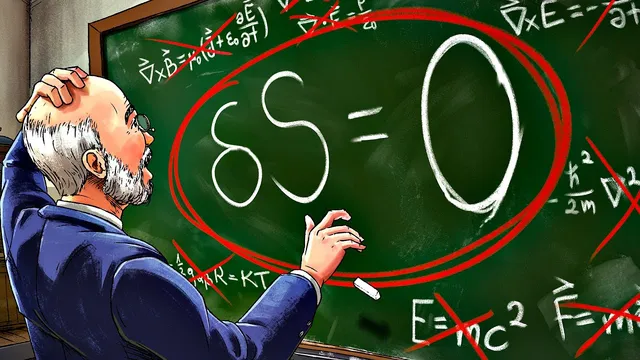
A single “stationary action” principle links the motion of falling objects, the bending of light, and the equations of mechanics—turning what once looked like separate laws into one unifying rule. The core claim is that nature doesn’t merely follow a path; it selects a trajectory for which a particular quantity, called action, changes as little as possible under small variations. That requirement—formalized by Euler and Lagrange—reproduces Newton’s second law and, in special cases, Fermat’s least-time principle for light.
The story begins with the fastest-descent problem: sliding a mass from point A to B, what ramp shape minimizes travel time? Common sense suggests a straight line, but Galileo showed that bending the ramp early lets the object accelerate sooner, beating the straight path. The question then sharpened into a challenge. In 1696, Johann Bernoulli posed the problem to mathematicians worldwide; no one submitted solutions. When Gottfried Leibniz persuaded Bernoulli to extend the deadline, Isaac Newton responded quickly—yet Bernoulli’s own solution outshone Newton’s.
Bernoulli’s key move was to borrow an idea from optics. Light traveling through a single medium follows the shortest path, but when it crosses between media it refracts, obeying Snell’s law. Pierre Fermat provided the missing “why” by proposing that refraction follows the path that minimizes total travel time. Bernoulli then translated the mechanics problem into an optics-like setup: treat the speeding-up of a falling particle as if light moves through layers whose effective speed changes with depth, so that Snell’s law holds at each interface. In the limit of infinitely thin layers, the resulting continuous curve becomes a cycloid. The fastest descent from A to B is therefore an arc of a cycloid—also known as a brachistochrone curve.
That optical-mechanical bridge set the stage for a deeper generalization. About forty years later, Pierre Louis de Maupertuis noticed that light and particles can behave similarly and proposed a new quantity—action—roughly tied to mass, velocity, and distance. He claimed that among all possible trajectories, the one nature chooses minimizes action. The idea drew ridicule and accusations of plagiarism, but Euler defended and strengthened it mathematically. Euler showed that the principle works cleanly when total energy is conserved across the compared paths, and he developed methods to handle continuous variations.
The final leap came with Joseph-Louis Lagrange, who delivered a general proof. The modern formulation reframes “least action” as “stationary action”: the first-order change in action vanishes for the true path. When the action is written using the Lagrangian (kinetic energy minus potential energy), the resulting Euler–Lagrange equations reproduce Newton’s second law for mechanics. The payoff is practical as well as philosophical: once kinetic and potential energy are known, the same variational machinery can generate equations of motion in multiple dimensions and even in awkward coordinate systems—making complex systems like a double pendulum far more tractable than force-based approaches.
In short, the unifying principle is not just a clever trick for one problem. It’s a framework where light refraction, particle trajectories, and classical mechanics all emerge from the same requirement: the action is stationary under small changes to the path.
Cornell Notes
The fastest way to move from A to B and the way light bends at boundaries both follow an optimization rule. Bernoulli solved the fastest-descent problem by translating it into an optics scenario using Fermat’s least-time principle, leading to a cycloid (the brachistochrone curve). Maupertuis then proposed a broader quantity—action—that should be stationary (not necessarily minimized) for the actual path, extending the idea beyond light. Euler and Lagrange supplied the mathematical rigor: with conserved energy and the modern Lagrangian (T − V), the stationary-action condition yields the Euler–Lagrange equations, which reproduce Newton’s second law. This matters because one variational framework can generate equations of motion across many mechanical systems, not just special cases.
Why does the fastest-descent path turn out to be a cycloid rather than a circle or a straight line?
How did Fermat’s principle of least time explain Snell’s law?
What did Maupertuis mean by “action,” and why was it controversial?
What mathematical conditions did Euler add to make the principle of least/stationary action work reliably?
How does Lagrange’s proof connect stationary action to Newton’s second law?
Why is the phrase “least action” misleading?
Review Questions
- In Bernoulli’s translation of fastest descent into an optics problem, what role does Snell’s law play as the layers become thinner and thinner?
- What specific change did Euler introduce to move from Maupertuis’s original action idea to a continuous, mathematically workable principle?
- How does the stationary-action condition using the Lagrangian (T − V) lead to the Euler–Lagrange equations and connect back to Newton’s second law?
Key Points
- 1
The brachistochrone problem’s fastest path is a cycloid, derived by mapping mechanics to an optics-style refraction setup using Snell’s law.
- 2
Fermat’s least-time principle explains refraction by selecting the light path that minimizes total travel time across media with different light speeds.
- 3
Maupertuis generalized the optimization idea by introducing action as a trajectory-dependent quantity, but the proposal initially lacked clear justification and faced strong criticism.
- 4
Euler strengthened the principle mathematically by converting sums to integrals and showing it requires conserved total energy across compared paths.
- 5
Lagrange provided a general proof that the true trajectory makes the action stationary (first-order variation zero), not necessarily strictly minimal.
- 6
In modern mechanics, writing action as the time integral of the Lagrangian L = T − V leads to Euler–Lagrange equations that reproduce Newton’s second law.
- 7
The variational framework scales beyond simple 1D motion, enabling systematic equation-building in multiple dimensions and convenient coordinate systems.