The Code Method: Building A Second Brain
Based on Greg Wheeler's video on YouTube. If you like this content, support the original creators by watching, liking and subscribing to their content.
Capture anything that resonates immediately, including emotional quotes and half-formed ideas, because they can reveal patterns later.
Briefing
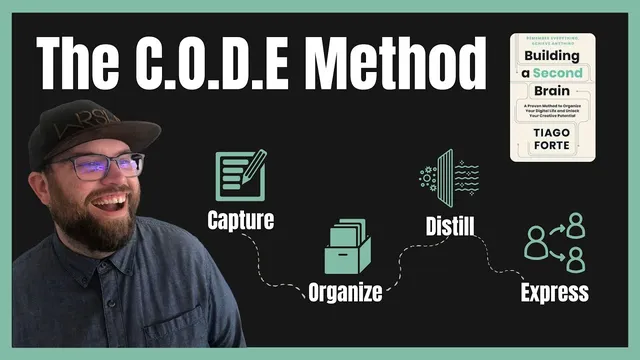
A “second brain” only becomes useful for creating and sharing when captured ideas are processed into something easy to retrieve and reuse. Thiago Forte’s “CODE Method”—Capture, Organize, Distill, and Express—turns raw notes into a personal system that supports creativity, not just storage.
The process starts with Capture: the system should hold anything that “strikes a chord,” including quotes that bring tears, half-formed thoughts, and ideas that aren’t fully developed yet. Those imperfect fragments are treated as signals of a person’s unique interests and patterns. The key is to jot them down immediately, then let them “marinate” so recurring themes can emerge later.
Next comes Organize, but not in the familiar “library” way of topics, subtopics, and nested layers. Instead, organization is designed for action. The method shifts to P.E.R.A.—Projects, Areas, Resources, and Archive—so notes map to how knowledge will be used.
Projects are time-bound efforts with a deadline, such as finishing a blog post or planning a vacation. Areas are ongoing responsibilities that never truly disappear—marriage, parenting, health, and finances—where knowledge may be relevant even if it doesn’t belong to any single project. Resources are topics of interest or passions: hobbies and recurring themes that can support either projects or areas. Archive is the holding zone for completed projects, outdated areas, no-longer-relevant resources, and anything that doesn’t fit cleanly elsewhere. Importantly, nothing gets deleted; search makes retrieval straightforward.
To make notes usable when needed, Distill focuses on discoverability. Rather than treating distillation as a one-time task, it happens continuously as notes are encountered. The essential meaning is extracted through techniques like bolding and highlighting key phrases, writing a one-sentence summary at the top in the note-taker’s own words, and using specific titles so scanning and searching quickly reveals what matters.
All three stages—Capture, Organize, and Distill—feed the final goal: Express. The system is framed as a creative pipeline: when inspiration appears, it gets captured, sorted into the right bucket, reduced to its core meaning, and then becomes ready to share. That sharing might take the form of a new business, a piece of writing, or even a conversation that adds value to someone else’s life. The underlying message is that creativity depends on retrieval: ideas must be processed so they can reappear at the moment they’re useful, turning stored information into real output.
Cornell Notes
The CODE Method for a “second brain” is designed to turn personal notes into something people can actually create and share with. Capture collects anything that resonates, including imperfect ideas and emotional quotes, because those fragments reveal patterns over time. Organize uses P.E.R.A. (Projects, Areas, Resources, Archive) to avoid deep topic hierarchies and instead sort notes by how they will be used. Distill increases discoverability by extracting essential meaning through bolding, highlighting, one-sentence summaries, and specific titles—done continuously as notes are revisited. The payoff is Express: ideas become ready for action, whether that means starting a business, publishing work, or contributing to conversations.
Why does the method treat “imperfect” notes as valuable rather than something to wait on?
How does P.E.R.A. organization differ from a traditional topic/subtopic “library” structure?
What decision questions determine where a new note belongs?
What does “distill” mean in practice, and how is it meant to be done over time?
Why does the method insist that nothing gets deleted?
Review Questions
- What are the four P.E.R.A. categories, and what makes each one distinct in terms of how knowledge will be used?
- Give three concrete distillation techniques mentioned in the method and explain how each improves discoverability.
- Describe a scenario where a single note would belong to more than one bucket (e.g., Project and Area).
Key Points
- 1
Capture anything that resonates immediately, including emotional quotes and half-formed ideas, because they can reveal patterns later.
- 2
Organize for action using P.E.R.A. (Projects, Areas, Resources, Archive) instead of deep topic hierarchies.
- 3
Treat Projects as deadline-driven efforts, Areas as ongoing responsibilities, Resources as topics of interest, and Archive as the safe zone for completed or non-fitting items.
- 4
Use simple decision questions to route each new note to the right bucket, and allow notes to belong to multiple buckets when relevant.
- 5
Distill continuously by extracting essential meaning with bolding/highlighting, one-sentence summaries, and specific titles to speed up retrieval.
- 6
Keep everything in the system and rely on search for finding older content rather than deleting notes.
- 7
Aim for Express: the system’s purpose is to turn stored ideas into real output—writing, business, or conversations that add value.