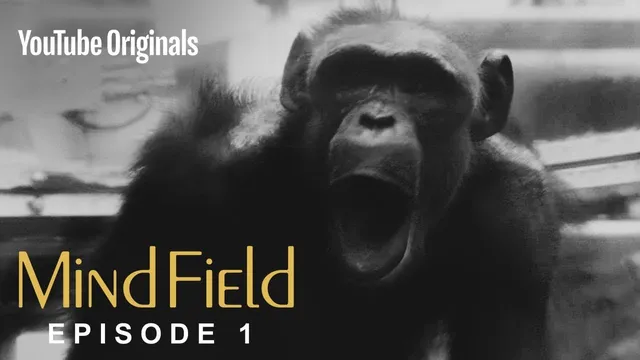
The Cognitive Tradeoff Hypothesis
Based on Vsauce's video on YouTube. If you like this content, support the original creators by watching, liking and subscribing to their content.
Chimpanzees can rapidly encode and recall digit locations in new puzzles, while human performance drops as timing and task complexity increase.
Briefing
Chimpanzees can outperform humans on tightly timed short-term memory tasks, and that gap is framed as evidence for a “cognitive tradeoff”: the evolutionary rise of complex symbolic language may have come at the cost of detailed, moment-to-moment memory. In a Kyoto University primate lab, chimpanzees trained on brand-new number-location puzzles can glance at an arrangement of digits and then point to where each number used to be—even when the display disappears immediately and the subject must rely on memory alone. Humans, by contrast, struggle more as the tasks get harder, especially when the time to encode the information shrinks to something like the blink of an eye.
The key idea is that language and memory compete for brain resources rather than simply coexist. The hypothesis traces this to a major environmental shift: early members of the chimpanzee-human last common ancestor (CHLCA) lineage lived in trees without the same pressures that later pushed some descendants onto the savanna. Without natural defenses, survival would have depended more on cooperation, planning, and coordinating roles—abilities that become easier when symbols can refer not only to what is present, but also to past events, hypotheticals, and generalities. Language, in this view, is a survival strategy that required reallocating brain capacity.
That reallocation is presented as a trade: as language develops, detailed short-term memory may be sacrificed. The transcript emphasizes that brains don’t add brand-new structures from nowhere; instead, anatomy repurposes what already exists. So the “best pupil” chimpanzees’ near-photographic short-term memory is treated not as a flaw in humans, but as a clue to what changed during the split between the lineages.
To test the tradeoff in practice, the lab’s Skylab setup uses computer booths and facial recognition to tailor tasks to individual chimpanzees. The memory games mimic foraging-like timing and reward correct performance with food for the chimpanzees, while humans receive only feedback and scores. In a face-off, a human participant competes first against Ai, a famous chimpanzee at the Primate Research Institute, and then against Ai’s son Ayumu, described as exceptionally fast at these tasks.
The match against Ayumu becomes the decisive stress test: the human must remember nine numerals in numerical order while the time window collapses to roughly half a second. Even with extra time and repeated attempts, performance lags far behind the chimp’s speed. The contrast is used to reinforce the tradeoff hypothesis: if language-enabled cognition prioritizes abstraction and labeling, it may reduce the bandwidth available for the kind of rapid, detailed memory that chimpanzees excel at.
The transcript closes by arguing that studying chimpanzees—especially as endangered animals—matters for understanding human origins. Humans may be uniquely capable of complex symbolic language, but that doesn’t automatically make humans “better.” It suggests the evolutionary path required specific compromises, and losing chimpanzees would mean losing a crucial part of the story about where cognition came from and where it might go next.
Cornell Notes
The cognitive tradeoff hypothesis links two abilities: complex symbolic language and detailed short-term memory. Chimpanzees excel at rapid memory tasks—remembering where digits were after they disappear—while humans fall behind as timing tightens. The hypothesis argues that when early humans evolved language to coordinate survival using abstract symbols (past, future, generalities), the brain likely reallocated resources away from immediate, detailed memory. In lab tests at Kyoto University’s Primate Research Institute, a human participant struggles to match chimpanzees, especially Ayumu, under extreme time limits. The result supports the idea that language and high-resolution short-term memory compete for cognitive bandwidth.
What memory task difference drives the “tradeoff” claim between humans and chimpanzees?
How does language connect to survival pressures in the evolutionary story?
Why does the hypothesis predict a memory cost for language rather than a simple “upgrade”?
What role does the Skylab chimpanzee habitat play in testing cognition?
Why is the confrontation with Ayumu treated as the strongest evidence?
What does the transcript suggest about whether humans are “better” than other species?
Review Questions
- How do the digit-location memory tasks change from the early rounds to the most difficult round, and why does that matter for interpreting the results?
- According to the cognitive tradeoff hypothesis, what specific evolutionary pressures are linked to the emergence of language, and what cognitive ability is predicted to decline as a result?
- What experimental features (timing, rewards, individual tailoring) in the Skylab setup are designed to make chimpanzee performance comparable to natural behavior?
Key Points
- 1
Chimpanzees can rapidly encode and recall digit locations in new puzzles, while human performance drops as timing and task complexity increase.
- 2
The cognitive tradeoff hypothesis claims language and detailed short-term memory compete for brain resources rather than both improving together.
- 3
Evolutionary pressure is tied to a savanna shift where cooperation, role assignment, and strategy planning would benefit from symbols that reference past and future.
- 4
Language is framed as repurposing existing brain anatomy, implying a cost in immediate, high-resolution memory.
- 5
Lab testing uses an open-air habitat (Skylab) with facial recognition and individualized task selection to run memory trials that resemble foraging-like timing.
- 6
Extreme time limits—down to roughly a blink—highlight the gap between human and chimpanzee performance, especially against Ayumu.
- 7
Preserving chimpanzees is presented as essential because they provide a living window into cognitive traits relevant to human origins.