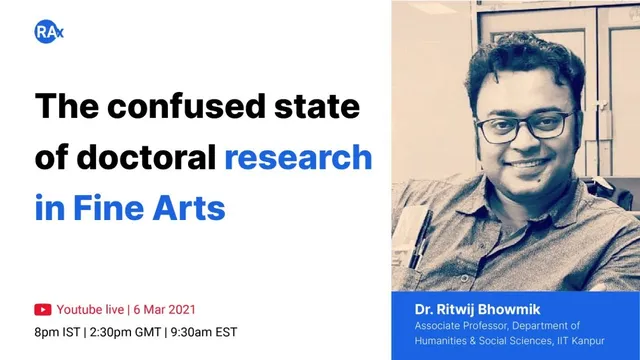
The confused state of doctoral research in FineArts - Conversation with Dr. Ritwij Bhowmik
Based on Enago Read (Previously Raxter.io)'s video on YouTube. If you like this content, support the original creators by watching, liking and subscribing to their content.
Fine-arts PhD confusion often stems from treating studio practice and academic research as the same career track, despite requiring different competencies.
Briefing
Fine-arts PhD paths in South Asia often get derailed by a mismatch between what artists are trained to do and what universities require—especially the expectation that studio practitioners will produce thesis-style academic research. Dr. Ritwij Bhowmik’s central message is that the confusion isn’t about whether art research matters; it’s about treating “practice” and “academic research” as if they were interchangeable career tracks.
Bhowmik’s own journey mirrors the instability many fine-arts graduates face. He initially planned a straightforward route: an MFA followed by teaching and professional practice, without heavy emphasis on research or publishing. After a job in school teaching and a period of market optimism for Indian art (followed by the 2008 recession), he sought scholarships and residencies abroad. Fine-arts fellowships became harder to find—he describes major programs like Japan’s Monbusho shifting away from fine arts research from around 2000 onward—leaving fewer options such as a Chinese government scholarship. In China, language barriers made daily life difficult until he learned enough Mandarin to function; later, returning to India brought unemployment and financial strain after the birth of his son.
That pressure eventually pushed him toward doctoral study, but even then the route wasn’t “studio-to-PhD” in the way many artists imagine. In Taiwan, he pursued a PhD topic within visual culture through a humanities and social sciences department, while managing family responsibilities and scholarship obligations. The lived experience—writing while caring for a child—underscored how doctoral research in fine arts can demand a different kind of labor than making art alone.
The conversation then shifts from personal narrative to system-level diagnosis. Bhowmik draws a sharp distinction between studio artists (painters, sculptors, graphic artists) and art historians/art researchers who write papers and build scholarly arguments. He argues that Western models developed clearer separation: studio degrees like the MFA are practice-based and typically don’t require a full thesis, while academic careers (lecturer/assistant professor roles) often require research outputs and publishing. Confusion arises when institutions expect artists to meet academic paper requirements without providing the research training needed—or when academic researchers are treated as if they can simply “practice” their way into scholarly credibility.
He points to a missing bridge in India: undergraduate fine-arts programs often underweight research methods, art history, and theory, then push students into PhD expectations immediately after an MFA. Without earlier training—how to formulate research questions, collect and analyze data, and write academic work—students may have strong studio skills but lack the competencies required to supervise future PhDs or publish.
Bhowmik also argues against making the PhD compulsory as a blanket job credential. He references protests against government directives in 2014 that required PhDs for assistant professor roles, warning that forcing everyone into the same credential can foreclose practicing artists from academia. Instead, he calls for curricula that integrate research training into UG/PG levels, including research methodology, visual communication theory, modern and ancient art history (including under-taught Asian traditions), and explicit instruction on writing academic papers and grant proposals.
Finally, he addresses the faculty pipeline: fewer fine-arts faculty openings and bureaucratic hiring priorities reduce incentives for students to endure doctoral hardship. The remedy, he suggests, starts earlier—educating decision-makers and students about art’s value, expanding research-capable training, and building clearer pathways so fine-arts graduates can choose practice-based careers or academic research careers with realistic expectations.
Cornell Notes
Dr. Ritwij Bhowmik describes fine-arts PhD confusion as a career-track problem: studio practice and academic research are different skill sets, and students often lack the bridge training needed for thesis-based doctoral work. His own path—from teaching and scholarship hunting to a PhD in visual culture—shows how language barriers, scholarship availability, and family obligations can reshape plans. He argues that undergraduate fine-arts programs in India frequently underemphasize art history, theory, and research methods, then expect MFA graduates to produce academic research immediately. He also warns against making the PhD a compulsory credential for all faculty jobs, advocating instead for curricula that teach research writing, question formulation, and publishing skills while preserving practice-based routes for artists.
Why does fine-arts PhD confusion persist, even when everyone agrees that art research is valuable?
How did scholarship availability and language barriers shape Bhowmik’s doctoral path?
What does Bhowmik say is missing between MFA and PhD in India?
Should a PhD be mandatory for fine-arts faculty jobs?
How should curricula change at UG/PG level to reduce confusion?
What advice does he give for selecting research questions as an artist?
Review Questions
- What specific mismatch between studio training and doctoral expectations does Bhowmik identify as the root of fine-arts PhD confusion?
- How does Bhowmik propose undergraduate and postgraduate curricula should change to prepare students for research without forcing a single credential path?
- Why does he argue that making the PhD compulsory for faculty roles can harm the practice-based artist’s place in academia?
Key Points
- 1
Fine-arts PhD confusion often stems from treating studio practice and academic research as the same career track, despite requiring different competencies.
- 2
Bhowmik’s path highlights real-world constraints—limited fine-arts scholarships, language barriers abroad, and job-market instability at home—that can redirect career plans.
- 3
Undergraduate fine-arts programs frequently undertrain students in art history, theory, and research methods, leaving MFA graduates unprepared for thesis-based doctoral work.
- 4
A bridge between MFA and PhD is needed: structured preparation in research question formulation, research methods, and academic writing.
- 5
Bhowmik argues against blanket PhD compulsion for all faculty roles, warning that it can exclude practicing artists from academia.
- 6
Curriculum reform should start at UG/PG level, integrating research writing, grant-proposal skills, and broader art-history/theory exposure (including under-taught Asian traditions).
- 7
Faculty hiring patterns and bureaucratic priorities can reduce fine-arts faculty openings, lowering incentives for students to pursue doctoral hardship.