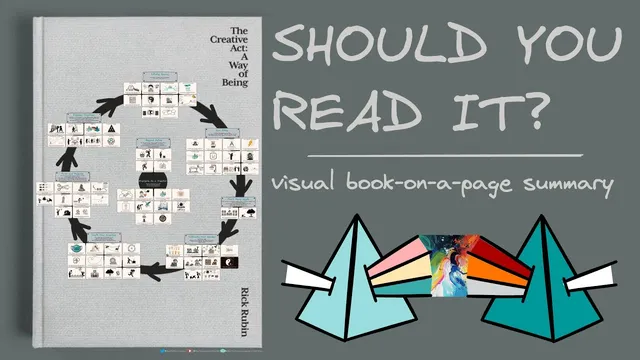
The Creative Act by Rick Rubin - Visual Book on a Page Summary - Should YOU read it?
Based on Zsolt's Visual Personal Knowledge Management's video on YouTube. If you like this content, support the original creators by watching, liking and subscribing to their content.
Rubin frames creativity as universal: anyone can create, including in everyday activities like cooking.
Briefing
Rick Rubin’s The Creative Act frames creativity as a universal human capacity rather than a talent reserved for artists. The core claim is that everyone is a “Creator,” whether that creativity shows up on a stage or at home—like cooking dinner. From there, Rubin shifts attention away from finding a single breakthrough idea and toward learning how to notice, filter, and cultivate many possibilities that already exist around us.
Central to the book is the idea of “The Source,” a reservoir of inspirations, ideas, and potential that people must tune into. Rubin treats attention as a kind of filter shaped by personality, what a person listens to, watches, reads, and even how thoughts are curated. Because the information stream is effectively infinite, creativity becomes less about hunting for the one perfect concept and more about planting multiple “seeds” from what the filter selects. Some seeds will look promising but fail to develop; others may seem pale at first and later grow into something substantial.
Rubin then lays out a practical progression for turning seeds into finished work. After planting comes “gardening,” which means experimenting—trying alternatives, playing with ideas, and even doing the opposite of what feels familiar. The goal is surprise and discovery, not immediate polish. When a seed shows real potential, the process moves from experimentation to “crafting,” a phase marked by sustained effort, skill-building, and long hours. Yet Rubin warns against getting trapped in crafting indefinitely. The book’s emphasis is on timing and momentum: ideas can go stale if they’re overworked after the spark fades.
That leads to “completion,” the step required to release work and enable the next cycle. Rubin argues that finishing matters for two reasons. First, timely ideas lose their urgency when crafting drags on too long. Second, unfinished work can’t be released—so it can’t be built on by others, and it can’t even move the creator toward new projects. Completion is portrayed as the gateway that turns private exploration into something shareable.
Rubin also treats creation as inherently collaborative. Audiences interpret and decide what a work means, often with insights that exceed the creator’s own intent. Other artists then take what’s been made and respond, adapt, or extend it, creating a “virtuous cycle” where personal perspective refracts shared input. The prism metaphor captures this: incoming light is observed through the creator, but the final outcome is shaped by personality.
The closing takeaways emphasized in the summary are twofold: the purpose of creating is fulfillment—internal success matters even when financial outcomes or public approval vary—and many myths about how famous creative people work are exaggerated. Creativity, in this framing, is less a mysterious gift and more a disciplined, iterative practice of noticing, planting, experimenting, crafting, and finishing.
Cornell Notes
Rubin’s The Creative Act argues that creativity belongs to everyone, not just professional artists. Creativity starts with tuning into “The Source” of inspirations and possibilities, then using a personal “filter” shaped by attention, inputs, and personality to select what to notice. Instead of chasing one big idea, Rubin urges creators to plant many seeds, experiment through “gardening,” and then shift to “crafting” when a seed shows promise. The process must end in “completion,” because unfinished work can’t be released or built upon, and ideas can go stale if crafting lasts too long. Creation is also collaborative: audiences interpret, and other artists extend what’s been made.
What does “The Source” mean in Rubin’s framework, and how does a creator interact with it?
Why does Rubin discourage the search for “the one big idea”?
What’s the difference between “gardening” and “crafting”?
Why is “completion” so important in Rubin’s model?
How does Rubin portray creativity as collaborative rather than purely individual?
What two practical takeaways about creativity are highlighted at the end of the summary?
Review Questions
- How does Rubin’s “filter” influence which ideas become seeds, and what inputs shape that filter?
- What triggers the shift from experimentation (“gardening”) to sustained effort (“crafting”)?
- Why does Rubin treat finishing (“completion”) as necessary for both personal momentum and community building?
Key Points
- 1
Rubin frames creativity as universal: anyone can create, including in everyday activities like cooking.
- 2
Creativity begins with tuning into “The Source” and using a personal filter shaped by attention and inputs.
- 3
Plant many seeds instead of hunting for a single perfect idea, because early promise doesn’t predict eventual growth.
- 4
Use “gardening” for experimentation and “crafting” for skillful development once a seed shows potential.
- 5
Avoid getting stuck in crafting; ideas can go stale if timing is ignored.
- 6
Finish work through “completion” so it can be released, built on by others, and so the creator can move to new projects.
- 7
Creation is collaborative through audience interpretation and the way other artists extend what’s been made.