The Crisis In Physics: Are We Missing 17 Layers of Reality?
Based on PBS Space Time's video on YouTube. If you like this content, support the original creators by watching, liking and subscribing to their content.
Reductionism works when emergent layers exhibit dynamical independence, letting effective theories predict macroscopic behavior without tracking microscopic details.
Briefing
Physics has long relied on reductionism: the idea that large-scale behavior can be understood by zooming in to smaller and smaller layers, where simpler rules govern. That approach works surprisingly well because many “emergent” systems have dynamical independence—effective theories can predict macroscopic outcomes without tracking every microscopic detail. But the Standard Model of particle physics may be a warning sign that this tidy picture breaks down at the bottom, where the separation between layers becomes extreme.
The core framework starts with methodological reductionism and effective field theory. In an effective theory, coarse-graining averages over the messy degrees of freedom of smaller constituents, producing a new set of variables—like temperature and pressure for gases—that remain predictive only within a limited range. Push the theory beyond its validity and it fails, as classical physics did for blackbody radiation: the “ultraviolet catastrophe” appeared when classical calculations kept counting high-energy contributions that quantum mechanics would suppress. In this language, every effective theory has a UV cutoff—an energy (and corresponding size scale) where the coarse-grained description stops working.
The trouble emerges when the Standard Model is treated as an effective field theory too. The Standard Model does not include gravity, so it should have some UV cutoff where a deeper theory (possibly quantum gravity) takes over. One possibility is that the cutoff sits near the Planck length (~10^-32 m), about 17 orders of magnitude below the heaviest Standard Model scales. Another, motivated by the logic of the ultraviolet catastrophe, is that the Standard Model’s predictive breakdown should occur much closer to the Higgs boson mass. Yet the expected “new physics” that would tame the Higgs-related sensitivity to high-energy contributions has not shown up at the Large Hadron Collider, even though experiments have probed well beyond where it was anticipated.
That mismatch feeds into the hierarchy problem: the Higgs boson’s mass appears unnaturally stable against large quantum corrections unless some mechanism suppresses or cancels them. If the Standard Model parameters are determined by physics at a deeper UV scale, why don’t those UV effects require extreme fine-tuning to reproduce the observed Higgs mass? The transcript postpones a deeper treatment of fine-tuning, but it emphasizes the conceptual strangeness of the scale gap.
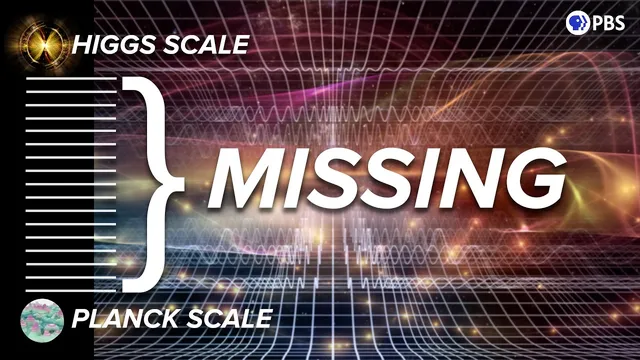
A striking illustration compares the typical emergence ladder—cells to organisms to molecules to atoms to Standard Model particles—with a potential chasm between the Higgs scale and the deepest layer. The gap could be as vast as the difference between atoms and blue whales. In a strict reductionist worldview, the parts should not “know” the whole; emergence should run from small to large. While some feedback between layers exists in nature (cells require stable environments; quarks exist only as part of composites), that feedback is usually local and plausibly limited in range. Stabilizing the Higgs over 17 orders of magnitude strains that locality.
Two broad escape routes are offered. One is that the UV theory is simply what it is—its parameters happen to yield the right emergent behavior, potentially supported by an anthropic argument across many universes. The other is a breakdown of the usual direction of influence: some form of UV–IR mixing, where large-scale (infrared) physics feeds back into small-scale (ultraviolet) behavior. Gravity is cited as a familiar place where such mixing already appears, hinting that the bottom of reality may involve a more anti-reductionist kind of causation than reductionism comfortably allows.
Cornell Notes
Reductionism works when emergent layers are dynamically independent: effective field theories (EFTs) use coarse-grained variables and remain predictive only within a limited scale range. When an EFT is pushed past its validity, it fails—classically illustrated by the ultraviolet catastrophe in blackbody radiation, resolved by quantum mechanics. The hierarchy problem challenges this picture for the Standard Model: as an effective theory lacking gravity, it should have a UV cutoff, yet the Higgs mass seems to require suppression of high-energy contributions that no new physics has revealed at the Large Hadron Collider. With a potential 17-order-of-magnitude separation between the Higgs scale and the deepest layer, the usual small-to-large emergence and local feedback may not be enough, motivating either fine-tuned/anthropic explanations or UV–IR mixing (large-to-small influence).
What does “dynamical independence” mean, and why does it make reductionism work in practice?
How do effective field theories fail, and what is the “UV cutoff”?
Why does the hierarchy problem put reductionism under pressure?
What role does “naturalness” play in this discussion, and what tension does it highlight?
Why is the scale gap (potentially ~17 orders of magnitude) such a conceptual problem?
What are the two broad explanations offered for the Standard Model’s behavior at the bottom?
Review Questions
- How does coarse-graining in an effective field theory lead to dynamical independence, and what condition determines the EFT’s range of validity?
- What is the ultraviolet catastrophe, and how does it motivate the idea of a UV cutoff in modern EFT language?
- Why does the absence of new physics near the Higgs mass intensify the hierarchy problem, and what two explanation strategies are proposed to address it?
Key Points
- 1
Reductionism works when emergent layers exhibit dynamical independence, letting effective theories predict macroscopic behavior without tracking microscopic details.
- 2
Effective field theories rely on separation of scales; when coarse-graining becomes too coarse, the theory breaks down at a UV cutoff.
- 3
The ultraviolet catastrophe in blackbody radiation illustrates what happens when a classical theory is pushed beyond its validity, and it foreshadows the EFT concept of a UV cutoff.
- 4
The Standard Model’s status as an effective theory (missing gravity) raises the question of where its UV cutoff lies and how it stabilizes the Higgs mass.
- 5
The hierarchy problem intensifies because expected new physics near the Higgs mass has not been observed at the Large Hadron Collider.
- 6
A potential ~17-order-of-magnitude gap between the Higgs scale and the deepest layer strains the usual picture of local feedback and small-to-large emergence.
- 7
Two broad responses are proposed: fine-tuned/anthropic explanations or UV–IR mixing, where large-scale physics can influence small-scale behavior.