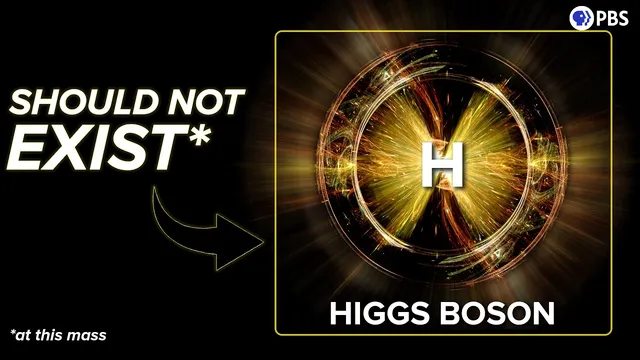
The Crisis in Physics: Why the Higgs Boson Should NOT Exist!
Based on PBS Space Time's video on YouTube. If you like this content, support the original creators by watching, liking and subscribing to their content.
The hierarchy problem centers on why the Higgs boson’s mass is far smaller than quantum corrections would naturally drive it toward, especially near the Planck scale.
Briefing
The central puzzle is why the Higgs boson is so light. In the Standard Model, the Higgs mass should receive enormous quantum “corrections” from fluctuations at very high energies, potentially pushing it toward the Planck scale—yet the Higgs mass sits at a comparatively small value. That mismatch is the hierarchy problem’s most famous face, and it has become a “crisis” because the required cancellations look wildly unnatural without new physics.
Mass in the Standard Model comes from the Higgs field: particles that interact with this field gain mass proportional to how strongly they couple. But the story doesn’t end there. Once a particle has mass from the Higgs field, it also picks up additional mass from the surrounding cloud of quantum fluctuations—virtual particles popping in and out of existence. For an electron, those corrections include contributions from many energy scales and fields, and if the theory were allowed to sum without any cutoff, the corrections would blow up. In practice, the electron’s small mass is protected by symmetries: chiral symmetry helps keep the mass from drifting upward, and the cancellation can be understood through how quantum corrections from related particle-antiparticle processes behave.
That kind of protection works for other particles too. Mesons such as kaons and pions have mass patterns that initially seemed to require implausibly large cancellations. In both cases, the “missing ingredient” turned out to be new physics appearing at the right energy scale—around a few giga-electron volts for kaons, and tied to the rho meson for pions—so the quantum corrections stop accumulating unchecked.
The Higgs boson is different. It is the only spin-0 elementary particle in the Standard Model, and it lacks the same symmetry-based safeguards that keep fermion masses stable. Because the Higgs is its own antiparticle, it shares some self-canceling features, but not enough to prevent its mass from being driven upward by quantum effects. The Standard Model is expected to fail at the Planck scale, where quantum gravity and spacetime fluctuations become relevant. If nothing intervenes below that scale, the Higgs mass would be pulled toward it. Achieving the observed light Higgs mass would then require an extreme, chance-level cancellation—described as “finely tuned” to one part in 100 million billion—making many physicists suspect that some mechanism must cut off or reorganize those corrections at accessible energies.
Supersymmetry (SUSY) was the most influential proposed fix. SUSY pairs every fermion with a bosonic partner and every boson with a fermionic partner. If these superpartners appear near the Higgs mass scale, their contributions would cancel the Higgs’s dangerous quantum divergences. But the Large Hadron Collider has not found the expected low-mass superpartners, leaving SUSY either incomplete or pushed to higher energies—where it would still require some residual fine-tuning.
Other proposals aim to protect the Higgs by changing what it “is.” In technicolor-like scenarios, the Higgs becomes a composite particle formed from a new fermionic field, with its mass arising dynamically and its constituents protected similarly to other fermions. Still another escape hatch is anthropic reasoning: if many universes exist with different Higgs masses, only those with a sufficiently light Higgs would avoid rapid recollapse and allow stars, planets, and observers. Many physicists dislike this approach because it weakens “naturalness” as a guide for discovering new physics.
Overall, the hierarchy problem ties together multiple extreme scale gaps—between the Higgs mass and the Planck scale, between gravity and quantum forces, and between dark energy’s observed weakness and expectations from quantum fluctuations—suggesting that the Higgs mass is a clue pointing beyond the Standard Model, not a settled endpoint.
Cornell Notes
The Higgs boson’s mass is unusually small compared with what quantum physics predicts once high-energy fluctuations are included. In the Standard Model, the Higgs field gives particles mass, but quantum corrections from many energy scales also add to the Higgs mass; without a protective mechanism, those corrections would push it toward the Planck scale. For fermions like the electron, symmetries (notably chiral symmetry) and related particle-antiparticle structure help prevent such runaway corrections, and similar “protection by new physics at the right scale” has appeared in meson mass patterns. The Higgs lacks comparable symmetry protection, so its lightness would require an extreme, finely tuned cancellation—one reason the hierarchy problem is treated as a crisis. Proposed fixes include supersymmetry, composite-Higgs (technicolor-like) models, and anthropic multiverse arguments, each with different implications for what experiments should find next.
Why does quantum physics threaten to make the Higgs boson much heavier than observed?
What does “fine-tuning” mean in this context, and why is it considered unnatural?
How does the electron avoid the same runaway mass problem?
What lesson do kaons and pions provide about “new physics at the right energy scale”?
Why does supersymmetry (SUSY) look like a natural solution—and why hasn’t it solved the problem cleanly yet?
What are the main alternative approaches to the hierarchy problem mentioned here?
Review Questions
- What specific feature of the Higgs boson makes it more vulnerable to large quantum corrections than fermions like the electron?
- How do symmetry-based protections (like chiral symmetry) differ from “new physics at a particular energy scale” in preventing unnatural mass corrections?
- Compare the roles of SUSY, composite-Higgs (technicolor-like) models, and anthropic multiverse reasoning in addressing the hierarchy problem. What experimental expectations differ among them?
Key Points
- 1
The hierarchy problem centers on why the Higgs boson’s mass is far smaller than quantum corrections would naturally drive it toward, especially near the Planck scale.
- 2
Quantum fluctuations add to particle masses; without a protective mechanism, the Higgs mass would receive enormous contributions from very high energies.
- 3
“Fine-tuning” describes the need for an extreme cancellation between large positive and negative quantum corrections—so precise that it is treated as unlikely by chance.
- 4
Fermion masses like the electron’s can remain small because symmetries (chiral symmetry) suppress mass growth, unlike the Higgs in the Standard Model.
- 5
Observed meson mass patterns (kaons and pions) historically pointed to new physics appearing at specific energy scales that cut off dangerous corrections.
- 6
Supersymmetry would cancel Higgs divergences if superpartners appear near the Higgs mass scale, but LHC searches have not found the expected low-mass spectrum.
- 7
Composite-Higgs models and anthropic multiverse arguments offer alternative ways to keep the Higgs light, but they imply different attitudes toward naturalness and different experimental targets.