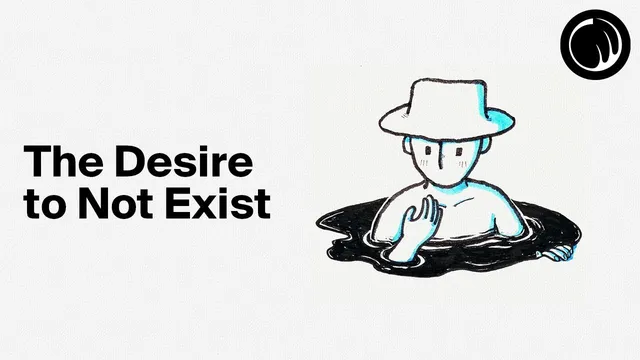
The Desire to Not Exist
Based on Pursuit of Wonder's video on YouTube. If you like this content, support the original creators by watching, liking and subscribing to their content.
The story frames suffering as a product of desire, passion, judgment, and attachment to a world experienced as separate from the self.
Briefing
A consciousness trapped in an endless cycle of birth, attachment, and loss is offered a choice: step out into liberation—or return to the same kind of life without remembering what came before. The central claim is that suffering isn’t random; it’s tied to “desire, passion, judgment, [and] attachment,” especially the way existence is experienced as separate objects rather than a unified source. When the figure reveals that the character’s “punishment” has ended, the offer of freedom reframes everything that came before as both meaningful and ultimately pointless—an absurd loop of craving and fear that ends only when attachment ends.
The character, named Giannis, begins in a blank, white void with no memory of punishment. A translucent figure explains that the character’s term is complete and that the only thing that matters now is what Giannis chooses. A portal opens to a life that feels familiar but initially unplaceable: Giannis is shown as a human raised by a loving mother, forming friendships, falling in love multiple times, marrying Renetta, and building a family. The life includes the full range of embodied pleasures—food, travel, achievement, laughter—and the deep comfort of care. Yet the same sequence turns: as time passes, safety and certainty erode, relationships drift, partners stop loving, friends become strangers or enemies, and doubt becomes a constant pressure. Even when Giannis achieves success, it doesn’t settle the underlying ache; the character is repeatedly “almost there,” never fully satisfied.
The narrative then tightens the causal knot. Giannis watches his mother age and die, knowing it was always coming. He loses friends, suffers illness and pain, clings to everything, and finally dies—only to have the entire lifetime return all at once in a surge of sorrow and meaning. The figure’s answer to “what was I being punished for?” is blunt: the punishment is the way attachment to separateness creates suffering. Desire and passion bind the self to outcomes; judgment and attachment keep the mind grasping at a world that cannot stay stable.
At the climax, two openings appear. One is a bright, warm realm with fractal-like echoes of memory—presented as the continuation of desire and passion. The other is darkness with a low hum and mist—described as the end of the cycle, where there are no hearts to break, no hopes to crush, and no loss because there is nothing to attach to. Giannis is told he can return to where everything comes from, or continue reincarnation without learning anything that would carry forward. In the final choice, the character confronts the “pain of everythingness” as strangely comforting against the “nothingness” of liberation, and steps toward the darker option—summarized as “If that’s heaven, give me hell.” The story uses a spiritual framing to argue that freedom requires letting go of the very mechanisms that make life feel personal, urgent, and separate.
Cornell Notes
Giannis wakes in a white void with no memory, guided by a translucent figure who says his “term” is over and he must choose what comes next. The figure reveals Giannis’s human life—love, marriage to Renetta, children, achievements, and embodied pleasures—then shows how time brings loss, fear, doubt, illness, and death. When Giannis asks what the punishment was, the answer is desire, passion, judgment, and attachment to a world experienced as separate objects rather than a unified source. Two portals appear: one continues the cycle through desire and passion, the other offers liberation from birth and rebirth, with no hearts to break and no loss because there is nothing to attach to. Giannis chooses the darker path, preferring “hell” to the emptiness of “heaven.”
What does the figure identify as the real cause of suffering?
How does the narrative treat love and pleasure—are they portrayed as purely bad?
Why does Giannis keep feeling “almost there” even when life seems successful?
What is the significance of the memory wipe and the “no lesson learned” warning?
How are the two portals contrasted, and what do they represent?
What does Giannis’s final line (“If that’s heaven, give me hell”) imply about attachment?
Review Questions
- If suffering is caused by attachment to separateness, what changes in perception would be required to avoid the cycle?
- Which parts of Giannis’s life are portrayed as genuinely fulfilling, and how does the story explain why fulfillment still leads to pain?
- Why does the narrative emphasize that continuing reincarnation brings no memory or lesson—how does that affect the likelihood of repeating the same suffering?
Key Points
- 1
The story frames suffering as a product of desire, passion, judgment, and attachment to a world experienced as separate from the self.
- 2
Giannis’s life is shown as both joyful and tragic, arguing that pleasure becomes painful when it depends on permanence.
- 3
Time erodes the conditions that once made safety and certainty feel possible, turning them into personal responsibility.
- 4
Even achievements and relationships don’t end the underlying restlessness, producing a cycle of effort, doubt, and exhaustion.
- 5
Death doesn’t end the experience; the entire lifetime returns at once, intensifying sorrow and meaning.
- 6
Two choices are offered: continue through desire and passion, or step out of birth and rebirth into a state described as liberation from loss and hope.
- 7
The final choice suggests attachment can feel more comforting than emptiness, even when attachment guarantees suffering.