The determinant | Chapter 6, Essence of linear algebra
Based on 3Blue1Brown's video on YouTube. If you like this content, support the original creators by watching, liking and subscribing to their content.
The determinant is the universal scaling factor for size under a linear transformation: area in 2D and volume in 3D.
Briefing
Determinants turn the messy question of “how much does a linear transformation stretch space?” into a single number: the factor by which areas (in 2D) or volumes (in 3D) change. In two dimensions, that number is the area-scaling factor for any region—positive for ordinary scaling, negative when the transformation flips orientation, and zero when everything collapses into a lower dimension.
A concrete example makes the idea tangible. The matrix with columns (3,0) and (0,2) stretches the i-hat direction by 3 and the j-hat direction by 2. The unit square spanned by i-hat and j-hat becomes a 2 by 3 rectangle, so its area grows from 1 to 6. Because linear transformations send grid lines to parallel, evenly spaced grid lines, every tiny grid square experiences the same area scaling. Any shape can be approximated by many small grid squares, so the entire “blob” scales by the same factor. That universal area factor is the determinant.
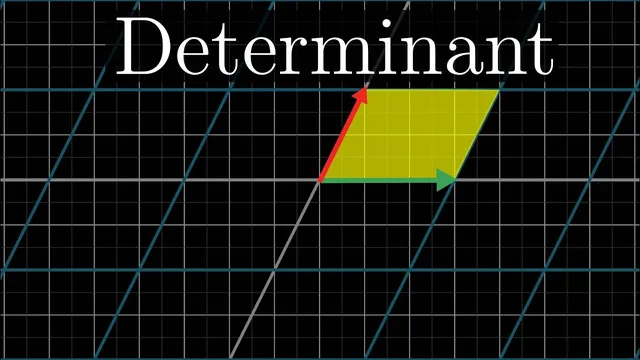
Shears show why the determinant is not just about “stretching.” A shear matrix like one with columns (1,1) and (0,1) slants the unit square into a parallelogram without changing its base or height, leaving its area unchanged. Even though the shape looks different, the determinant stays at 1 because the area scale factor is 1.
The determinant also detects when a transformation destroys dimensionality. If the determinant is 0, the transformation squashes all of space into a line (or, in the extreme, a point), making the area or volume of any region collapse to zero. In 2D, this corresponds to the matrix columns becoming linearly dependent—exactly the situation where the transformation can’t span the plane.
Negative determinants add the missing piece: orientation. A transformation can flip a coordinate system—like turning a sheet of paper over—so the determinant becomes negative. The absolute value still gives the magnitude of area scaling. The intuition comes from continuously moving i-hat toward j-hat: as they align, the determinant approaches 0; pushing past alignment makes the determinant continue into negative values, reflecting the flip.
In three dimensions, the same logic applies to volumes. The determinant gives the factor by which a unit cube becomes a parallelipiped, and a determinant of 0 means the cube collapses into something with zero volume (a plane, a line, or a point). Orientation in 3D is tracked with the right-hand rule: if the transformed i-hat and j-hat still produce k-hat using the right hand, the determinant is positive; if only the left hand works, it’s negative.
Finally, the transcript connects meaning to computation. For a 2×2 matrix [[a,b],[c,d]], the determinant is ad − bc, with intuition tied to how the unit square’s image depends on stretching along axes versus diagonal effects. It also notes a key algebraic property: det(AB) = det(A)det(B), so determinants multiply under matrix multiplication—an insight that will matter when linear transformations are composed to solve systems of equations later.
Cornell Notes
A determinant is the single number that measures how a linear transformation scales geometric size: area in 2D and volume in 3D. In 2D, the determinant gives the factor by which any region’s area changes; it is positive for orientation-preserving transformations, negative when the transformation flips orientation, and zero when the transformation collapses space into a lower dimension. In 3D, the determinant plays the same role for volumes, with the sign determined by whether the right-hand rule orientation is preserved. For computation, a 2×2 determinant [[a,b],[c,d]] equals ad − bc, and determinants multiply under composition: det(AB) = det(A)det(B).
Why does knowing how a linear transformation changes one unit square determine the area change for any region in 2D?
What does a determinant of 0 mean geometrically in 2D and 3D?
Why can determinants be negative, and what does the sign represent?
How does the right-hand rule determine the sign of a 3D determinant?
Where does the 2×2 formula det([[a,b],[c,d]]) = ad − bc come from intuitively?
Why should det(AB) equal det(A)det(B)? (One-sentence justification prompt)
Review Questions
- In 2D, how do you distinguish between a determinant of 0 and a determinant with small magnitude but nonzero value?
- Give a geometric interpretation of the sign of a determinant in 2D and relate it to orientation.
- For a 2×2 matrix [[a,b],[c,d]], what role do the terms ad and bc play in the area of the transformed unit square?
Key Points
- 1
The determinant is the universal scaling factor for size under a linear transformation: area in 2D and volume in 3D.
- 2
A positive determinant means orientation is preserved; a negative determinant means orientation is flipped.
- 3
A determinant of 0 signals dimensional collapse: areas/volumes become zero because the transformation maps space into a lower-dimensional set.
- 4
In 2D, the determinant can be understood by tracking how the unit square’s image changes, then extending to any region via grid-square approximation.
- 5
In 3D, the determinant equals the volume of the parallelipiped formed from the unit cube, with the sign determined by the right-hand rule.
- 6
For 2×2 matrices, det([[a,b],[c,d]]) = ad − bc, reflecting axis stretching versus diagonal/shear contributions.
- 7
Determinants multiply under composition: det(AB) = det(A)det(B).