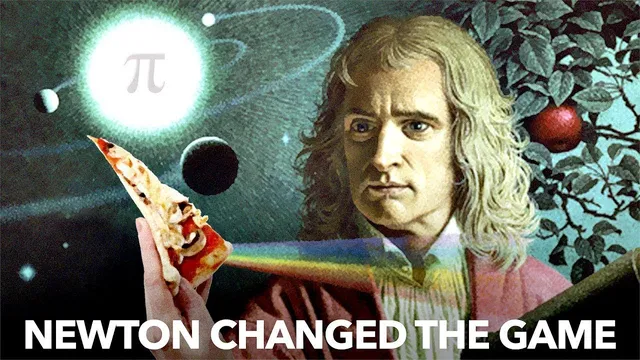
The Discovery That Transformed Pi
Based on Veritasium's video on YouTube. If you like this content, support the original creators by watching, liking and subscribing to their content.
Polygon bounds place π between 3 and 4 using a hexagon inscribed in a unit circle and a square circumscribed around it.
Briefing
For more than 2,000 years, mathematicians squeezed better and better approximations of π by drawing polygons inside and outside circles and laboriously computing their perimeters. The breakthrough that changed everything came when Isaac Newton stopped treating those patterns as something to extend by brute force—and instead used algebraic structure, calculus, and a clever choice of where to integrate to turn π into a rapidly converging infinite series.
The story begins with the “obvious” bounds. A regular hexagon inscribed in a unit circle has perimeter 6, while the circle’s circumference must be larger, forcing π > 3. Wrapping the circle in a square gives perimeter 8, so the circumference must be smaller, forcing π < 4. Archimedes then improved the method by replacing the hexagon with higher-sided regular polygons—dodecagons, 24-gons, 48-gons, and so on—until he could pin π down between 3.1408 and 3.1429. The work became a contest of endurance: Ludolph van Ceulen later spent decades computing perimeters of polygons with an astronomically large number of sides, eventually reaching 35 correct decimal places (later surpassed by Christoph Grienberger with 38).
Newton’s shift was not about drawing ever more sides. It was about recognizing that the coefficients in expansions like (1 + x)^n follow Pascal’s triangle, and then pushing that pattern beyond the usual limits. The binomial theorem normally works cleanly for positive integers n, where the expansion stops after finitely many terms. Newton extended it to negative and fractional exponents, producing infinite series whose terms cancel in just the right way. For example, applying the theorem to (1 + x)^(-1) yields an alternating infinite series that still behaves correctly because multiplying the series by (1 + x) collapses everything except the leading term.
The key move for π came when Newton connected these generalized binomial expansions to geometry. A unit circle satisfies x^2 + y^2 = 1, so y = √(1 − x^2). That square root can be expressed using the fractional-power binomial series, turning the area under a quarter-circle into an infinite sum of integrable powers of x. Integrating from 0 to 1 gives the quarter-circle area, which equals π/4. Newton then made the convergence dramatically faster by integrating only from 0 to 1/2. With that limit, each term shrinks by an extra factor (in this case, effectively a quarter when substituting x = 1/2), so far fewer terms are needed to reach high precision.
The payoff is practical as well as mathematical: computing just the first five terms gives π ≈ 3.14161, already accurate to about two parts in 100,000. Matching van Ceulen’s polygonal precision would require only about 50 terms in Newton’s series—turning years of polygon grinding into something closer to days. The larger lesson is about technology in mathematics: once a new method exists, the old “obvious” approach stops being the default, because patterns plus the right analytic tool can outclass brute force.
Cornell Notes
For centuries, π was approximated by bounding a circle with inscribed and circumscribed polygons, a method that improved only as polygon side counts grew. Archimedes refined this by doubling polygon sides repeatedly, reaching π between 3.1408 and 3.1429, while later mathematicians like Ludolph van Ceulen pushed the polygon method to extreme side counts for more digits.
Newton changed the game by extending the binomial theorem beyond positive integers using Pascal’s triangle coefficients, creating infinite series for expressions like (1 + x)^(-1) and (1 + x)^(1/2). He then applied calculus: the unit circle relation y = √(1 − x^2) turns π/4 into an integral of a binomial-series expansion. By integrating from 0 to 1/2 instead of 0 to 1, the series converges much faster, letting a few dozen terms reproduce high-precision values of π.
Why did polygon bounds force π to lie between 3 and 4 in the first place?
How did Archimedes improve the polygon method without changing the basic idea?
What does Pascal’s triangle have to do with expanding (1 + x)^n?
Why does Newton’s extension of the binomial theorem produce an infinite series for non-integer powers?
How does Newton justify that an infinite binomial series still equals 1/(1 + x) when n = −1?
What geometric and calculus steps turn the binomial series into a fast method for π?
Review Questions
- How does the polygon method guarantee upper and lower bounds on π, and what changes when the number of polygon sides increases?
- What role does Pascal’s triangle play in Newton’s use of the binomial theorem, and why does extending to non-integer exponents create infinite series?
- Why does integrating from 0 to 1/2 (instead of 0 to 1) make Newton’s π series converge faster?
Key Points
- 1
Polygon bounds place π between 3 and 4 using a hexagon inscribed in a unit circle and a square circumscribed around it.
- 2
Archimedes tightened π’s bounds by doubling polygon side counts repeatedly, reaching 3.1408 < π < 3.1429.
- 3
Pascal’s triangle provides the coefficients for (1 + x)^n, enabling rapid construction of binomial expansions.
- 4
Newton extended the binomial theorem to negative and fractional exponents, turning finite expansions into infinite series.
- 5
Multiplying Newton’s infinite series for (1 + x)^(-1) by (1 + x) collapses terms to verify the identity.
- 6
Newton connected √(1 − x^2) to the unit circle and used calculus to convert the quarter-circle area π/4 into an integrable series.
- 7
Choosing the integration interval (0 to 1/2) dramatically improves convergence, reducing the number of terms needed for high-precision π.