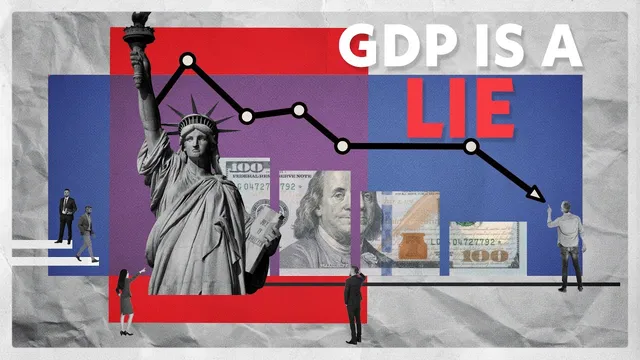
"The Economy" Isn't What You Think
Based on Second Thought's video on YouTube. If you like this content, support the original creators by watching, liking and subscribing to their content.
“The economy” functions as a contested label because different groups emphasize different metrics, producing apparent disagreement over facts rather than over definitions.
Briefing
America’s post-election argument about “the economy” hinges on a trap: the term is elastic enough to mean whatever a political side needs it to mean. Supporters of Donald Trump point to headline indicators and a narrative of economic strength, while Democrats and Harris-aligned voters emphasize different measures and lived costs—especially inflation’s lingering effects and the gap between macro gains and household realities. The result is a divide that looks less like disagreement over facts and more like disagreement over definitions.
A central claim is that GDP growth—often treated as the scoreboard for national well-being—doesn’t reliably track how people actually live. GDP is a monetary measure of the value of goods and services produced within a country, designed to quantify economic activity. But chasing GDP growth turns into chasing spending and production, even when that spending reflects harm, waste, or exploitation rather than improved quality of life. The transcript argues that GDP is essentially a “static picture” of money changing hands at a moment in time; “growth” comes from comparing those pictures across years, which can rise when costs rise, debts are incurred, or people are forced to buy things they can’t afford.
The discussion traces GDP’s rise to the Great Depression and World War II era, when governments needed measurable tools to track unemployment, tax revenue, and the effects of policy. It also contrasts GDP with earlier concepts like GNP, which tracked national ownership rather than where production occurred. Over time, GDP became dominant partly because institutions like the IMF and World Bank pushed growth targets tied to loans, and partly because GDP’s territorial accounting can mask who actually captures profits in an era of globalization.
The transcript’s critique goes further: GDP can treat socially destructive activity as economic success. It notes that GDP counting rules have historically included categories such as military spending and other expenditures that may be “unnecessary” in human terms, while excluding or complicating other measures of welfare. It uses the example of Cuba’s healthcare outcomes—described as comparable or better than the U.S. on key indicators despite far lower costs—to argue that systems can deliver better lived results while producing less GDP. In that framing, GDP rewards expensive, inefficient provision and penalizes affordability and effectiveness.
Ultimately, the transcript argues that GDP’s staying power is political. By presenting economic performance as a technocratic, measurable objective, GDP growth can be sold as proof that “everyone benefits,” making inequality easier to tolerate and reducing room for class-based debate. The conclusion is blunt: when politicians promise growth as a shortcut to votes, the promise often translates into more commodification—more decisions about daily life being made for profit—rather than genuine improvements in well-being. The economy, in this view, isn’t a neutral dashboard; it’s a contested story built on a flawed metric.
Cornell Notes
The transcript argues that “the economy” is a politically flexible label, and that GDP growth—often treated as the main proof of success—doesn’t measure how people actually experience life. GDP is a monetary scoreboard of production and spending, so it can rise when costs rise, debts accumulate, or harmful activity expands. The discussion traces GDP’s dominance to Depression-era and wartime needs for measurable indicators, then to global institutions that tied development to GDP-style targets. Because GDP focuses on where money is made rather than who benefits, it can hide exploitative globalization and make politics seem like a shared project managed by technocrats. The result: growth can be used to justify inequality while crowding out debates about welfare, equality, and public services.
Why does the transcript say both sides can “be right” about the economy while still talking past each other?
What is the core problem with using GDP as the main measure of economic success?
How does the transcript connect GDP’s rise to historical events and government needs?
Why does the transcript say the shift from GNP to GDP matters for politics and globalization?
What examples are used to argue that GDP can reward the wrong things?
How does the transcript claim GDP growth becomes politically useful even when it doesn’t improve welfare?
Review Questions
- What kinds of real-world changes can increase GDP without improving people’s lived welfare, according to the transcript?
- How does switching from GNP to GDP change what a country’s “growth” can hide about profit flows?
- Why does the transcript argue that GDP can weaken class-based political debate?
Key Points
- 1
“The economy” functions as a contested label because different groups emphasize different metrics, producing apparent disagreement over facts rather than over definitions.
- 2
GDP growth is treated as an unreliable welfare measure because it can rise when costs rise, debts accumulate, or harmful activity expands.
- 3
GDP is described as a money-based snapshot that requires comparison across time, which makes it sensitive to price changes and spending patterns rather than quality of life.
- 4
GDP’s dominance is traced to Depression-era and wartime needs for measurable indicators, followed by global institutions that tied development and lending to GDP-style targets.
- 5
Territorial accounting (GDP) can obscure who captures profits in globalization, unlike national accounting (GNP).
- 6
The transcript argues that GDP counting rules can treat socially destructive or wasteful spending—such as military expenditures—as economic success.
- 7
Politically, GDP growth can be used to justify inequality by presenting expansion as a substitute for equality of income and by framing policy as technocratic management rather than democratic choice.