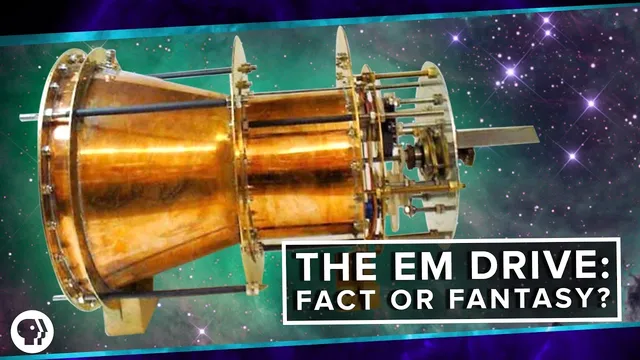
The EM Drive: Fact or Fantasy?
Based on PBS Space Time's video on YouTube. If you like this content, support the original creators by watching, liking and subscribing to their content.
The EmDrive’s claimed propellantless thrust conflicts with momentum conservation unless photons effectively escape the cavity; otherwise momentum should remain internal and cancel out externally.
Briefing
The EmDrive’s reported thrust in vacuum remains unproven, with the most credible path forward hinging on eliminating mundane thermal and measurement artifacts that could mimic a real force. The device—an asymmetric tapered copper cavity driven by microwaves—has been claimed to produce net thrust without propellant, a result that would challenge the usual momentum accounting behind rockets. But momentum conservation arguments cut against the core mechanism unless photons truly escape the cavity; if they don’t, any exchanged momentum should cycle back inside a closed system.
The latest scrutiny centers on Harold “Sonny” White and colleagues’ 2016 paper, “Measurement of Impulsive Thrust from a Closed Radio Frequency Cavity in Vacuum,” which tested an EmDrive in an ultra-high vacuum chamber (about one ten-billionth of sea level pressure) to suppress convection-driven forces. Using a torsion balance—an extremely sensitive setup historically used by Henry Cavendish to measure the gravitational constant—the team reported a positive thrust in the expected direction at three microwave power levels (40, 60, and 80 Watts), with the direction reversing when the device orientation was flipped. They also reported thrust magnitudes comparable to earlier non-vacuum measurements, and an average thrust-to-input-power ratio around 1.2 millinewtons per kilowatt.
Those numbers are small: at roughly 1 millinewton per kilowatt, levitating a human-sized mass would require power on the order of a gigawatt—comparable to a large nuclear plant’s output. Still, the thrust-to-power ratio is far larger than what a simple photon-thruster picture would predict, which is why the result drew attention.
The central problem is statistical and physical plausibility. The analysis notes that the 60 W and 80 W data points appear statistically equivalent and that scatter is large, making a straight-line fit to thrust-versus-power potentially misleading. Even if the net displacement looks significant, the claim of “new physics” doesn’t survive until alternative causes are exhaustively ruled out.
Thermal effects remain the leading suspect. Even in vacuum, microwave heating can deform the cavity or its mounting through thermal expansion, shifting the torsion balance in ways that look like thrust. A straightforward control—heating the device without the resonant radiation field to see whether the same apparent force appears—has not yet been reported. The paper also lists other possible false-positive mechanisms and proposes tests, but those checks need to be performed before the thrust can be treated as real.
On the theoretical side, the paper links the EmDrive to pilot wave theory, treating the quantum vacuum as a deformable medium that could exchange momentum. That move is described as speculative and dependent on an assumption that the vacuum behaves unlike standard quantum field theory predicts. In standard treatments, exchanging momentum over macroscopic distances would require processes involving real particles (not just virtual fluctuations), which would likely trap them or turn the device into something effectively photon-thruster-like.
Overall, the most likely outcomes are either that improved experiments remove the apparent thrust, or that conventional physics—especially thermal and apparatus-related effects—accounts for it. A genuinely new mechanism is possible but sits behind those mundane explanations. The discussion then pivots to unrelated community questions about interplanetary radio interferometry and how alien civilizations might communicate, emphasizing that practical constraints—not just theoretical possibility—often dominate what can be built and detected.
Cornell Notes
EmDrive claims of propellantless thrust in vacuum hinge on whether tiny torsion-balance signals reflect real momentum exchange or measurement artifacts. White et al. (2016) report positive thrust at 40, 60, and 80 W in ultra-high vacuum, with thrust direction reversing when the device is flipped, and a thrust-to-power ratio near 1.2 millinewtons per kilowatt. The strongest challenge is that thermal effects can still occur in vacuum: microwave heating can deform the cavity or mounting and produce a false-positive force. The analysis argues that a key control—heating the device without the resonant radiation field—has not yet been done. Until such mundane causes are ruled out beyond reasonable doubt, the thrust result can’t be confidently attributed to exotic physics or pilot-wave-inspired vacuum dynamics.
Why does momentum conservation pose a problem for the EmDrive’s “closed cavity” thrust idea?
What experimental design choices were meant to make the EmDrive test more credible?
What statistical concern complicates confidence in the thrust-versus-power claim?
Why are thermal effects still a major suspect even in vacuum?
How does the paper’s pilot-wave connection relate to standard quantum field theory expectations?
If the EmDrive effect is real, what would still need to be established?
Review Questions
- What experimental controls would best distinguish a genuine thrust from thermal expansion or torsion-balance artifacts in an EmDrive setup?
- How would photon escape (or lack of it) change the momentum-conservation expectations for a resonant cavity thruster?
- Why does the shape and scatter of thrust-versus-power data matter as much as the sign of the thrust measurement?
Key Points
- 1
The EmDrive’s claimed propellantless thrust conflicts with momentum conservation unless photons effectively escape the cavity; otherwise momentum should remain internal and cancel out externally.
- 2
White et al. (2016) reported positive thrust in ultra-high vacuum using a torsion balance, with thrust direction reversing when the device was flipped.
- 3
The reported thrust-to-power ratio (~1.2 millinewtons per kilowatt) is still extremely small in practical terms, requiring enormous power for meaningful lift.
- 4
Large scatter and apparent statistical equivalence between the 60 W and 80 W results make simple linear scaling claims questionable.
- 5
Thermal effects remain a leading explanation even in vacuum because microwave heating can deform the cavity or mounting and mimic force.
- 6
A critical missing test is heating the device without the resonant radiation field to check whether the same apparent thrust signal appears.
- 7
Pilot-wave-inspired vacuum explanations are speculative and depend on assumptions that diverge from standard quantum field theory’s account of vacuum behavior.