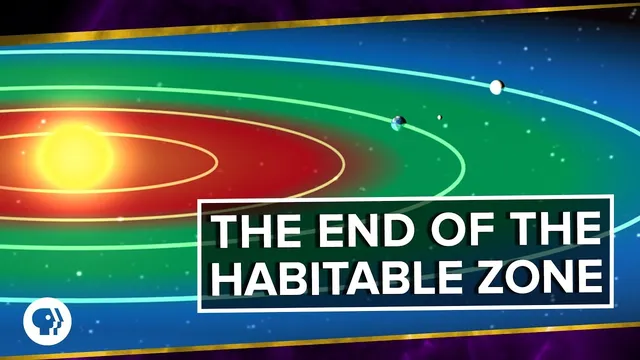
The End of the Habitable Zone
Based on PBS Space Time's video on YouTube. If you like this content, support the original creators by watching, liking and subscribing to their content.
The Sun brightens over time because core contraction and heating increase fusion rates as hydrogen becomes diluted.
Briefing
The Sun’s steady brightening will push Earth out of the habitable “Goldilocks zone” long before humans reach the end of their species—triggering a cascade of climate collapses that ultimately eliminates life in stages. The core driver is stellar physics: as hydrogen in the Sun’s core gets diluted, the core contracts and heats, boosting fusion rates and raising the Sun’s overall energy output. Even a slow increase—about 1% per 100 million years today—adds up on geological timescales, making Earth’s long-term future far less stable than its comfortable present.
The timeline starts with a gradual shift in habitability. In roughly 600 million years, rising solar energy and atmospheric feedbacks are expected to shut down most photosynthesis, killing the majority of plant life. The mechanism isn’t just heat; it’s the long-term carbon cycle. Over hundreds of millions of years, higher temperatures accelerate the weathering of silicate rocks, which pulls CO2 out of the atmosphere and locks it into carbonate minerals. CO2 levels are projected to fall from today’s ~400 parts per million to around 50 parts per million, too low for C3 photosynthesis—the pathway used by most plants, including trees. C4 plants (including many grasses) may persist longer, but the combined pressures of warming, CO2 depletion, and ocean loss keep tightening the noose.
Ocean loss becomes the next existential step. Earth currently sits well inside the habitable zone, but the habitable zone moves outward as the Sun brightens. The transcript highlights the “faint young sun paradox”: early Earth should have been frozen under standard astrophysical expectations, yet geology shows liquid water and early life. Explanations likely involve a stronger early greenhouse effect (higher CO2 or methane), but no single solution has achieved consensus. Whatever resolved the early mismatch, the late-time problem is more straightforward: as the Sun brightens, Earth will eventually lose its oceans even without literal boiling. Increasing atmospheric water vapor boosts stratospheric H2O breakdown, and the light hydrogen escapes to space—an ongoing process that accelerates with rising solar radiation.
Most climate models converge on runaway ocean loss beginning about a billion years from now (give or take). The end state is described as a planet-wide desert—“Arrakis”—with life surviving only in refuges. Water stored in minerals within Earth’s mantle can continue to seep back to the surface, allowing adaptation and persistence in subsurface or remaining wet pockets. But extinction proceeds in reverse order of complexity: after an initial wave from plant die-off, heat and CO2 collapse eliminate complex multicellular organisms, leaving extremophiles longer. Eventually, even simple prokaryotic life is expected to fail once CO2 levels flatten, potentially in less than 2 billion years.
Finally, the transcript offers a limited “bright side.” Mars sits near the outer edge of the habitable zone and could warm as the Sun brightens, thawing ice reserves—though its thin gravity and atmosphere mean water would likely be lost to space unless future technology can replenish it. Large-scale geoengineering is also floated as a theoretical delay: seeding the upper atmosphere with reflective nanoparticles could reduce incoming sunlight, buying time until the Sun exhausts hydrogen and expands into a red giant that would engulf Earth.
Cornell Notes
As the Sun ages, its core contracts and heats, increasing fusion and raising the Sun’s brightness. That slow brightening shifts Earth’s habitable zone outward, eventually driving CO2 depletion, photosynthesis collapse, and runaway ocean loss. Around 600 million years from now, most photosynthesis is expected to shut down as CO2 falls to ~50 ppm due to faster silicate weathering. Roughly a billion years out, water vapor feedback and hydrogen escape can trigger irreversible ocean loss, leaving a desert-like world. Life may persist longest in subsurface refuges and among extremophiles, but extinction is expected to follow the decline of CO2 and the rise of surface temperatures, potentially ending even prokaryotes in under 2 billion years.
Why does the Sun get brighter even though it’s running out of fuel?
How does CO2 decline lead to the collapse of most plant life?
What is the “faint young sun paradox,” and why does it matter for future habitability?
Why can Earth lose its oceans without boiling?
What does the extinction sequence look like once oceans and CO2 start collapsing?
What “escape hatches” are mentioned for keeping life going longer?
Review Questions
- How does core contraction maintain fusion equilibrium as the Sun’s hydrogen becomes diluted?
- What chain of processes links rising temperature to CO2 depletion and the shutdown of C3 photosynthesis?
- Why does hydrogen escape from the upper atmosphere make ocean loss possible without surface boiling?
Key Points
- 1
The Sun brightens over time because core contraction and heating increase fusion rates as hydrogen becomes diluted.
- 2
Earth’s long-term habitability depends on both stellar output and atmospheric composition, as illustrated by the faint young sun paradox.
- 3
Around 600 million years from now, faster silicate weathering can drive CO2 down to levels (~50 ppm) that make C3 photosynthesis impossible.
- 4
Runaway ocean loss can begin roughly a billion years from now, driven by water-vapor feedback and hydrogen escape to space.
- 5
Life’s survival prospects shrink in stages: plants first, then complex multicellular organisms, then eukaryotes, with prokaryotes potentially lasting longest until CO2 stabilizes.
- 6
Mars may become warmer as the Sun brightens, but its thin atmosphere and gravity make sustained water retention unlikely without intervention.
- 7
Reflective atmospheric nanoparticles are proposed as a way to reduce incoming sunlight and delay the worst outcomes.