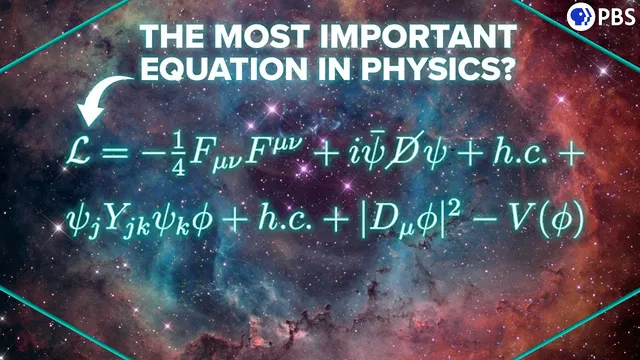
The Equation That Explains (Nearly) Everything!
Based on PBS Space Time's video on YouTube. If you like this content, support the original creators by watching, liking and subscribing to their content.
Gauge invariance links symmetries of nature to the appearance of force-carrying gauge fields, producing electromagnetism (U(1)), the weak force (SU(2)), and the strong force (SU(3)).
Briefing
The Standard Model Lagrangian is the compact mathematical “engine” behind the most accurate particle-physics theory ever built—able to predict how known subatomic particles behave and interact across experiments with extraordinary precision. It’s also far from coffee-mug friendly: in full form it’s a dense, multi-term expression that encodes the forces, the matter fields, and the Higgs mechanism in one framework. Even with its complexity, the payoff is clear: plugging in the right fields and parameters lets physicists calculate the outcomes of a wide range of particle processes, and the theory still resists serious failure.
At the heart of the Standard Model’s structure is a guiding idea from symmetry. Gauge invariance treats certain choices—like how a quantum wavefunction’s phase is defined—as physically irrelevant. Enforcing that kind of symmetry forces the appearance of gauge fields: electromagnetism emerges from a U(1) symmetry, the weak force from SU(2), and the strong force from SU(3). Gravity is left out of this symmetry story for now, not because it’s unimportant, but because it hasn’t been woven into the same gauge-symmetry framework.
Turning symmetries into equations requires the Principle of Least Action and the Lagrangian formalism. Nature’s behavior can be derived by minimizing an “Action” quantity, and the Lagrangian is the specific ingredient used to build the equations of motion. Crucially, when the Lagrangian respects a continuous symmetry, Noether’s Theorem guarantees conserved quantities like energy and momentum. The Standard Model Lagrangian is technically a Lagrangian density—an ingredient that must be integrated over spacetime—but physicists commonly use the shorter term.
The Lagrangian’s terms separate into three big jobs. First come the kinetic and interaction terms for bosons, the integer-spin particles that carry forces. For electromagnetism, the photon field (often written as A) enters through derivatives that track how the field changes in space and time. For the strong force, gluon fields interact nonlinearly—unlike photons, gluons can couple to each other—reflecting the SU(3) structure. The weak force follows SU(2) and includes additional kinetic structure tied to how electromagnetism and the weak interaction were once unified at higher energies.
Second come the fermion terms, where the matter fields live. Fermions—half-integer spin particles such as electrons, quarks, and neutrinos—are represented by wavefunction fields (often bundled into a single symbol for many species). Their dynamics include a covariant derivative that mixes spacetime changes with couplings to the gauge fields, with charges like electric charge, isospin, hypercharge, and color charge determining how each fermion interacts. The formalism also introduces “ghost” terms from quantum field theory; a carefully constructed hermitian conjugate (h.c.) term cancels the problematic contributions.
Third is the Higgs sector, which supplies mass. The Standard Model’s fermions and weak bosons are massless until the Higgs field (Φ) is added. Yukawa-like couplings connect fermions to the Higgs, with a matrix (often written with y) encoding the squared masses of different fermion types—though the theory doesn’t predict those values from first principles, requiring experimental input. The Higgs field also has its own kinetic and potential terms, and its excitation corresponds to the Higgs boson, discovered at the Large Hadron Collider about a decade before this explanation.
Despite its success, the Standard Model Lagrangian doesn’t settle everything: it doesn’t explain why parameters like coupling strengths take their observed values, nor does it account for dark matter, dark energy, or the matter–antimatter imbalance. Still, the theory remains a rare triumph—so precise that physicists keep hoping that where it finally breaks, the next, more elegant “equation for everything” will emerge.
Cornell Notes
The Standard Model Lagrangian is the mathematical framework that unifies the known subatomic particles and forces into one set of equations. Its structure is driven by gauge symmetries—U(1) for electromagnetism, SU(2) for the weak force, and SU(3) for the strong force—implemented through the Lagrangian and the Principle of Least Action. The Lagrangian contains separate pieces for boson dynamics, fermion (matter) fields and their couplings to gauge fields, and the Higgs sector that generates masses. Even though it requires measured input for parameters like fermion masses and coupling strengths, it predicts experimental outcomes with exceptional accuracy. The remaining gaps—dark matter, dark energy, and other mysteries—are where physicists expect new physics to appear.
How do gauge symmetries determine the existence of forces in the Standard Model?
Why does the Lagrangian formalism matter for turning symmetry into equations?
What roles do boson and fermion terms play inside the Standard Model Lagrangian?
What is the purpose of the hermitian conjugate (h.c.) in the matter sector?
How does the Higgs field generate mass in the Standard Model?
Review Questions
- Which gauge symmetry corresponds to electromagnetism, the weak force, and the strong force in the Standard Model framework?
- How does the covariant derivative connect fermion fields to gauge fields, and what kinds of charges determine those couplings?
- What specific function does the Higgs sector serve, and what does the theory still require experiments to supply?
Key Points
- 1
Gauge invariance links symmetries of nature to the appearance of force-carrying gauge fields, producing electromagnetism (U(1)), the weak force (SU(2)), and the strong force (SU(3)).
- 2
The Principle of Least Action and the Lagrangian formalism translate symmetry requirements into equations of motion, with Noether’s Theorem tying continuous symmetries to conserved quantities.
- 3
The Standard Model Lagrangian is a Lagrangian density that must be integrated over spacetime, but it’s commonly referred to as the Lagrangian for convenience.
- 4
Boson terms encode kinetic behavior and self-interactions for force carriers—gluons interact with each other due to SU(3), unlike photons.
- 5
Fermion terms describe matter fields and their couplings to gauge fields through a covariant derivative, with interaction strengths determined by charges such as electric charge, isospin, hypercharge, and color charge.
- 6
The hermitian conjugate (h.c.) structure is used to cancel problematic ghost contributions that arise in the quantum-field-theory formulation.
- 7
The Higgs field supplies masses via its own interaction terms and potential, but the Standard Model does not predict the numerical mass and coupling parameters from first principles.