The essence of calculus
Based on 3Blue1Brown's video on YouTube. If you like this content, support the original creators by watching, liking and subscribing to their content.
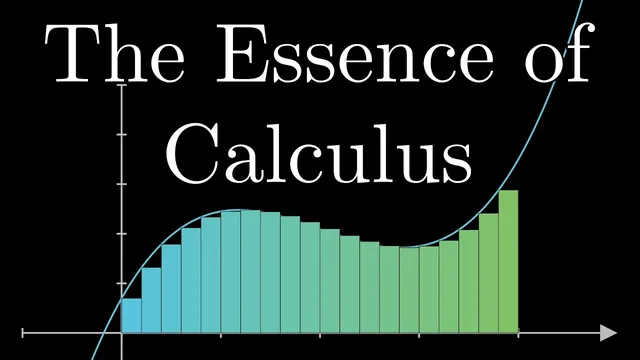
Slice a region into thin pieces whose areas can be approximated by rectangle formulas, then interpret the total as an area under a graph in the limit.
Briefing
Calculus can be “invented” from a single geometric question: why a circle’s area equals πr². Starting with a circle of radius 3, the approach slices the disk into many thin concentric rings. Each ring has radius r, circumference 2πr, and thickness dr (a tiny step in radius). Unwrapping a ring into a thin rectangle turns its area into an approximation: (2πr)·dr. As dr shrinks, the rectangle approximation becomes more accurate, and the sum of all ring areas stops behaving like a messy collection of numbers and starts behaving like the area under a graph.
That graph is y = 2πr. The rectangles sit under the straight line from r = 0 to r = 3, so the limiting “exact” sum becomes the area under that line—just a triangle with base 3 and height 2π·3. The triangle’s area is (1/2)·3·(2π·3) = π·3², which generalizes immediately to any radius R as πR². The key move isn’t memorizing a formula; it’s treating an approximation made of many small pieces as something that converges to a precise geometric quantity when the pieces become infinitely thin.
From that circle argument comes a deeper calculus principle: many hard problems can be reframed as adding up infinitesimal contributions that look like thin rectangles. In general, if the quantity being added can be interpreted as the area of many narrow rectangles under a curve, then the original problem becomes “find the area under a graph.” That idea leads directly to integrals. For example, if A(x) denotes the area under y = x² from 0 to x, then A(x) is an integral—mysterious at first, but defined by its geometric meaning.
The next leap is to relate this unknown area function A(x) to the curve x² itself. When x increases by a tiny amount dx, the area increases by a tiny amount dA. For very small dx, that added sliver of area is well-approximated by a rectangle of height x² and width dx, giving dA ≈ x²·dx. Rearranging suggests that dA/dx is approximately x², and as dx shrinks further, the approximation becomes exact in the limit. That limiting ratio is the derivative: a measure of how sensitively a function’s output responds to small changes in its input.
This creates the central calculus connection: integrals and derivatives are inverses. If a function describes accumulated area under a curve, then differentiating it recovers the original curve (the height). If a function describes a curve’s height, integrating it reconstructs the accumulated area. That back-and-forth relationship is the fundamental theorem of calculus, presented here as the natural outcome of geometric reasoning rather than a rule to memorize.
Cornell Notes
The circle-area formula πr² emerges from a “sum of thin rectangles” idea. By slicing a disk into concentric rings of thickness dr, each ring’s area is approximated by (2πr)·dr, and as dr shrinks, the total becomes the exact area under the line y = 2πr from 0 to r. That limiting area is a triangle, giving πr². Generalizing, the area under a curve y = x² from 0 to x defines an integral A(x). When x increases by dx, the added area dA is approximately x²·dx, so dA/dx approaches x²—revealing derivatives as the inverse operation to integrals (fundamental theorem of calculus).
How does slicing a circle into rings turn a geometry problem into something graph-like?
Why does the sum of many small rectangle areas become a triangle in the circle case?
What is the role of dr in both the rectangle area and the spacing of rectangles?
How does the unknown area function A(x) relate to the curve y = x²?
What does dA/dx becoming exact mean, and why is that a derivative?
How does this reasoning show integrals and derivatives are inverses?
Review Questions
- In the circle argument, what exactly is being approximated by (2πr)·dr, and what changes as dr gets smaller?
- For A(x) defined as the area under y = x² from 0 to x, what relationship between dA and dx leads to the derivative being x²?
- Why does a linear height function like 2πr make the limiting region a triangle rather than a more complicated shape?
Key Points
- 1
Slice a region into thin pieces whose areas can be approximated by rectangle formulas, then interpret the total as an area under a graph in the limit.
- 2
In the circle derivation, each ring’s unwrapped rectangle has height 2πr and width dr, so ring area is approximated by (2πr)·dr.
- 3
Letting dr shrink turns a discrete sum into a continuous geometric quantity: the exact area under y = 2πr.
- 4
Define an integral as an area function A(x) that accumulates the area under a curve from a fixed left endpoint to a variable right endpoint.
- 5
Relate changes in accumulated area dA to small input changes dx using dA ≈ (height of curve)·dx for tiny dx.
- 6
The derivative emerges as the limiting ratio dA/dx, measuring sensitivity of the area function to input changes.
- 7
The fundamental theorem of calculus links the two operations: differentiating an area function recovers the original curve, making integrals and derivatives inverse processes.