The Evolution of the Modern Milky Way Galaxy
Based on PBS Space Time's video on YouTube. If you like this content, support the original creators by watching, liking and subscribing to their content.
Stellar archaeology reconstructs the Milky Way’s assembly by matching stars with shared metallicity and correlated orbital properties.
Briefing
The Milky Way’s “true history” is no longer a mystery of speculation—it’s being reconstructed from the motions and chemical fingerprints of stars, revealing a galaxy built through repeated mergers. That violent past matters because it determines how much gas the Milky Way has had to form new stars, how its disk and halo were assembled, and what the galaxy’s next major collision will likely do to its future.
Astronomers now have a dynamical map of the Milky Way thanks to enormous surveys tracking positions and motions of more than a billion stars. With that dataset, researchers can work backward in time using “stellar archaeology,” a kind of galactic forensics: stars that originated together in the same merger or starburst should share similar chemical compositions (metallicity) and move on related orbits. Metallicity is measured from spectral features—dips and spikes at specific wavelengths tied to particular elements—while orbital histories are inferred from how stretched, eccentric, and tilted a star’s path is relative to the galactic disk. Over billions of years, even stars from the same event can drift apart, but their orbital shapes and orientations can still preserve the event’s signature.
One of the clearest milestones is a major merger about 10 billion years ago, often treated as the birth of the Milky Way’s “modern” structure. The consumed galaxy is dubbed “Gaia-Enceladus,” identified using the Gaia Space Telescope, which pinpoints tiny stellar motions to reconstruct detailed orbits. Stars from Gaia-Enceladus occupy highly elongated inner-halo orbits with a slight “backwards” bend, signaling an origin outside the Milky Way. The evidence extends beyond individual stars: a set of 13 globular clusters also shows matching orbital and spectral properties, likely tied to the same accretion event.
That merger also helps explain the Milky Way’s two-disk structure. The thin disk is a few hundred light-years thick and hosts most star formation, while the thick disk reaches a few thousand light-years above and below the plane and is made of older stars with fewer heavy elements. Those thick-disk stars orbit with different inclinations and likely formed around 9 billion years ago (plus or minus a billion). A consistent picture emerges: the Gaia-Enceladus collision heated and puffed up the Milky Way’s earlier thin disk into a thick disk, while fresh gas from the merger rebuilt the thin disk and triggered new star formation.
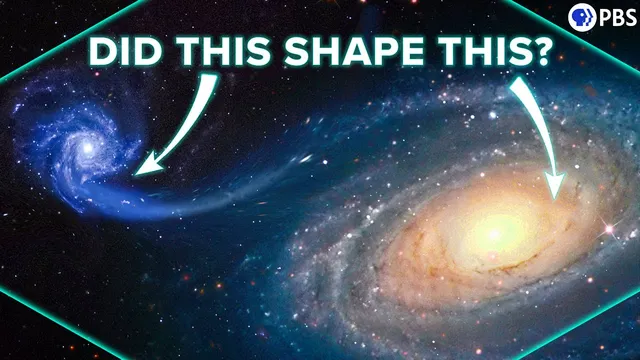
Since then, the Milky Way has continued to snack on smaller galaxies, leaving behind tidal streams—long, stretched-out ribbons of stars. Some are small and still coherent, like GD-1, while others, such as the Helmi stream, wrap around the galaxy in large loops. The Sagittarius Dwarf Spheroidal Galaxy is the biggest recent example: it first fell in roughly 5 billion years ago, has punched through the Milky Way’s disk multiple times, and its gravitational “drumming” may have coincided with episodes of Milky Way star formation, potentially even aligning one pass with the era when the Sun and solar system formed 4.5 billion years ago.
Looking ahead, the Milky Way is poised for its next major meal. The Large and Small Magellanic Clouds are currently making their first pass, already showing tidal disruption and a massive Magellanic Stream of gas. Although the clouds themselves are only about 1% of the Milky Way’s mass, the stream may contain around 10 billion solar masses when dark matter is included—likely the biggest accretion since Gaia-Enceladus. In about 2 billion years, the infall of gas could trigger another burst of star formation. The largest event is still to come: a major merger with Andromeda, whose mass is roughly twice that of the Milky Way, setting up the next chapter in the galaxy’s evolution.
Cornell Notes
Reconstructing the Milky Way’s past now relies on “stellar archaeology”: stars that formed together in mergers or starbursts tend to share both chemical signatures (metallicity) and orbital patterns. Surveys tracking more than a billion stars enable detailed dynamical mapping, letting astronomers infer which accretion events happened and when. A key event occurred about 10 billion years ago—Gaia-Enceladus—identified using Gaia’s precise proper motions and revealed through elongated, slightly “backwards” inner-halo orbits and matching globular cluster properties. That merger likely heated an earlier thin disk into the thick disk while replenishing gas to rebuild the thin disk and restart star formation. Since then, smaller accretions have left tidal streams, and the next major infall is expected from the Magellanic Clouds, followed by a major collision with Andromeda.
How can astronomers link stars to the same ancient merger if those stars are now scattered across the galaxy?
What makes Gaia-Enceladus such a central event in the Milky Way’s history?
How does the Gaia-Enceladus merger connect to the Milky Way’s thin and thick disks?
What are tidal streams, and what do they reveal about smaller mergers?
Why is the Sagittarius Dwarf Spheroidal Galaxy especially important for Milky Way star-formation history?
What future mergers are expected to affect the Milky Way soonest, and what might they do?
Review Questions
- What two kinds of evidence—chemical and dynamical—are most useful for linking stars to specific merger events?
- Why does a major merger like Gaia-Enceladus help produce both a thick disk and a renewed thin disk?
- How do tidal streams differ in size and coherence, and what does that imply about the timing of the mergers that created them?
Key Points
- 1
Stellar archaeology reconstructs the Milky Way’s assembly by matching stars with shared metallicity and correlated orbital properties.
- 2
Gaia-Enceladus, a major merger about 10 billion years ago, is identified through Gaia Space Telescope measurements of stellar motions and the resulting elongated, slightly “backwards” inner-halo orbits.
- 3
The Gaia-Enceladus merger likely heated an earlier thin disk into the thick disk while merger-supplied gas rebuilt the thin disk and restarted star formation.
- 4
The Milky Way’s thin disk is a few hundred light-years thick and is the main star-forming region; the thick disk is a few thousand light-years thick, older, and more metal-poor.
- 5
Smaller accretions leave tidal streams—stellar ribbons that can wrap around the galaxy—providing a record of repeated “snacking” events.
- 6
The Sagittarius Dwarf Spheroidal Galaxy’s multiple disk crossings may have helped trigger star-formation episodes, potentially including the era of solar system formation.
- 7
The next major infall involves the Magellanic Clouds, with a likely star-formation boost in ~2 billion years, followed by a major Andromeda collision.