The Examined Life - Zettelkasten mind map walkthrough
Based on FP's video on YouTube. If you like this content, support the original creators by watching, liking and subscribing to their content.
Use folder cards to organize sections without making claims; use idea cards to store the actual arguments.
Briefing
A philosophy course assignment is turning the Zettelkasten method into a visible, student-built “mind map” of ideas: index-card notes are organized into a branching system where each card either stores an idea or acts as a folder that lists what belongs inside. The core payoff is clarity—students can see how concepts connect, how lines of thought continue, and how readings from multiple sources get woven into one structured set of claims about happiness, money, materialism, and advertising.
The walkthrough begins with course scaffolding. In Miro, the creator builds a top-level branch labeled for the course “The Examine Life,” designed so future students can add new courses or topics. Within that branch sit “folder cards,” which contain no ideas themselves—only lists of the contents in that section. A nested set of folder cards narrows from the course to “Philosophy,” then to “Definitions of philosophy,” before the first actual “idea card” appears.
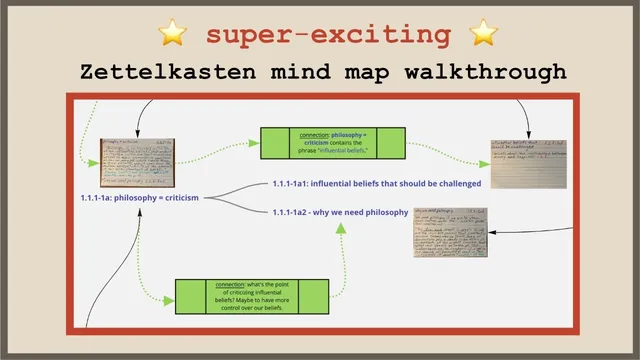
The first idea card defines philosophy as “thinking about thinking.” A follow-on card continues the line of thought by saying philosophy amounts to what the American philosopher John Dewey calls “criticism.” To make those links explicit, green explanatory boxes are added at connection points—because the relationship may feel obvious to the note-maker but not necessarily to anyone reading the card alone.
From there, the numbering system is treated as part of the method. Cards progress from “1” to “1a” to “1a1,” where each step is a continuation of the previous card’s line of thinking—what’s described as a “full zettel.” The map then shifts to the course’s second major reading on money and happiness (from Sonia Lyubomirsky’s The Myths of Happiness, specifically her chapter on money and happiness). Here, a “money and happiness” folder card holds multiple idea cards.
One idea card argues that money can buy happiness, but only when spent on the “right things.” The walkthrough gives concrete examples: spending on gifts for friends and family, donating to people in need, and investing in what Lyubomirsky frames as basic psychological needs. Those needs—competence, relatedness, and autonomy—are attributed to Tim Kasser’s The High Price of Materialism (with the reference placed at page 173).
The third reading, drawn from multiple paragraphs across three advertising-focused sources, is initially considered as a separate branch. Instead, the notes are folded into the existing argument that materialism leads to unhappiness. A card states that being materialistic makes people unhappy, supported by “mountains of research” cited in Lyubomirsky’s work. Two continuation cards explain why: materialism damages relationships, and advertising pushes people toward materialism. Advertising, in turn, is said to create additional unhappiness by implying that people have solvable problems that only advertised products can fix—sometimes even inventing problems people don’t actually have.
Overall, the mind map functions as a structured argument network: folder cards organize, idea cards claim, numbering signals continuity, and connection notes make the logic legible across readings and students’ future revisions.
Cornell Notes
The Zettelkasten mind map walkthrough shows how to turn course readings into an “analog” note system using index-card-style idea cards and folder cards. Folder cards list what belongs in a section, while idea cards contain actual claims. A numbering scheme (e.g., 1 → 1a → 1a1) marks continuations of a line of thinking, and green connection notes make the relationships between cards explicit. The example argument network links philosophy’s definition (thinking about thinking; Dewey’s “criticism”) to happiness research: money can support happiness when spent on gifts, donations, and basic psychological needs (competence, relatedness, autonomy). It then connects advertising to materialism and unhappiness, including relationship damage and the creation of “problems” solved only by products.
How do folder cards differ from idea cards in this Zettelkasten-style mind map?
What does the card numbering system (1 → 1a → 1a1) signal?
How does the map connect philosophy’s definition to John Dewey?
What conditions are given for money to buy happiness?
Why does the map link advertising to unhappiness?
Review Questions
- How would you decide whether a new note should be a folder card or an idea card in this system?
- If you added a new reading that supports a claim already on the map, where would it likely go in the numbering/continuation structure?
- Which specific pathways from materialism to unhappiness are named, and how does advertising fit into those pathways?
Key Points
- 1
Use folder cards to organize sections without making claims; use idea cards to store the actual arguments.
- 2
Make card-to-card connections explicit with short notes so logic isn’t lost when ideas aren’t obvious on their own.
- 3
Adopt a numbering scheme that signals continuation (e.g., 1 → 1a → 1a1) to show how lines of thought develop.
- 4
When building happiness-related notes, separate “what supports happiness” (e.g., spending on gifts/donations and psychological needs) from “what undermines it” (materialism).
- 5
Integrate multiple readings by linking them to shared claims rather than isolating each source in its own branch.
- 6
Treat advertising as more than a topic: connect it to downstream effects like materialism and the creation of dissatisfaction tied to product consumption.