The Excitement Map | How To Actually Achieve Your Goals
Based on Tiago Forte's video on YouTube. If you like this content, support the original creators by watching, liking and subscribing to their content.
Start with what energizes you at a body level, not with what you think you “should” achieve.
Briefing
The fastest way to make goals stick is to build them from what genuinely energizes you—down to the body-level sensations that signal real curiosity and joy. Instead of starting with “what should I achieve?” Tiago Forte’s framework starts with “what lights you up?” The core claim is that goals set from obligation or prestige tend to drain energy, while goals aligned with deep excitement create fuel for follow-through.
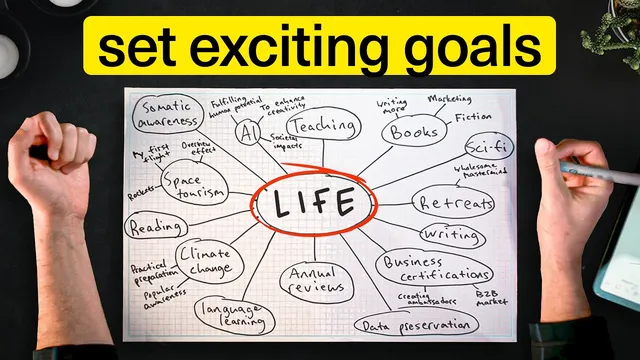
The method is called the Excitement Map, a cousin of mind mapping but designed specifically to surface the sources of enlivenment. The process begins with a large page: write the word “life” in the center and circle it. Then create surrounding bubbles filled with topics that feel exciting on a somatic level—things that produce a flutter in the chest, a lift in the stomach, or a sense of energetic aliveness. Examples given include books, retreats, business certifications, annual reviews, climate change, space tourism, AI, teaching, data preservation, language learning, somatic awareness, and sci-fi reading and writing. The list isn’t pulled from theory; it’s assembled by scanning what has already sparked interest—journal entries, notes app highlights, recent projects, and the “favorite problems” that reliably trigger an “ooh, that’s interesting” reaction.
Next, draw lines from each excitement bubble back to “life.” Those connections represent the idea that the things that excite you are largely what make your life feel like flow and fuel. If the goal is a more invigorating, satisfying life, the practical implication is to invest more time and energy in the areas that already generate that internal charge.
The most important step comes one level deeper: branch each broad category into more specific “what exactly about this is fascinating?” For instance, “books” can split into writing more, marketing books, and fiction. “Climate change” may feel terrifying at the headline level, but the excitement can come from practical preparation and how awareness spreads to people who aren’t receptive. “AI” can be exciting for its potential to fulfill human potential, enhance creativity without replacing it, and reshape society, jobs, and the economy. “Business certifications” can connect to building ambassadors and enabling a B2B market through certified consultants. “Space tourism” can spark a desire to experience space personally and to explore the “overview effect,” plus a simple fascination with rockets.
Once the map is filled, the framework argues that goals, New Year’s resolutions, projects, and creative pursuits should be informed by what activates reserves of energy and physical sensations—not by what looks cool, prestigious, or required. To verify that excitement is more than an abstract preference, the method points to physical cues such as heart palpitations, conviction in the gut, goosebumps, dilated pupils, or skin tingling. In short: identify what you viscerally feel, then let that excitement guide what you choose to pursue.
Cornell Notes
The Excitement Map is a goal-setting method that starts with what genuinely energizes a person, not with external expectations. It asks people to list topics that create body-level excitement (fluttering chest, gut lift, goosebumps), connect them back to “life,” and then drill down one more level to pinpoint what specifically about each topic is fascinating. The result is a set of concrete, actionable directions that can inform goals, resolutions, projects, and creative work. The framework also treats physical signals—heart palpitations, neck-hair rise, tingling skin—as evidence that the interest is meaningful rather than purely intellectual. Aligning goals with this internal “fuel” is presented as the best way to sustain motivation and satisfaction.
How does the Excitement Map begin, and what goes into the first set of bubbles?
What do the lines from each bubble back to “life” represent?
Why is the “one level deeper” step considered the most important?
How can a terrifying topic like climate change still produce excitement?
What kinds of physical signals are used to validate whether excitement is real?
How does this approach connect to goals and resolutions?
Review Questions
- What is the difference between listing broad excitement categories and branching them one level deeper in the Excitement Map?
- Give two examples of how a broad topic (like “AI” or “books”) can split into specific sub-interests that would guide goal-setting.
- Which physical signals does the framework treat as evidence that an interest is genuinely exciting, and why does that matter for turning interests into goals?
Key Points
- 1
Start with what energizes you at a body level, not with what you think you “should” achieve.
- 2
Write “life” in the center of a page, then add bubbles for topics that produce real somatic excitement.
- 3
Connect each excitement bubble back to “life” to visualize how your interests function as flow and fuel.
- 4
Branch each broad category into specific sub-aspects that explain exactly what fascinates you.
- 5
Use physical cues—such as goosebumps, heart palpitations, or tingling skin—to confirm excitement is visceral, not merely intellectual.
- 6
Let the resulting excitement map guide goals, resolutions, and projects so motivation comes from internal energy rather than obligation.